




Kristen Kovatch

SmartPak Monday Morning Feed: Barn Field Trip, Part 5
SmartPak’s educational series at the barn continues! Today we’re working on safely measuring a horse’s height.
SmartPak‘s always looking out for us: they’re not just a great supplement producer and our favorite online tack shop, but the company is also devoted to educating us as horse owners and caretakers, as well as its staff. Every few months, both new and current employees from every one of SmartPak’s departments heads to the barn to learn about hay, grain and other feeds from SmartPak veterinarian Dr. Lydia Gray, and SmartPak is kindly sharing videos from these sessions in a six-part series.
If you missed the first few installments, you can catch up here: Parts One and Two (discussing feed and decoding feed labels), Part Three (body condition scoring) and Part Four (measuring a horse’s weight). In Part Five, Dr. Lydia Gray helps the team understand the way a horse’s height is measured and shows them how to measure height safely.
Just one installment left in the Barn Field Trip series! Our hats are off to SmartPak for this helpful series with great visual examples, not to mention the downloadable worksheets that let you learn right alongside the SmartPak team.
Go SmartPak, and go riding!

Kentucky Performance Products: Winter Dehydration
Dehydration isn’t just a summertime horse concern!
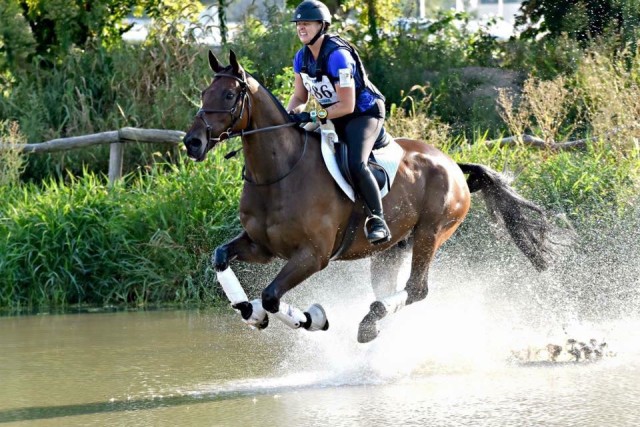
24-Hour Photo Challenge: 22 Airborne Horses
Ever heard the phrase “horses fly without wings”? These reader-submitted horses are taking that phrase quite literally.

The Academic Equestrian: Listening to Horses
Collegiate blogger Haley Ruffner describes a recent challenging ride on a friend’s horse that tested her abilities to adapt as a horseman.

Haley and Berkeley. Photo by Ellie Woznica
Arguably the most difficult aspect of riding in the Intercollegiate Horse Show Association, or IHSA, is adapting to each different horse you ride in practice or draw at a show. Even having ridden the Alfred University horses for the past five years as both a high school and now college equestrian, I still learn something new about them each ride.
Most of my coaches have emphasized “getting the feel” of your mount in the few moments you have between getting on and entering the show pen — how much leg do you need to use? Does your horse prefer a soft hand, or do you need to be more assertive? Is he spur broke, does he get antsy if you use any leg at all, does he snap at other nearby horses? Much of this can be determined from watching warm-ups and previous classes, but there is no alternative to actually sitting on the horse and feeling his barrel between your legs and his mouth on the end of your reins.
Last semester, one of my teammates rode my horse, Cricket, for the first time. In short, he operates with very little leg, soft hands, and a lot of seat and voice. My teammate, being primarily used to riding her own fancy (though slightly lazy) jumper, tended towards squeezing with her calves and rising out of the saddle at the canter. The combination of two very different disciplines and riding styles confused both of them and resulted in a rather hilarious learning experience for both horse and rider — a dramatic example of what IHSA riders endure every time they draw a new horse at a show.
To her, stopping was a drawn-out “whoaaaaaa” and pulling on the reins, while my horse was used to a short, firm “whoa,” deep seat, and calves away from his sides. In true IHSA fashion, they were both excellent sports and figured each other out within a few minutes with no casualties and little embarrassment.
This week, the tables were turned and my teammate let me ride her own personal horse, the aforementioned fancy jumper. I can now say that I fully appreciate her struggle to figure Cricket out — I struggled as much (if not more) in my ride on her horse. She warmed him up and explained to me how I should ride him — soft hands, bend him away from the scary end of the arena, lots of constant leg and keep his stride contained to avoid him stepping on himself.
It seemed simple enough until I actually had to do all of those things at once, and stay cantering, and try to maintain some semblance of equitation. To Berkeley, “whoa” means “whoa,” but so does “good boy!”; sometimes passing the side door also means “whoa.” He was wiggly everywhere Cricket tracks straight and let me know exactly when I wasn’t riding him correctly.
My ride on Berkeley was strictly for fun and had no connection to my IHSA practices, but I think I learned more from that ride than I did from the parade of western horses I rode this week. His differences from what I am used to, drastic as they are, will remind me to be more sensitive even on the western horses, who are all fairly similar. Not all horses will tell you when you’re wrong as dramatically as Berkeley and Cricket do, but nevertheless it’s just as important to listen to your horse as it is for him to listen to you.
Go riding!
Haley is the author of Horse Nation’s “Academic Equestrian” series, following her collegiate experience as she balances her studies with participation on the varsity equestrian team and time with her own horse. Catch up on past columns by clicking the #ACADEMIC EQUESTRIAN tag at the top of the page!
Haley Ruffner is attending Alfred University, majoring in English and minoring in Business and Equestrian Studies. She has a green Quarter Horse, At Last an Invitation “Cricket,” and he is also “enrolled” at Alfred. She rides western and hunt seat and also loves to rein and trail ride.

Photo courtesy of Haley Ruffner.

Emperor Qin Shihuang’s Terracotta Army
Shya Beth delves into the history of this iconic excavation.

#TBT: Humans With Horse Vices — Buddy Sour
In a column that’s both hilariously tongue-in-cheek and painfully accurate, Maria Wachter tackles horse vices that we as humans have adopted. Today’s vice: being buddy sour.

Come For the 16.5 Horse, Stay For the Comments
Sometimes we get a “Best of Craigslist” submission that deserves its own special spotlight. This is one of those times.
Reader Elizabeth sent this one our way: “This ad popped up on my Facebook news feed today, and there were several intriguing factors.” We took a look and realized that we had true comedic gold on our hands. And today, we share that gold with you, Horse Nation. Enjoy.
We’ll start with the ad itself:

Via Facebook
At this point, we know what you’re thinking: “oh, yeah, another 16.5-hand goof-up.” (And maybe a raised eyebrow at the “dapple gray.”)
Oh, but there’s more: enter, the comments. (We’ll color-code the censor bars so you can keep track of who’s who.)

Via Facebook

Via Facebook

Via Facebook

Via Facebook
Uh, yeah. Let’s see that last bit again:

Via Facebook
Horse Nation, keep it real. Go riding!
Readers, if you run across an “interesting” ad in your Internet wanderings, send it our way! Email the link to [email protected]. Who knows – maybe you’ll help connect a horse with a safe, loving home. Go Riding.

Standing Ovation by Ovation Riding: The Brooke in Ethiopia
Aiding working animals in drought conditions.

NickerDoodles: Capture the Moment
The best-laid plans of social media don’t always pan out.

Equine Law: 2016 Vaccine Requirements
Kjirsten Lee, both a lawyer specializing in equine law and a horse owner/competitor, introduces the new 2016 changes in vaccine requirements. Keep on top of the new rules!

Book Review: ‘Horsefever’ by Lee Hope
A dark romance set in the eventing world!

Grab Some Tissues and Watch Reba’s New Music Video
If the video alone doesn’t make you weep, then learning the emotional and personal backstory behind Reba McEntire’s latest song “Just Like Them Horses” probably will.

St. Moritz Snow Polo Kicks Off Friday
We caught up with US polo player Melissa Ganzi just before she took off for Switzerland to become the first woman to ever play in the world-famous St. Moritz Snow Polo World Cup.

SpectraVET Classic Perf. of the Week: TR Dual Rey
Cutting horse aficionados and novices alike will find their jaws dropping with this replay from 2003: check out the great cutting horse stallion TR Dual Rey.
One of the top influential stallions of the modern age of cutting with offspring consistently netting big checks and wins all over the country, TR Dual Rey was just as impressive to watch in the pen himself. There’s nothing prettier than watching a cutting horse and all of its raw ability and athleticism turned loose on a wily calf to show his stuff, and TR Dual Rey does not disappoint.
His incredible lightning-quick reflexes and preternatural ability to read a cow was showcased in an incredible performance to capture the reserve championship at the 2003 National Cutting Horse Association Derby Open level. (Yep, it’s the one where TR Dual Rey gets on his knees.)
Now that’s truly a horse who will defy the laws of physics to get his job done — getting so low to give the cow “the eye” that he actually gets down on his knees for a moment, never breaking that intense stare.
Go cutting, and go riding!
Why SpectraVET?
Reliable. Effective. Affordable.
SpectraVET is committed to providing only the highest-quality products and services to our customers, and to educating the world in the science and art of laser therapy.
We design and manufacture the broadest range of clinically-proven veterinary therapeutic laser products, which are represented and supported worldwide by our network of specialist distributors and authorized service centers.

World Equestrian Brands Helmet/Drone Cam: Babbitt Ranches Cattle Gather
This video uses both drone AND helmet cameras to portray a day in the life of working ranch hands as the drive, separate and load cattle from horseback.

Buchiko the Spotted Racehorse Turns Heads in Japan
100% Thoroughbred and 100% awesome.

#TBT: Does Your Horse Have a Sense of Humor?
Alternately, how to tell if your horse actually hates you and is too polite to say it.
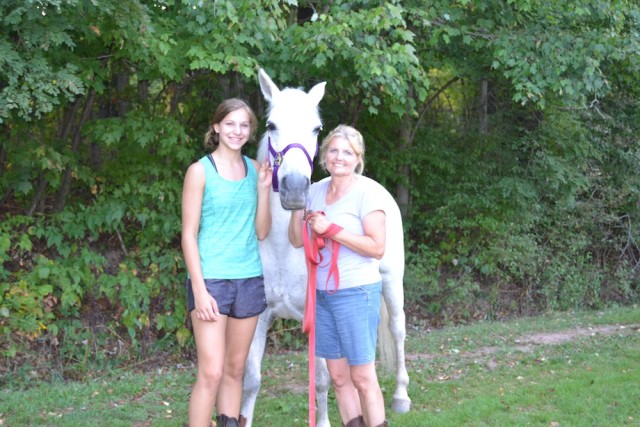
Back on Track ‘Horse Therapy’
Katherine tells her story about Josie Girl.

Tuesday Video: Snow Can’t Stop Me
Deep snow? That won’t stop this horse from getting to where he needs to go.
Adverse conditions bring out our most creative and intrepid sides, and the same can be said of this horse who won’t let chest-high snow drifts prevent him from enjoying a little turnout time. His — shall we say — “unusual” way of going is nonetheless effective!
(Note: must be logged in to Facebook to view.)
[SO CUTE]Quand tu croises une biche dans le champ …?Aww… horsing around in the snow … So awsmCredit : crazyfunnystuffcfs
Posted by In horse we trust on Tuesday, January 19, 2016
Hey, you gotta do what you gotta do.
Go riding!

Weekly Instagram Round-Up
Another week of horse life, captured in your images!
‘Gram of the Day from @equitateful: What everyone is looking for. A horse that cleans up after himself! #horsesofinstagram #horsenation #equestrianproblems A video posted by Horse Nation (@go_riding) on
‘Gram of the Day from @foster.rescue.adopt._: Frozen toes call for the farriers fireplace #horsenation #farrier #horseshoes A photo posted by Horse Nation (@go_riding) on
‘Gram of the Day from @invaderlala: A much needed break in the clouds.. #icelandichorse #equestriansofinstagram #horsenation A photo posted by Horse Nation (@go_riding) on
Join the conversation! Follow us on Instagram at @go_riding and tag your public photos with #horsenation. We’ll share our favorites daily. Go riding!

‘Oh Crap’ Monday
Monday is already the crappiest day of the week, so it only makes sense that we make things official.

If Snowflakes Were Horses
We caught up with paper snowflake artist and author Marion Nichols to discuss her latest project, ‘100 Amazing Paper Animal Snowflakes’ — horse snowflake included, of course!
Marion Nichols has published an impressive ten collections of paper snowflakes. Her most recent work is 100 Amazing Paper Animal Snowflakes, published on October 15, 2015 through Quarry Books. Each snowflake template within the book is a work of art, using the image of an animal to create a unique design.
Marion, of course, included a horse in the collection:

Courtesy of Quarto Publishing Group USA
We caught up Marion to discuss her creations, her artistic life and her horse background.
So how did you come up with the idea to use animals in snowflakes?
I was watching television one evening and cutting a regular paper snowflake — I can’t just sit there in front of the TV, I have to be creating something. I was watching an animal program, and looked at the animals and the snowflake and thought, “I bet I can do that.”
I started with a songbird, and went from there. I’ve published 10 different snowflake books now.
You mentioned you work at the City Museum in St. Louis. What do you do there?
Definitely look up the City Museum as it’s very unique. Originally I was a volunteer there — I was the “hat lady,” and director of the Art City section. Mr. Cassilly [museum mastermind and creator] noticed that people liked my little six sided snowflakes, so he built me a little six sided room where I cut snowflakes from recycled paper and tell stories. The museum gets on average about 4,000 visitors a day, so I meet lots of people. The tradition of cutting paper and telling stories is actually quite old; there are many cultures who historically blended these activities on a winter’s evening.
And why snowflakes in particular? How did you get into that art form?
Well, I always have to do something artistic with my hands. I like cutting paper — as I mentioned, every culture has a paper-cutting art form and tradition. Snowflakes aren’t just paper art, either — they are math and language lessons. They teach tessellations and fractals. They show both positive and negative space.
How do you design a snowflake, especially with a shape like an animal?
You can turn anything into a snowflake. First you fold a six sided snowflake. Then, any shape I use has to fit in that triangle that results from that fold. I’ve found that I need a minimum of four points of contact on the edge of that triangle to keep the snowflake together.
And because we’re always curious… do you have any horse background?
Oh, we had an old racehorse when I was seven! I remember that he was pretty mean. He used to brush me off on trees, and he would hold his breath when you tried to tighten the girth. Needless to say I am not a horsewoman now.
Check out Marion’s animal snowflake book and order a copy! Winter’s not so bad when there’s a way to relate all that snow back to horses, and in a fun, hands-on way.
Go riding!

The Academic Equestrian: Winter Expectation vs. Reality
Winter: where good intentions come to die.

A Comic to Kick Off Your Week
Need a little comic relief for your Monday? You’ll get a kick out of Kellie Lewis’ latest comic!

Comic courtesy of Kellie Lewis
KickyBrand.com is an online horse lovers site currently selling clothing, greeting cards and stickers. It also routinely publishes a cartoon strip by Kellie Lewis that has a little bit of kick to it.
