




Kristen Kovatch

Thursday Video: Equestricats Ride Donkey Double
The only thing better than a cat riding a donkey? TWO cats riding a donkey.
I mean, let’s be honest — how much else do we really need to say? There are cats, the cats are riding a donkey, and everything is adorable. Seriously, I can only aspire to be as cool as these two, lounging on the back of my most noble steed, taking in the afternoon sun.
Happy Thursday, Horse Nation. Let’s make it a good one.
Go riding!

SpectraVET Performance of the Week
Jason Vanlandingham and Not Ruf At All!

Understanding Equine Lyme Disease, Part I: What Is Lyme Disease?
Dr. Joyce Harman presents a four-part series to help horse owners better understand the increasingly-common but often misunderstood Lyme disease. In Part I, she introduces us to the basics.

World Equestrian Brands Helmet Cam: Camargue Herd
Ride along for an exhilarating drive of the iconic white Camargue horses through the brush!
Who hasn’t fantasized about galloping down a wild trail on the back of a snow-white steed, listening to the thunder of hoofbeats as other horses run freely around you? Thanks to a helmet cam video, you can now get at least one step closer to making that dream a reality — ride along for this exhilarating drive of a herd of Camargue horses in France!
(Note: must be logged into Facebook to view.)
The Camargue is the iconic breed of southern France, often photographed in the marshes where their gray coats stand out among their background. Contrary to popular belief, the Camargue herds aren’t truly wild but have semi-feral status, with a registry helping to organize the breed. Horses to be registered in the main studbook must have been born outside in one of the recognized semi-feral herds from a registered dam.
Camargue horses are popular mounts in southern France for livestock herders, and are also becoming increasingly popular as sporthorse mounts.
Go riding!

Lessons Learned: A Rolex Rookie’s Recap
With her first trip to the Rolex Kentucky Three-Day Event under her belt, Ainsley Jacobs shares her tips for future first-timers — as well as the big lesson she learned while browsing the vendor village.

#TBT: … Said No One Ever, Again
Our readers had so many good additions that we decided to add a second installment.

Equine Law: Presenting the Liability Release
Equine attorney Kjirsten Lee explains why presentation is as key as content.

Tuesday Video: For the Birds
Need a helping hand this spring shedding season? How about a helping beak instead?
Many of us leave our horses’ shedding spring coat out on the muck pile or set aside in a location where the birds can easily take what they need to line their nests. These birds are going one better and eliminating the need for the middle man — they’re getting their hair direct from the source.
(Note: must be logged into Facebook to view.)
Is your spring shedding season for the birds? Show us your photos and videos in the comments section!
Go riding!

#horsenation ‘Grams of the Week
Another week of horse life, rounded up in your images!
A photo posted by Horse Nation (@go_riding) on
‘Gram of the Day from @lchoos11: Nap time snuggles #horsesofinstagram #horsenation #naptime
A photo posted by Horse Nation (@go_riding) on
Join the conversation! Follow us on Instagram at @go_riding and tag your public photos with #horsenation. We’ll share our favorites daily. Go riding!
#TBT: Let’s Discuss — Good Days and Bad Days
Maria Wachter makes a case for learning to let stuff go.

A Comic to Kick Off Your Week
Need a little comic relief for your Monday? You’ll get a kick out of Kellie Lewis’ latest comic!

‘Oh Crap’ Monday
Here’s our latest reader-submitted photo!

SmartPak Monday Morning Feed: Ask a Non-Rider, Spur Strap Edition
“Little jeweled cat collars!” “Why would they come in pairs?” “Because they have two cats!”

Nyquist Keeps Perfect Record With Win in the 2016 Kentucky Derby
Going eight for eight, Nyquist put in a perfect performance to keep his perfect race record intact. Watch the Kentucky Derby replay here!

Cathryn Sophia Wins 2016 Kentucky Oaks
A relatively late decision in mid-April to enter Cathryn Sophia in yesterday’s Kentucky Oaks paid off in spades for her connections, as the filly motored under the wire almost three lengths in front. Check out the replay!

KY Performance Products: Nutrition for Lactation
Breeders, take note: while the pregnant mare has her own nutritional needs, the lactating mare has her own particular demands as well. Kentucky Performance Products explains.

Photo provided by Kentucky Performance Products
Lactation places extraordinary physiological demands on mares. Well-fed lactating mares produce the equivalent of 3-4% of their body weight in milk daily during the first two months of lactation. For a 1,100-pound Thoroughbred mare, that amounts to about 33-44 pounds. Considering a gallon of milk weighs almost eight pounds, average foals consume approximately four to five gallons of milk each day. In order to sustain this incredible output, the energy requirement of nursing mares is nearly double that of barren or early-pregnant mares. In addition to elevated energy requirements, nursing also boosts protein, calcium, and phosphorus requirements.
The primary goal of feeding the nursing mare should be to maintain optimal body condition. Attempting to regulate the amount of milk produced or its composition is more or less futile in everyday farm situations; therefore, the focus should be on supplying sufficient dietary energy.
Because early lactation can drain energy reserves, mares should be in at least moderate body condition prior to foaling (i.e., a layer of fat should pad the ribcage allowing it to be felt but not seen). Mares in poor body condition have inadequate internal energy stores to produce ample milk, and foals nursing these mares often grow slower than their well-nourished peers. On the opposite end of the spectrum, obese mares also appear to produce less milk than mares in moderate condition. As with the offspring of too-thin mares, the foals of obese mares tend to lag behind others in terms of growth milestones.
The temptation to overfeed energy to mares in adequate body condition may be rooted in the erroneous belief that it causes spikes in the amount of energy, protein, and fat contained in the milk. No scientific research supports this notion. On the contrary, excessive dietary energy may actually lower these values in the milk yield of mares in average or above-average body condition.
Feeding the Underweight Lactating Mare
Just as some hardworking horses are unable to maintain their weight on typical portions of hay, grain, and pasture, many mares cannot stay in optimal body condition while nursing a foal. Most concentrates formulated for broodmares have a feeding rate of 10-14 pounds. If the daily grain allotment is more than 10 pounds, feeding the mare three times a day would be necessary as no single grain meal should be over five pounds.
Even when consuming the maximum amount of grain that can be safely fed and the highest quality legume hay, some mares lose considerable weight while nursing. One way to counteract this is to top-dress fat to the concentrate. This is most easily achieved by feeding a high-fat additive such as corn oil or rice bran. One alternative is Equi-Jewel, a high-fat heat-stabilized rice bran. A pound of Equi-Jewel contains more energy than one cup of corn oil or one pound of a high-calorie concentrate (such as those high in fat and fiber).
Mares that are thin at foaling must consume sufficient calories to not only support the growth of their foal but also to increase their own body condition. These combined reasons make provision of calories essential to underweight mares, especially if the mare is to be rebred. Research has shown that thin mares have a more difficult time conceiving and maintaining pregnancy than mares in average body condition.
Feeding the Obese Lactating Mare
Every attempt should be made to keep mares from becoming obese during any stage of reproduction. As noted above, obesity can lead to decreased milk production. Mares must continue to be fed forage in the form of high-quality hay and pasture, and this alone may provide sufficient dietary energy and protein to support lactation. In mares that are particularly easy keepers, excessive intake of high-quality legumes such as alfalfa may contribute to obesity during lactation, and slowly switching to a clean grass hay may deter weight gain. Mare owners must ensure proper fortification of vitamins and minerals, and this is best achieved by feeding a supplement pellet. Adequate levels of protein, calcium, and phosphorus are guaranteed if recommended amounts of the supplement pellet are offered.
Water
Just as energy requirements are elevated during lactation, mares have an increased need for water. Studies have shown that nursing mares require 1.5 to 1.8 times more water than that necessary for maintenance, and this may be due to increased feed intake or milk production. As such, mares should have unlimited access to fresh clean water. This is particularly important in the management of mares that foal early in the year when water sources may freeze or in drought conditions when water is scarce.
End of Lactation
By the time a foal is five months old, milk production in the mare has declined. What was once 30-40 pounds of daily milk production is curtailed to approximately one-half to two-thirds of that. As milk production wanes, so do the mare’s nutritional needs. The amount of feed may be decreased during the latter months of lactation to keep the mare at a desirable body condition. If the mare is fed as she was in early lactation, she may begin to gain weight.
In order for mares to nourish their foals properly and remain healthy throughout lactation, they must be kept at optimal body condition. This is achieved by furnishing sufficient dietary energy in the form of a well-balanced diet. Special attention must be given to thin and obese mares to ensure optimal milk production.
Article written by KPP staff.
Copyright (C) 2016 Kentucky Performance Products, LLC. All rights reserved.
Article sponsored by Equi-Jewel, a high-fat, heat-stabilized rice bran; excellent source of safe calories that support proper muscle function, and by EndurExtra, a concentrated source of calories from fat with additional antioxidants and digestive aids.
When health issues arise, always seek the advice of a licensed veterinarian who can help you choose the correct course of action for your horse. Supplements are intended to maintain healthy systems and support recovery and healing. They are not intended to treat or cure illness or injury.
About Kentucky Performance Products, LLC: The horse that matters to you matters to us®. Click here to sign up for KPP’s nutritional minute and join other horse lovers who receive monthly fast facts on horse nutrition and care, informational “tips and topics” articles and educational infographic downloads. You can count on Kentucky Performance Products to provide affordable, high-quality, research-proven products that carry a 100% satisfaction guarantee. Not sure which horse supplement best meets your horse’s needs? We are here to help. Contact us at 859-873-2974 or visit our website at KPPusa.com.

#FailFriday, Kentucky Derby Edition
These champion racehorses seemed like a lock for the Derby win… until they picked the most important race of their life to run their worst race ever. Heather Benson counts ‘em down.
The Kentucky Derby hype machine is at a fever pitch and everyone has their pick to win the big race.
But much like meteorologists predicting the weather, predicting a horse’s performance is a crapshoot at best. Hype tends to slam into reality on the first Saturday in May and one bad day at the track can mean the difference between destiny and destitution.
And so we present some of the biggest fails in Kentucky Derby history:
#4: Himyar — 1878 Kentucky Derby
Sure, it was 1878 and the Kentucky Derby wasn’t even a big deal yet, but Himyar still managed to catch the attention of the nation after a series of scintillating wins at age 2. He went into the Derby as the shortest priced favorite (1-4 odds) in history and lost by two lengths to Day Star. He did make up for in a way, by siring 1898 Kentucky Derby winner Plaudit.

Himyar. Photo courtesy of thevaulthorseracing.com.
#3: Native Dancer — 1953 Kentucky Derby
The “Grey Ghost” was undefeated in nine races at age 2 and crowned Champion 2-Year-Old Colt in 1953, with many viewing him as the Horse of the Year as well. He was just as sparkling at 3 and went into the Kentucky Derby still undefeated. As it happened, that Derby would be the only race he ever lost after being fouled twice during the race and losing by a narrow margin to victor Dark Star.

Native Dancer. Photo courtesy of thevaulthorseracing.com.
#2: Arazi — 1992 Kentucky Derby
During the 1991 Breeder’s Cup Juvenile, held that year at Churchill Downs, Arazi had put on a performance that made him look like the second coming of Secretariat. Shipped back to his native France to condition for the following year’s American classic, he underwent a minor surgery and never again showed the same sparkle, despite the public still favoring overwhelming to win. He placed 8th behind Lil E Tee.

Holy Bull. Photo courtesy of whitehorseproductions.com.
#1. Friesan Fire — 2009 Kentucky Derby
He may not have the household name status as some of the other Derby fails, but his Derby failure wasn’t pretty. After wins in the entire 3-year-old stakes series at the Fairgrounds Race Course, including the Grade I Louisiana Derby, he was on the board as the Derby favorite. Not only did he manage to lose and place nearly last, he lost to 50-1 longshot Mine That Bird. Double fail!

Friesan Fire. Photo courtesy of bloodhorse.com.
Go Riding.

2016 Kentucky Derby Need-to-Know Guide
All the links you need, plus one you don’t.

Valerie Ashker Riding Coast to Coast to Raise OTTB Awareness
To demonstrate the versatility and value of the second- or third-career Thoroughbred, Valerie Ashker is about to embark on a coast-to-coast ride aboard her OTTB. We caught up with Valerie just days before she saddles up!
The Academic Equestrian: Finals Week
Haley’s pushing through finals week of her spring semester, and draws a few parallels between muddling through her exams and riding a horsemanship pattern.

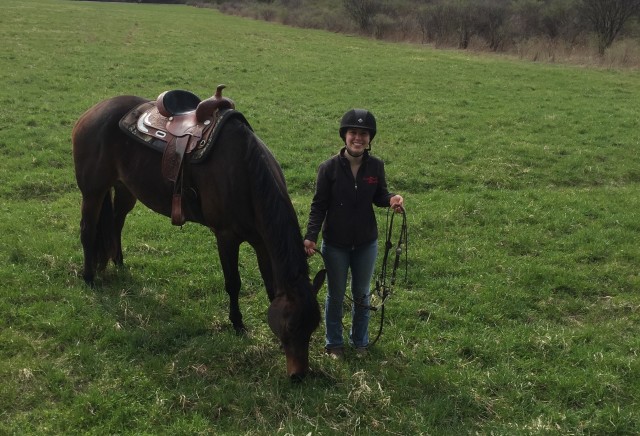
This photo is from a trail ride during which Cricket somehow unbridled himself so that he could graze, which kind of set the tone for finals week in that I’m not sure what I’m supposed to do and I’m mildly stressed. Photo by Ellie Woznica.
Finals week is upon us, and as the week draws to a close I can look back on my tests and all the anxiety with some humor. (Even though I do still have one test on Saturday. Who gives tests on a Saturday?!)
I’ve started to look at final exams like I do horsemanship patterns, but with less excitement and more nerves, and instead of a ribbon I hope for a passing grade. I study for both tests and horsemanship patterns, but both are more successful if I’ve been practicing consistently instead of cramming right before. Below are some steps, pattern-style, to get through a final exam.
- Enter at a jog because, let’s face it, you’re probably late.
- Halt in the doorway long enough to ensure that you are in the correct classroom.
- Nod at the professor, proceed at a walk.
- Perform a square corner at a desk row of your choosing.
- Step over book bags and other obstacles until you reach your selected desk.
- Place book bag on ground, turn 90 degrees on the haunches, and sit down.
- Remove working pen or pencil from your bag. Penalty points may be given if this step is skipped.
- Open test booklet and perform any and all maneuvers as directed.
- When finished, stand and turn 90 degrees in the opposite direction. Walk to professor without hitting students, book bags, or desks.
- Hand in test, hesitate to demonstrate completion, then exit at an extended lope.
Crying and laughing are permitted once a distance of at least 25 feet between student and classroom has been attained. Crying during the test can result in a steep penalty.
And now it’s time for summer vacation for me — I hope you enjoyed “riding along” for my first year of college! I’ll be back in the fall, so until then, go riding!
Haley is the author of Horse Nation’s “Academic Equestrian” series, following her collegiate experience as she balances her studies with participation on the varsity equestrian team and time with her own horse. Catch up on past columns by clicking the #ACADEMIC EQUESTRIAN tag at the top of the page!
Haley Ruffner is attending Alfred University, majoring in English and minoring in Business and Equestrian Studies. She has a green Quarter Horse, At Last an Invitation “Cricket,” and he is also “enrolled” at Alfred. She rides western and hunt seat and also loves to rein and trail ride.

Standing Ovation by Ovation Riding: Sabino Recovery
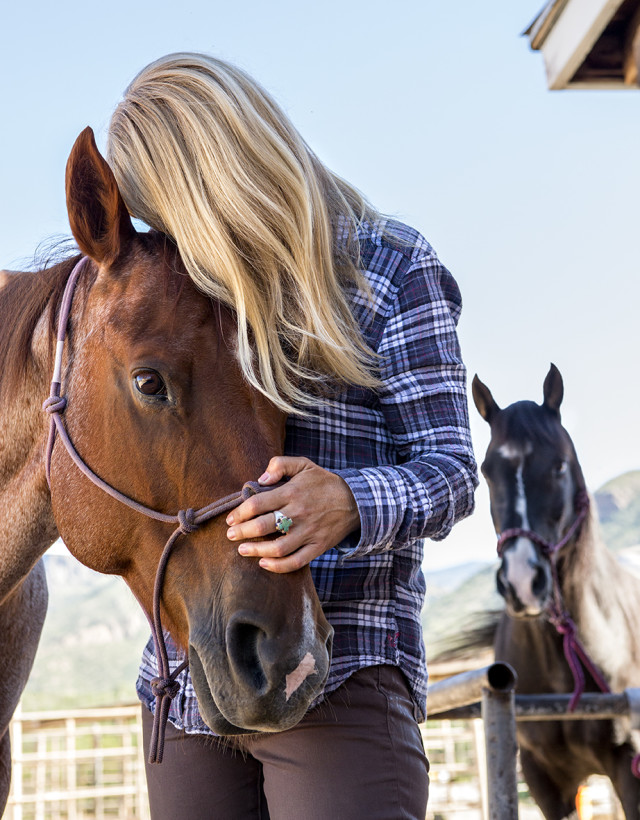
Each Friday, Horse Nation teams up with Ovation Riding to spotlight an organization doing good work with horses. Today, we recognize Sabino Recovery, a trauma and addiction treatment center in Tucson, Arizona.

Infographic: The 2016 Kentucky Derby, By the Numbers
We’ve broken down the 2016 Kentucky Derby field to take a closer look at some random statistics, including coat color, sire and where each horse was bred.

Photo Challenge: 5 Barn/Show Moms
We’re so grateful for the support of our barn and show moms, and in honor of Mother’s Day we’re sharing reader-submitted tributes for this week’s photo challenge!
The saying goes “it takes a village” — and no member of an equestrian’s village is more important than supportive family. We’ll be honoring our barn and show dads in June for Father’s Day, but for the first week of May, we’re focusing on the much-beloved show moms of Horse Nation. Here are 5 reader-submitted barn/show moms!

Bre Every: Cheryl Every is the best horse mom I know to me and our Canadian Warmblood, Bentley! My mom is the whole reason I grew up riding and owning horses. She goes above and beyond to make sure Bentley has the best possible care. As you can tell from this photo, she is his FAVORITE person and he certainly appreciates all she does for him too. Photo by Bre Every.
#horsenation #24hourphotochallenge #meandmom A photo posted by Cassandra (@cassandrareneeb) on

Paul Lopez: Laurie Slifer Lopez: she’s at the barn with our young rider in all kinds of weather. Double trips back and fourth for riding. Helping with grooming,tack, barn chores and whatever! She’s the best! Photo by Paul Lopez.
Keep an eye out for next week’s 24-hour photo challenge! We announce challenge subjects on Monday around the middle of the day on both Instagram and Facebook.
Go riding!
