



Kentucky Performance Products Presents Thoroughbred Logic: The Exit Physical
“You know what they should do? They should have an exit physical like we do in the Army. They should take all the x-rays, do all the diagnostics, and have the owners/trainers fill out forms with any known issues.”
Welcome to the next installment of Thoroughbred Logic. In this weekly series, Anthropologist and trainer Aubrey Graham, of Kivu Sport Horses, offers insight and training experience when it comes to working with Thoroughbreds (although much will apply to all breeds). This week ride along as Aubrey shares her logic on a post-track exit physical.
I have been thinking a lot about not just the transitions that happen as Thoroughbreds move from the track to the second-career farm, but also the process, the people, and the data involved. In a recent conversation with my partner, I was noodling around on the idea that there perhaps ought to be Thoroughbred-based institutional support for the average owner for vet bills, maintenance, and education. I’m working on that concept, but his contribution to the conversation was perhaps more interesting than mine.
“You know what they should do? They should have an exit physical like we do in the Army. They should take all the x-rays, do all the diagnostics, and have the owners/trainers fill out forms with any known issues.”
Taylor did this very thing when he retired from the Army after 23 years of active service. They found old fractures in his neck and back, ears that rang, headaches that didn’t go away, and so on. Any paratrooper or anyone in the armed forces will probably find these to be common, not exceptional problems. And both his retirement pay and his medical access were based to some degree on the severity of the findings.

I don’t have his x-rays, but for example sake, I do have my busted AC joint post Crafty Charger wipeout. Image of x-ray (because they didn’t give them to me) by author.
Now, I’m not saying that the way the Army does things is the be-all-end-all of how to do things. I don’t know nearly enough there to make anything akin to that statement.
Rather, this is more of a think piece. And before diving down the “Thoroughbred Exit Physical” rabbit hole, let me note that I think there are oodles of positive potentials here and equally plenty of things that would keep me up at night.
When we think about an exit physical for a racehorse, it would, on one hand, be awesome. How great would it be to know as much as possible? To have a full understanding of the constitution of the horse you’re about to restart?
On a collective level, we’d know statistically just how many of these horses come off with hock arthritis, how many have stress visible to their suspensories, and how many have touching points in their back or osselets that form outside of or impact the joint space. We’d have a fuller sense of the physical patterns built of highly specialized breeding programs, race training and running. And perhaps we’d be able to support new or additional training tactics, treatments, and plans to both prevent and manage.
Maybe.

Twoko Bay and Zoe’s Delight duel in a race in 2022. Photo courtesy of Laura Newell, then of Winchester Place Thoroughbreds.
Perhaps this data would be accessible to the public and buyers would be able to filter databases for the things they 100-percent cannot live with, as well as the markers they’re looking for. Perhaps one could simply do as we do to look up race records and click a tab on the horse’s Equibase profile. Neil’s (Lute’s Angel) would say “splints; pinfired; minor hock arthritis;” and likely something in his lumbar — but I haven’t gone looking, so I don’t know. Perhaps there would be a tab for their radiographs and ultrasounds, gastrointestinal, and airway scopes.
Again the data-driven science side of me would LOVE this.

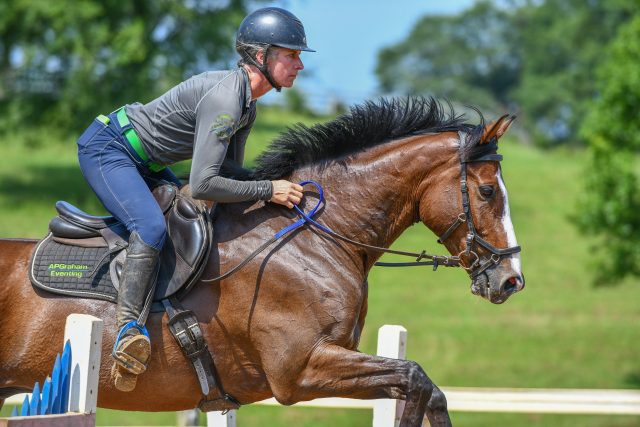
Neil tackling fence two in Beginner Novice at the Kentucky Horse Park this past weekend. His physical issues certainly don’t impact his scope. Screenshot by Greta Colley.
I also know, for a fact, that there are a ton of folks who will read this and think about the heartbreak that they could have avoided if they had “just known.” If they knew about the arthritis, the chip, the ligament strain, the chronic ulcers…
Hell, my biggest heartbreak to date is still Juice (Pulpituity), whose race career ended in his first race. His suspensory that failed there was the same suspensory that I spent two years, a ton of money, and likely an equal amount of stubborn determination and tears trying to fix. Juice is now happily retired with the folks who bred his dam (not technically his breeder, as he foaled out in the ownership of others), and I’m eternally grateful for his ability to have a field-based life despite the chronic lameness. You can read his saga here in “Of Love and the Pursuit of Soundness” part I, Part II, and Part III.

Apparently I have a thing for sensitive, tough horses with ample scope. Juice (Pulpituity) featured here, schooling at Chatt Hills in 2019. Photo by Kassie Colson.
But, on the other hand, that would be a lot of data to have in our hands before we know what it all actually means. And I’m certain that good horses would be passed over for the findings.
And that is what scares me.
Let’s not even bother with the logistical or financial aspects of this — it currently is impossible with the myriad and uncoordinated ways in which horses retire and move from the track, the outrageous funding needed to do such work, the number of vets, and the sheer hours of their already strapped time that would have to be involved, and the coordination of the trainers, owners, and racing industry as a whole. Again – this is a think piece, not a “How do we build it?” piece. The logistical hurdles to anything of this scale, scope, or goal would be monumental, and I fear that the cost of the work would fall disproportionately on the trainers or owners, many of whom already struggle at the lower-tier tracks.
That said, here’s the part I really want to think through: What would the impact of those diagnostics be on individual horses or the breed as a whole?

This gnarly knee actually should not have too much of an impact on Wine Responsibly’s lower level career. But the look of it certainly would scare away a host of quality buyers. Radiograph by Early Winter Equine.
For the sake of the horses, there are a lot of reasons to fear that level of data and knowledge. And this is the same reason I often sigh in defeat at intense pre purchase exams that aim to do a ton of “survey” rads. Survey info is information “just to see;” it is not because there’s a clinical or behavioral reason to go looking. If a horse flexes poorly on a joint, great — let’s radiograph it. If a horse is pretty clean on flexions and sound on the lunge, why are we taking four images of every joint in their body, their necks, and backs (on a f$4000-dollar horse, no less)?
Again, data is great. I guess I just don’t trust most people to be able to look at veterinary data for data sake and make positive decisions. So often any findings on survey rads are considered significant and problematic despite the lack of any associated symptoms of pain or problems…
But I digress…
As such, with an exit physical, “survey data” would be rife. I doubt that many — if any — of the horses who were x-rayed and scanned would come up perfect. But those who were close, they’d be snapped up in a moment. For the rest, I would worry about their future.
And I think that speaks to the level of faith that I have in the buying population right now. Sure, some folks are OK with some maintenance. But even at the low level — even at the “never really going to jump above two-foot, want to play on trails and hunter paces, want to maybe do a starter-level event once a year” — folks are looking for horses who will perfectly “pass” a PPE. And, of course, PPEs are not pass-fail; they are moments in time that try to contextualize and provide data on the physical condition of the horse at that time on that day. But there is still the buyer desire for next-t0-no findings: Minimal maintenance. Clean legs. Good bill of health and soundness without assistance.

Louis (Unbridled Bayou) is one of my favorite examples for survey x-rays gone awry. This horse packed ammies, jumped everything, and was uncomplicated as the day is long. Survey rads in a PPE found multiple points of kissing spines that had no behavioral outcomes. Thank goodness his buyer still took a chance on him and loves him like crazy. Photo by Cora Williamson Photography.
I understand that from a buyer’s perspective. I get not wanting to take the risk on something that will be a physical challenge later. Absolutely. I get it.
That said, I don’t act on it. All of my horses are physical or mental risks — just look down my show string’s maintenance list. It could be turned into a song around hock, coffins, ankles… hocks, stifles, feet… hocks, back, feet… hocks, hocks, hocks… But the scope of their heart and bravery and try can’t be measured by veterinary instruments. And so long as I can keep them happily in work, I don’t give a damn about the maintenance I have to put in (though I’m going to have to sell a few more horses to pay for all of it, of course…)

Neil (Lute’s Angel – right) and Artie (Reunion Tour – left) have an array of things that would scare off buyers but they’re both successfully clicking up the levels (dressage scores be damned). Photo by Greta Colley.
So yes, in theory, I get it as a buyer — especially when one only has one horse to ride. But as a seller, I look at this exit survey idea and think: shit. And I worry immediately about the horses and the breed as a whole. It’s like this: That ISO that wants to give a good life and a low-level job to a Thoroughbred on a pretty tight budget? I read that and think, “Scooter would be such a fun horse in that situation.” But Scooter (Star of the Beast) had knee chips removed and has a healed fracture line there, too. He’s hard to drum up interest, even on a buyer’s wildly tiny budget. Because despite being sound, kind, and very likely able to do the job, we have disclosable information on his bones that make folks wonder why they would bother with “scratch and dent” when they could have perfect instead. So because of what we know, Scooter is still here.

Scooter (Star of the Beast) hacking quietly in the xc field. Photo by Lily Drew.
The same thing happens when one is able to share radiographs of a known issue ahead of time. Sure, I have rads of the not-perfect hock, and I’ll share them before a buyer comes to visit. I share the rads, the buyer’s vet takes a look, and despite the temperament of the horse perhaps being a perfect fit and its ability level being commiserate with the two-year-from now goals of the buyer, the vet wonders why they would bother with something that already has this known issue. I’m not blaming the vets; they’re doing the job they are paid to do. BUT, when folks who have not met and fallen in love with the horse make decisions based on veterinary data alone, these horses rarely sell.
Folks, I’m not talking about horses who have proven that they can do the job. This is not your 1.20m jumper who has been in the game successfully for 10 years. I’m not talking about the proven Training-level event packer or the competing second-level dressage horse. I’m talking about a horse who has yet to be trained for sport. A “blank canvas” horse who is retiring from the track with a potentially long future ahead of them to go in any direction.

Ranger (Cowboy Night) is another great example. Ranger has been a wonderful mount for his owner, Amanda Woomer and for a number of others who have leased him over the years. In recent radiographs, vets found a well-placed screw in Ranger’s ankle that we had no idea was there. The screw is just a finding with no associated pain, but would that screw have kept him from his finding Amanda? From having the chance at a quality second career? I don’t know, but that’s the type of stuff I worry about and keeps me striving to educate buyers (PSA: well-placed screws and well healed fractures pose very little risk to soundness in a horse’s second career). Photo from the 2021 RRP Makeover by Lauren Kingerly.
If we had all the veterinary information on their bodies as they left their racing careers, how many of these horses would be retired to fields before they had a chance to see what their bodies thought of the job? How many horses simply would not sell from the track or from rehomers’ barns? How many nonprofits would be overfull with the scratch and dent that still has wildly athletic abilities? And how many would end up in less than great spots — bouncing into auction pipelines or to homes that can afford the track-purchase price, but cannot afford to take care of them?
Ultimately, how would this amount of survey data impact the movement and potential of these horses to have a shot at a great career or home after they exit the track?
And it is exactly that survey nature of that data, coupled with the risk-averse culture of buyers, that would keep me up at night.

Iago (Camino de Santiago) is an impressive, quiet, smart kid who has moved to a wonderful home with a dear friend (and man I’m excited about his future). Who knows what an exit physical would find or what that impact would be. But with no data, we ride the sound horse before us and manage as needed. Photo by Lily Drew.
So here we are — down a “think piece” rabbit hole about veterinary data, buyer culture, and Thoroughbreds. I don’t have a solid position on any of this. I’d love to have the data. And access is always brilliant. BUT we’d need an equally open-minded, well-educated population of horseman to understand and make rational, not reactive decisions about these horses and their findings. We would need more buyers who seek appropriate mounts as opposed to unicorns.
So go ride folks and pat your pony. And perhaps remember that you’re riding the horse, not the x-ray.
About Kentucky Performance Products, LLC:
Strong bones start with smart management and targeted nutrition. A well-balanced bone supplement is beneficial to maintain normal bone development for horses in utero, horses showing signs of developmental bone diseases, young horses going into training, horses confined to a stall or laid up, mature horses recovering from skeletal injury or returning to training, or older horses with a demanding competition schedule.
BoneWise® supports strong, resilient bones throughout a horse’s life. It contains a unique form of highly digestible calcium (Lithothamnion) that is research-proven to sustain optimal bone mineral content, bone density, and bone remodeling, which ensures a strong skeletal system. It also contains several trace microminerals and vitamin D, which play a role in bone turnover.
Ask your vet if BoneWise is right for your horse.
Kentucky Performance Products creates scientifically proven supplements for your horse. Our supplements provide solutions to the everyday challenges facing your horse. The horse that matters to you matters to us®. Learn more about KPP at kppusa.com.

