



Thoroughbred Logic, Presented by Kentucky Performance Products: Good Diagnostics and Henny’s Story
This week’s article offers a case study on the importance of good diagnostics.
Welcome to the next installment of Thoroughbred Logic. In this weekly series, Anthropologist and trainer Aubrey Graham, of Kivu Sport Horses, offers insight and training experience when it comes to working with Thoroughbreds (although much will apply to all breeds). This week ride along as Aubrey shares her logic on investing in good diagnostics.
A few weeks back, Hennessy (Johnny Bootleggs) came up as an example for getting good diagnostics. This week I want to dive into his situation little further. There’s a lesson or twelve in there somewhere.
Hennessy (Johnny Bootleggs) has grown into one of my favorite horses in the barn. He’s a sizable redhead and he is indeed very red in all the ways. He is equal parts sensitive and opinionated and tough. He has high standards and a very low threshold for anything even remotely below them (aka uncomfortable is rarely acceptable). He’s also quite handsome and I’d go so far as to assume he knows that.
When Henny arrived back in March, he was fat, shiny and maybe just a touch pushy to handle. He clearly loved his then-owner and their set up and was a little like, “This looks like boarding school. School is stupid.”

Hennessy (Johnny Bootleggs) upon arrival. Photo by Lily Drew
He wasn’t at mine to gain manners (though it didn’t take long for him to remember the ones he had and learn a few extra). He was here on consignment because his owner didn’t believe she could do him justice with her schedule. Henny had sat through the winter and prior to that, he and his owner had never really hit their stride.
Sure they did some things — some trails and such, but he was always a little difficult to get right. She wanted the best for him, and had come to the realization that it both wasn’t the right time in her life and that maybe she wasn’t the rider/owner he needed. I have nothing but respect for her and her commitment to trying to get him what he needed.

Screenshot of a tight, but obedient Hennessy (Johnny Bootleggs) during his early rides here. Screenshot from Lily Drew.
In that situation, Henny represents many Thoroughbreds who have come off the track and struggled to not just get going, but to get going well. It wasn’t that he was riding great and then hit a bump in the road that needed to be addressed. Rather, he never really, really got going. He was ‘OK enough’ that he seemed manageable (you know, when he was not laid up for this or that injury from dumb gelding paddock antics). Play stupid games, win stupid prizes…

Henny’s pastern — a rad taken hunting for a paddock-based lameness. Radiograph courtesy of Black Brook Vet Services.
Based on what I have gathered about his life before coming here, Hennessy was good on the ground, but under saddle, he was consistently kind of challenging. On one hand, he’d resemble an anxious llama for the starts of much of his ride (or at least this is how I picture it from the description of “high headed, nervous and wanting to run on his forehand”) or if in consistent work, would be “hard to get going and very difficult to get round.”
At many barns, both the llama or the no-go version of the Thoroughbred sometimes just garner eye rolls and “that’s Thoroughbreds for ya” from other boarders, managers, and even some trainers. Horses going like Henny also get the assumed, “Well, that one just needs to be in a program.” And then folks prescribe something wild like lots of lunging, six-day a week work, or a new young (read: brave) trainer to kick him through.
Hell, that ‘needs-a-program’ logic was the driving factor for him coming here — not just consignment, but access to more rides and a consistency. (Fun fact, no horses in my program work six-days-a-week — not even my competition string. Most do great in three to four days-a-week).

Even this kid is only in 3-4 days a week normally. Photo of Neil (Lute’s Angel) by Flatlandfoto
But it’s not just about how many rides a week one puts on.
When I first swung a leg over Henny, my first thought wasn’t “Oh, we need to do this six-days-a-week.” It was simply, “Oh shit.”
The confident horse disappeared when I stood on the mounting block. His eye widened. As I got my right foot into the stirrup, he skittered under himself and I wasn’t sure if he was going to sideways or up. I sat still, skilled sack of potatoes-ed his antics, and waited for my assistant, Lily, to get to his head. This wasn’t a thing to kick through. He needed to trust me, and I needed to figure out what his triggers were.
Over the next few rides, we spent the first five or more minutes pony riding (me getting led around). I rode with a neck strap to stay still and out of his way. And as we went, he took a breath and started to trust. Skittering and threatening disappeared, but he was still defensive and maybe not quite right.

Throughout the figuring it out periods, he still enjoyed his hacks. Photo by Lily Drew.
Yes, he needed training, but he needed help to be able to get to a point to be open to training suggestions.
Looked at up close, Henny has some of the most special legs in the barn. To start, his left front foot, ankle, and knee look like they’re in a funhouse mirror — they all point different directions. That could likely have been fixed in the first few weeks of his life, but for whatever reason, it wasn’t.
Add to that that he has knees. Somewhere in his veterinary history, we have rads of them. They’re gnarly and there are chips and arthritis, which don’t need surgery but will eventually need maintenance. He still has good range of motion and is happy to plunk around pretty damn sound on them, so that injection can hang tight for a minute. I mean, I wouldn’t slate him for your next meter jumper, but on the flat, he has plenty of life left in those legs.

One of Henny’s knees. Radiography by McGee Equine Veterinary Clinic.
The distracting issues of his left front forelimb and his knees aren’t actually the immediate problems — for that one, one needed to start at his hind end. Sit him up over his hocks and Henny had a bit of a temper (understandably). I had to ride carefully to keep him balanced and on his own terms and own balance, avoiding asking him to truly flex and push from behind. It wasn’t ideal for me or him, and it would have been very tough for anyone not used to that kind of sensitive ride. This wasn’t a horse I put my working student riders on. I didn’t.
His owner didn’t have the ability to support the vet work, so after a handful of months of the inability to move him to a new, highly-skilled and appropriate home, and knowing the fact that he’ll easily bounce if just given away to just anyone, we moved him over to our in-house non-profit, Stall 13, Inc., and scheduled a workup.
You can find out more on Stall 13, Inc., here: www.stall.13.org or listen to our Episode with OTTB on Tap:
My vet watched him travel, flexed him, and noted levels of lameness. And then we took far more x-rays than any wallet enjoys witnessing. We got foot rads to make sure we could shoe him correctly. Then we moved up the hind limbs. The most glaring findings showed that both hocks had arthritis in the bottom two joints (the TMT and DIT), with the left hock showing partial fusing. Using x-ray guided injections, my vets got the Depo into the joints. And then I waited.

Henny’s left hock. Radiograph from Early Winter Equine
I watched him play in the field, standing up and bouncing around like I haven’t seen before. And when I next swung a leg over, I got goosebumps. Hell, I almost got teary (and if you know me, you know that that’s huge — I’m not a crier).
For the first time since I had been riding him, he pushed easily from behind. He reached into contact and actually lengthened the neck that for so long he had held short, carefully crooked, and arbitrarily fancy. His stride lengthened. And I could actually ride, not just manage him through stillness.

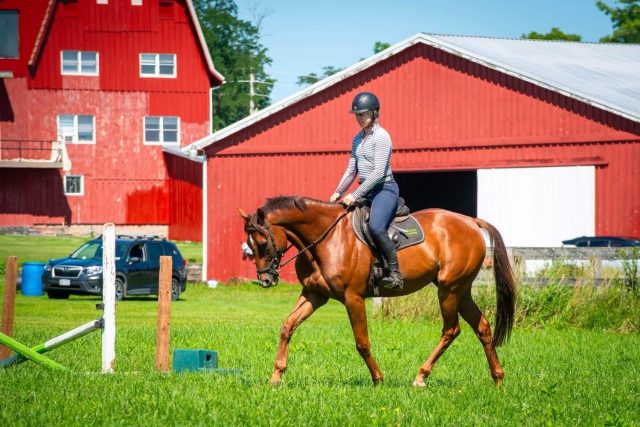
Henny flatting outside post maintenance. Photo by Lily Drew.
The difference was wild. And although he’s not perfect, he’s now serviceably sound and importantly, safe(r). He’s not angry, and he’s happily able to do the job asked — no llama, no hard to get-forward. Hell, I ditched the neck strap and am plotting to get other riders on him soon.
Finally, a few years off the backside, Henny can actually get going. Each ride, he’s leaving the post-track rut further behind him. And it turns out that rut wasn’t edged just by a lack of training or the need for a stricter, more demanding program, but also by chronic pain.

Good kid, Hen. Photo by Lily Drew.
So go ride folks, and if you’re finding your horse in a similar rut, it never hurts to draw both trainer and vet into the conversation. And if you’re not opposed to annual maintenance and one hell of a rewarding partnership, Henny is still available through Stall 13, Inc. (just saying… ;).
About Kentucky Performance Products, LLC:
Girthiness. Sour attitude. Colic. Poor body condition. Little appetite. Does that sound like your horse? If your horse is consuming a high-grain diet, regularly under stress (i.e., competition horses, horses that travel, young horses in training) or prone to digestive issues, Neigh-Lox ADVANCED should be a staple in your feed room.
This supplement provides a scientifically advanced blend of ingredients that work synergistically to maintain a healthy stomach, small intestine, and hindgut. Horses with a robust GI tract don’t just feel better, they absorb optimal levels of nutrients and maintain body condition more easily. They aren’t just less prone to digestive problems—they have a stronger immune system overall. Don’t underestimate the role your horse’s gut plays in their overall well-being. Click here to learn more about Neigh-Lox ADVANCED.
Kentucky Performance Products creates scientifically proven supplements for your horse. Our supplements provide solutions to the everyday challenges facing your horse. The horse that matters to you matters to us®. Learn more about KPP at kppusa.com.

