



Thoroughbred Logic, Presented by Kentucky Performance Products: Of Artists and Engineers
This week’s article explores how rider mindset shapes training, progress, and the path to a happier Thoroughbred.
Welcome to the next installment of Thoroughbred Logic. In this weekly series, Anthropologist and trainer Aubrey Graham, of Kivu Sport Horses, offers insight and training experience when it comes to working with Thoroughbreds (although much will apply to all breeds). This week ride along as Aubrey shares her logic on she approaches horses and their riders based on the rider’s proclivities.
It is probably never fair to split the people of the world into two groups — right brained – left brained; Type A or Type B; Introvert – Extrovert. Sure from a million miles up those categories might work on some macro level. But of course we lose all the nuance that makes humans human and individuals exactly that.
Despite the fact that I know better, when it comes to horses, I find myself grouping people into a concocted dichotomy: Artists or Engineers. There’s nothing ground breaking about this way of categorizing and it’s far more a thought game than a prescriptive reality. But such stereotypes — and the set of (yes, sometimes woefull incorrect) assumptions that come with them — help me understand how to help folks manage, train, and ride their Thoroughbreds.

Playing with Zeke (Analyzethisandthat) during his photoshoot the other day. Photo by Lily Drew.
Whether at a lesson or clinic or when someone drops off a horse for training or consignment, I not only ask about their horse (of course), their successes and challenges, but also what they do for work. Bio-engineer? Mechanic? Awesome. Freelance writer? Music teacher? Sweet. See the thing is, I don’t actually care what job someone has so long as they enjoy it enough. But what I do care about is whether or not the proclivities that come with either side of that way-too-general coin [Artist:Engineer] apply when they’re working with horses.
So, no, I don’t think a job necessarily defines a person, but there are definitely folks who are good at certain tasks and not at others. Do not ask me to follow instructions and assemble anything or figure out any form of machine. I’m just going to ignore the extensive “how-to,” get the duct tape and hay string, and see what I can rig. Equally, please do not ask my partner to paint (though I’d kinda love to see what he came up with).

Doing the things he begrudgingly does best: Fixing what breaks (not using duct tape or hay string). Photo by Lily Drew.
For folks whose work/persona sits more on the art side of things, “feel” often takes a front seat. When they are in the saddle, that concept shapes way I try to teach. If I can get them to a sensation, a moment of connectedness, through-ness, I can help them feel their way back there again… and again until it becomes muscle memory, until there’s flow and a soft, happy horse. Often “Art” folks are great at allowing for errors and sidetracks, and giving the horse the accommodations and room they need to get to the goal. On the flip side, this category of folks may be less likely to hold strict boundaries or set plans to make it to the competition season on time. (Remember, these traits are hypothetical stereotypes, not individually prescriptive.)
For Engineer-y folks whose jobs and brain operate more on clear, step-by-step processes to get to an outcome on a measured timeline, there’s an equally dialed in step-by-step way to convey information both about how to ride the horse and how to manage and handle it on the ground. I find with such precision-driven folks, there are more numbers in my discussions, measurements, angles. There are more replicable steps that strive to get to the same outcome assuming the variables don’t range too widely in any given direction. And for the stereotypical Engineer type, there is often determined and incremental movement toward progress, toward heading on up the riding levels of a given discipline. Yet, that same, a+b = c that keeps progress kicking along, also sets expectation and may drive frustration when individual horses and their needs and variables do not fit within the given equation or cannot produce the required outcome.

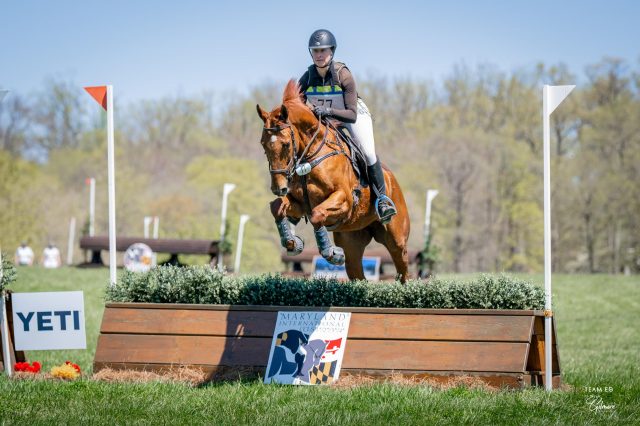
And I probably need to channel a bit more engineer energy if I want to make a schedule and training plan that actually helps me get these kids on track and up the levels (Photo of Artie (Reunion Tour) by Erin Gilmore Photography).
Yes, yes, these categories are both woefully general and also very permeable. And yes, I know, in all likelihood, someone is going to read this and go, “Hey, I’m an engineer and I ride through feel!” or “I literally teach Art and I thrive when my instructor gives me clear numbers, or angles to ride from.” Fine. As I said, it is an extremely imperfect dichotomy based on stereotypes and the equally imperfect assumptions they’re built of. You’re just getting a view into how my brain processes the challenges I encounter with humans and their respective Thoroughbreds.
See, when dealing with Thoroughbreds, I have found that there are strengths and weaknesses to both arbitrary categories. Horses absolutely are capable of being happy with owners who ride, manage, and operate a farm from either perspective. But I think often the precision engineering folks may struggle more with the first year of a Thoroughbred’s off-track life. That period of variable timelines, steps forward, and small wins met by unexpected holds, challenges, and slides reads more like a game of chutes and ladders than correctly stacked dominos where each action has an associated and expected reaction.

Acorn (Mo Lucky) is one of the horses I picked up from Laurel last week. Although he has already gained a bunch of weight and is on a good track, I’m certain his first year post-track won’t be without a few steps forward and equal steps back. Photo by Lily Drew.
I see this frustration in the occasional owner who sends horses for training or consignment when that first year of retraining or ownership has not gone to plan. Somewhere along the way, the wheels may have come off, or at least the lug nuts loosened enough for the owners to realize that the progress made or the process needed is not what makes them or the horse happy. (No, I should not be allowed to use mechanical things as metaphors, but you get the point). Descriptions of their horses’ problem is sometimes accompanied by the phrase, “They’re just not where they should be by now.”
A+B somehow did not equal C.
And that’s OK. I actually love working with those horses and clients. I get to listen to their goals and the processes carefully tried and inject a more free-form side of the “Art” world into management and training. I don’t set up fixed, written training plans or plainly map out expected progress. To sound like a total hippy, with a rider’s goals in mind (be it for training or sale), I get to find a situation and a flow for their horse that heads confidently in a direction that makes the horse happy and ticks in the right direction for the rider.

Mr. Magico taking a walk break in his first ride back at Kivu. I’m happy to see him happy. Photo by Lily Drew.
See, training plans are great, but they need to be just as comfortable being amended or scrapped as being executed. Dialed in management and riding processes that works for most horses are wonderful, but sometimes-creative accommodation for the oddball who doesn’t fit the norm is critical. Thoroughbreds often are those oddballs. And it is exactly those who don’t fit the expectation that often find their way here. And they’re my favorite. Each represents a challenge that usually isn’t too terribly hard to get on the right path when looked at as “let’s see what you need to be happy” as opposed to “I have done A and B, so why can’t you produce C?”

Sisterson is hanging out with Alice Beckman in KY until I can pick him up, and this flexible, easy-going barn seems to be just what he needs to start his let down. Photo by Alice Beckman.
Looked at a little differently, I usually find that the horses struggling with fixed plans and needed progress need a bit more “Artist” in their world, and folks who want to gear up for a season or really get going need more “Engineer” to make the plans and put the specific work in to meet the needed milestones to move up the levels. There’s benefit to both, for sure.
But, regardless of your job or which way you identify, go ride folks. Enjoy the process and the small wins alongside the big ones.
About Kentucky Performance Products, LLC:
Strong bones start with smart management and targeted nutrition. A well-balanced bone supplement is beneficial to maintain normal bone development for horses in utero, horses showing signs of developmental bone diseases, young horses going into training, horses confined to a stall or laid up, mature horses recovering from skeletal injury or returning to training, or older horses with a demanding competition schedule.
BoneWise® supports strong, resilient bones throughout a horse’s life. It contains a unique form of highly digestible calcium (Lithothamnion) that is research-proven to sustain optimal bone mineral content, bone density, and bone remodeling, which ensures a strong skeletal system. It also contains several trace microminerals and vitamin D, which play a role in bone turnover.
Ask your vet if BoneWise is right for your horse.
Kentucky Performance Products creates scientifically proven supplements for your horse. Our supplements provide solutions to the everyday challenges facing your horse. The horse that matters to you matters to us®. Learn more about KPP at kppusa.com.

