



Liberty Training and the Connection-Disconnection Dance
In The Greatest Horse Trainer on Earth: The Sylvia Zerbini Story, author Rebecca M. Didier shares some of the secret sauce that makes renowned liberty horse trainer Sylvia Zerbini an exceptional example of how to preserve the equine mind in performance.
An important point of consideration when determining how to best mentally preserve a performance horse is understanding that the connection you have with a horse changes. It can change on a daily basis or even from one hour to the next. The changeability doesn’t disrupt the necessity of the connection — it remains integral to whatever it is that you are choosing to pursue with your horse, whether that’s groundwork or under-saddle work or hanging out together in a field. “Managing” connection is the nuanced “next step” after forming it.
“You can’t expect to be connected to a horse twenty-four-seven,” emphasizes ninth-generation circus performer and esteemed horsewoman Sylvia Zerbini. “You have to know how to ask for the connection, yes, and a lot of people are like, ‘Oh, I’m so connected to my horse!’ or ‘I just learned how to connect!’ and then they think they’re connected for life. That’s it. The work is done. I feel that we have to ask for the connection with a horse, and then we get to connect, we converse and do whatever we’re doing. And then…we disconnect. The disconnection has importance as well, which I think we fail to talk about as horse people. It is huge for horses. I learned its importance being in so many shows, you know, the classic circus scenario. Doing shows all the time, my livelihood depended on me preserving the horses mentally, and they taught me that they needed to not always have a connection with me, or it was overwhelming for them. And so this is what I teach everybody who takes lessons with me now: we ask for the horse’s attention, and we release it instantly, so then we’re constantly connecting and disconnecting. But when we ask to connect, we’ll get the eye and we’ll get that feeling of positive energy and they’ll want to connect. Connection shouldn’t be constant.”
The connection-disconnection dance comes back to a sense of balance. Horses need space, but they also seek safety. They want a choice, but they also need a leader. They enjoy freedom but take comfort in the order of the herd. As a human partner in a complex relationship, the acknowledgment of the necessary give-and-take is imperative. And learning how to manage boundaries without creating a fear of abandonment or inspiring sulkiness or resentment is a skill that requires sincere commitment.
“After performing all these years with horses on stage, and after paying attention to what they’ve taught me in terms of how to preserve them, I can tell right away when a horse has had too much pressure put on him or has been worked too hard,” says Sylvia. “You know, there’s a balance that you have to take into consideration, especially with performance horses. I think the way that people have been trying to determine how mistakes happen or how miscommunication happens between horses and people, whether they’re riding or on the ground, is to say a horse is ‘testing’ you. It is a very common thing to say, and you fall into that trap with this idea. I used to say it too—so many people say it. But we need to reframe that because it is more about timing, connection and disconnection, and a horse’s expectations. Maybe he thinks, ‘This is what’s supposed to happen,’ and when it doesn’t, then it’s a question for him. For a moment, he doesn’t quite understand. The more I do this, the more I educate others, the more I see it’s not that they’re ‘testing.’ It’s just there’s a change. And the horse’s brain works like a snap of your fingers—some snap very quickly, and some are slower. The thought process for each horse is a little bit different. So when you notice there’s a little bit of a change in your horse, a little bit of a question (not ‘testing’), you have to bring that energy up and say, ‘Hey, pay attention! We’re about to do something.’ And then you can ask for it.”
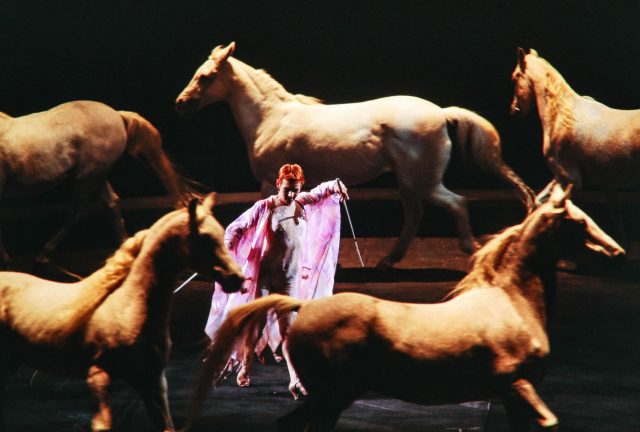
“The most challenging part is not knowing what to expect,” Sylvia explained to Denise Hearst in Arabian Horse World. “To think on your feet and adapt. Because [the horses] can make me look like I don’t know what I’m doing so fast. Sometimes, when I’m not feeling too good and I’m a little bit slow, they know immediately. And it’s challenging to get them all to work without trying to bite or kick each other… It’s not that they’re being aggressive, but it will get aggressive if I don’t stop it. My timing has to be right on…. Once they understand all my body movements, the rest just comes into place.”

- Photo by Kenneth Feld/Feld Entertainment
This excerpt from The Greatest Horse Trainer on Earth: The Sylvia Zerbini Story by Rebecca M. Didier is reprinted with permission from Trafalgar Square Books, an imprint of The Stable Book Group. You can purchase the book here.
