



Thoroughbred Logic, Presented by Kentucky Performance Products: The Critical Art of Hoof Angles
“Instead of beginning one’s search for pain under where a horse palpates sore (their back or SI, for instance), I’d recommend first taking a good long look in the other direction — their feet.”
Welcome to the next installment of Thoroughbred Logic. In this weekly series, Anthropologist and trainer Aubrey Graham, of Kivu Sport Horses, offers insight and training experience when it comes to working with Thoroughbreds (although much will apply to all breeds). This week ride along as Aubrey shares her logic on a horse’s level of comfort and its hoof angles.
Probably one of the best things about my job (a strange mix that is part eventer, part trainer and part rehomer) is that I get to encounter, ride, influence and follow the careers of a whole lot of Thoroughbreds. And because I both retrain from the track and work with consignment Thoroughbreds who are well into their second careers, I have the chance not only to identify patterns, but also to witness them at various points in the off-track cycle.
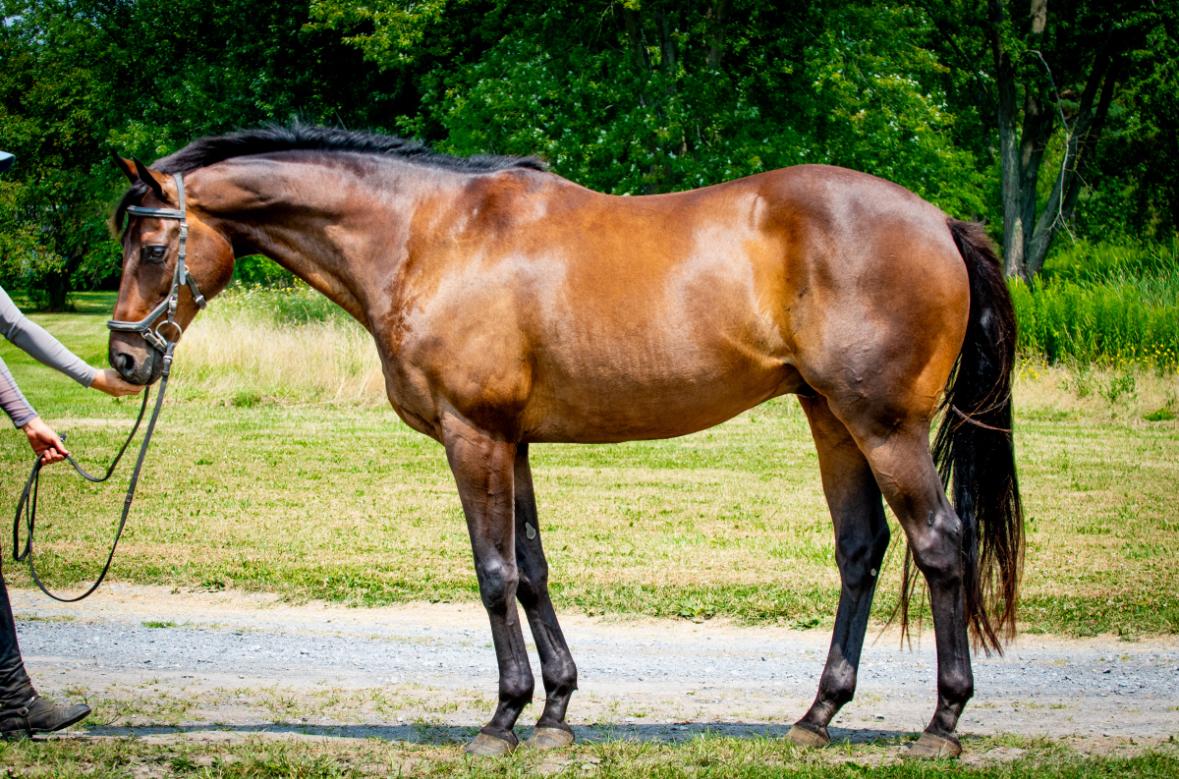
I’m super excited to see how this kid (Mr. Magico) travels with shoes (he’s not sore, just needs kicks to manage the new job). Photo by Lily Drew.
For instance, often horses come in body sore. Sore is common (but it doesn’t need to be) for these big, leggy creatures who were built for speed and not necessarily durability. They’re either tight and sore off the track, or they are feeling a bit uneven behind and react to palpation around their sacroiliac joint and their topline after potentially years of retraining.
While some label Thoroughbreds as “sensitive” and hard to manage, I really have just found them to be exceptionally honest. They’re rarely so stoic that you’ll have no idea they are hurting — they’ll let you know when something isn’t right. The tough part is just figuring out the cause.
Often body soreness might flow from their hind limbs forward along their topline, making them reactive in their lumbar and thoracic spine. And frequently, such post-track horses come with humans concerned about kissing spines or back problems as well as behavioral problems under saddle — bucking, not wanting to go forward, issues over fences, trouble with being able to sit on their hind end or get a certain lead, etc. This is where I usually hit the pause button, avoid jumping to conclusions (and definitely hold off on taking back radiographs).
Instead of beginning one’s search for pain under where a horse palpates sore (their back or SI, for instance), I’d recommend first taking a good long look in the other direction — their feet.
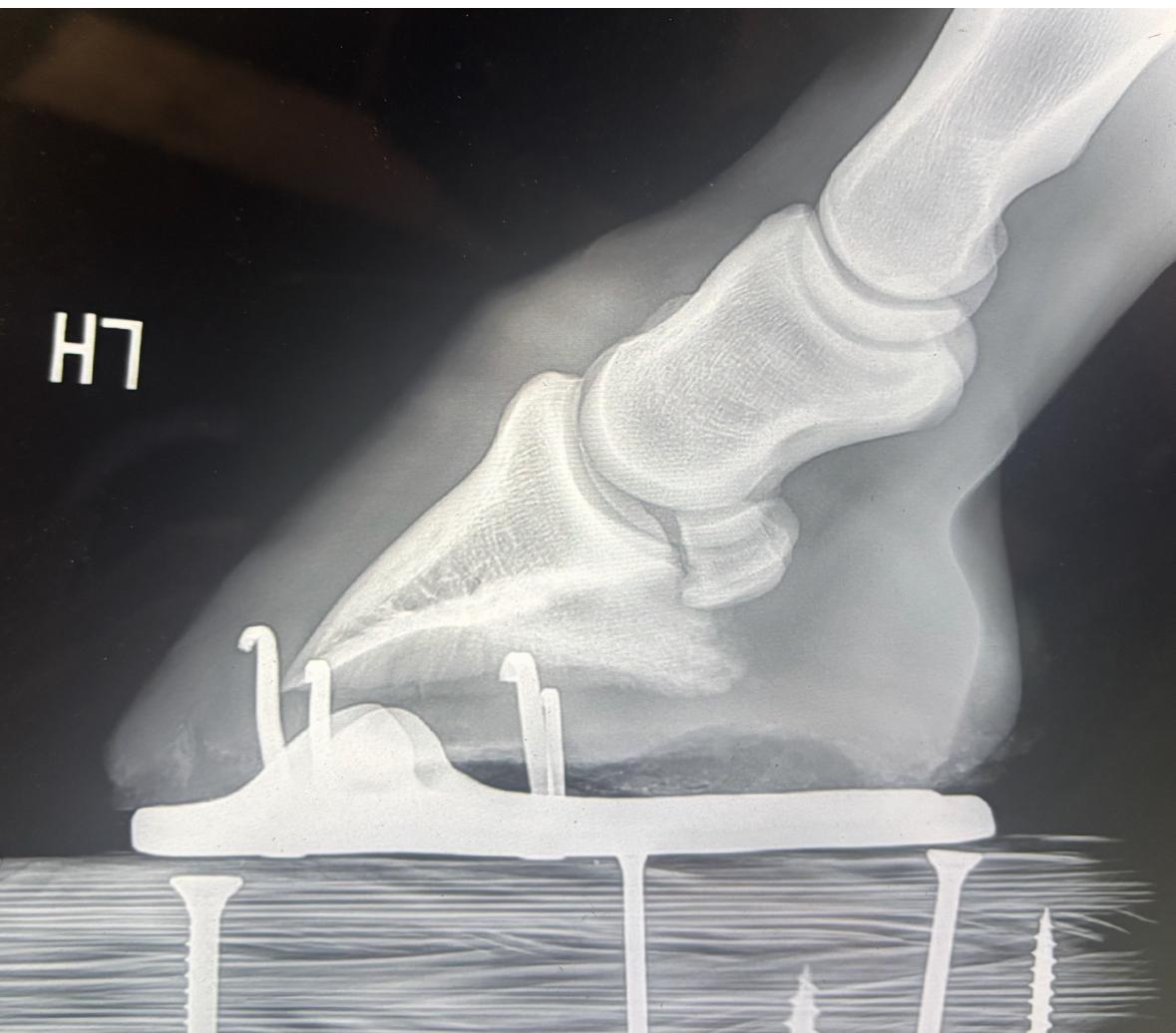
A view of the left hind of one of my recent sales horses. Yes, they reshot the rad to line up the shoe better — please bear with what images I can find this morning… Radiograph by Fingerlakes Equine Practice.
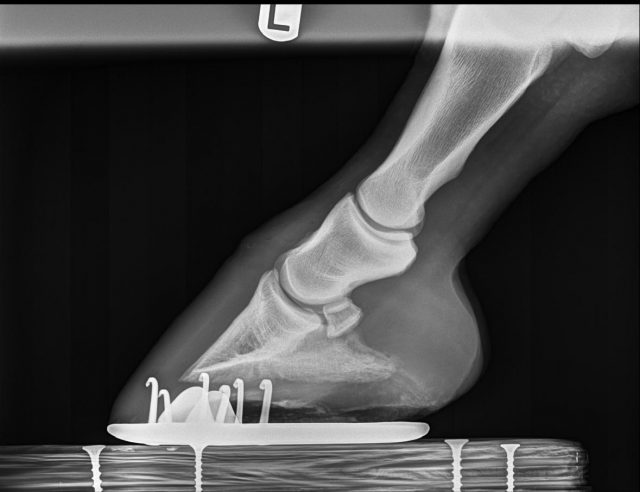
If I were to bet, I’d wager nine out of 10 (if not 95 out of 100) horses that arrive at my farm have negative (or perhaps neutral) angles either in front or hind hooves (and often both). The negative palmer (fronts) or plantar (hinds) angles (NPA) indicate that the coffin bone in the hoof is set with the rear portion lower than the toe portion. It should be either flat (at a zero degree angle), or slightly positive with the heel portion of the coffin bone higher than the toe. From that point up the leg, the horse’s joints align with proper joint spacing. In the rear, the ankle, hocks, stifles and then lower back of the horse relies on the angle of the coffin bone. Up front the would be your ankles, knees, shoulder and neck and so on.
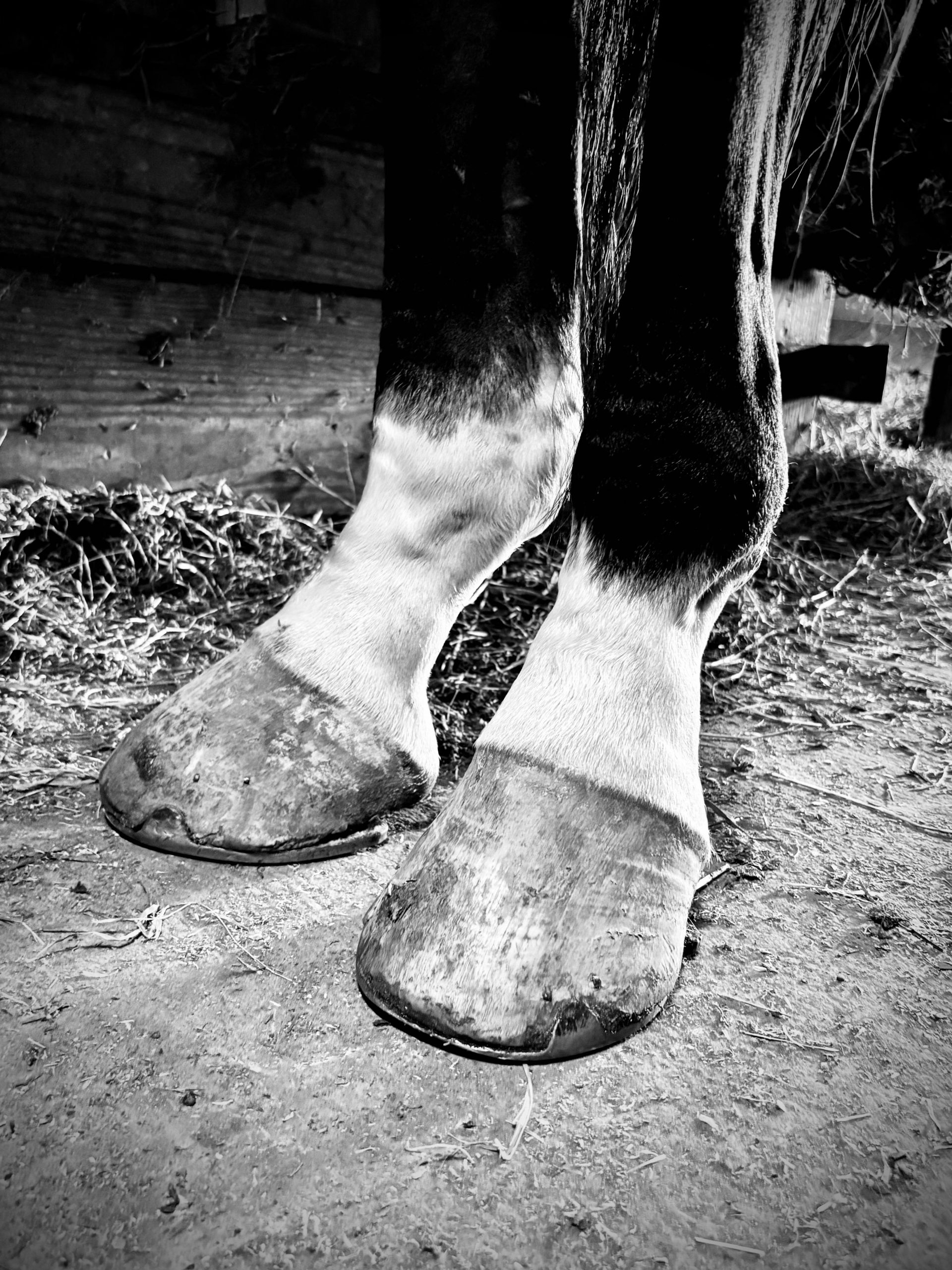
A pair of negative-angled hinds. Photo by author.
In short, often being body sore or sore along the topline/in joints is related to the compensation that is necessary to rebalance the body when the very base of support — the hooves — are out of order. Without correct angles, the whole horse will slowly (or sometimes with surprising efficiency) start to fall apart. Basically imagine walking in reverse heels and what that would do to pain in your knees and lower back — not only that, but also how that would shift one’s ability to stand up straight, balance, use your core and be athletically viable. No thanks.
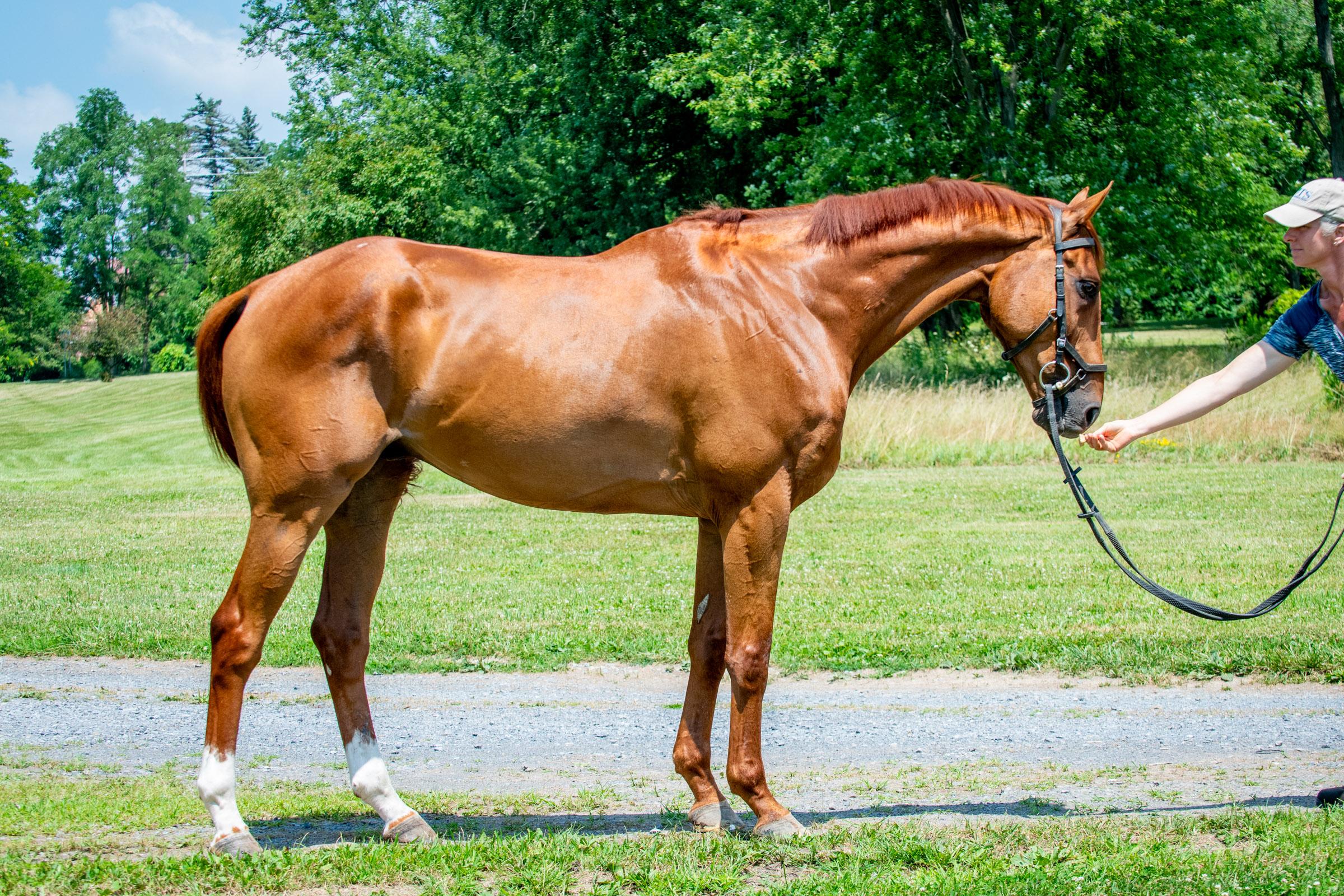
Artie (Reunion Tour) has come a long way in terms of growing good foot (of course still very much a work in progress) and resolving body soreness from the track. Photo by Lily Drew.
So when a horse is NPA we need to rebalance them, correct the mechanical issue from the bottom up, and then allow the soreness to resolve as the joints line back up and the compensation patterns dissipate. This is often easier said than done.
As I was writing this article, someone shared this video with me about how angles affect the lower joints. Even though the video is discussing navicular problems (less common in Thoroughbreds than say Quarter Horses), the principal is the same — if we let the toe run, the alignment becomes an issue and pain results. And. it’s another example of the importance of correct hoof angles.
Thoroughbreds are renowned for their long toes and low heels. In the hind, their hooves quickly take on a bull-nose shape when the angles are off. Fixing this is not a matter of simply wedging the heel, or trimming the toe. Rather, its a process of proper farrier work over time, absolutely bringing the toe back, and growing more (and less under-run) heel (and sure if totally necessary, adding some mechanical support to help them grow in the right direction). To improve some hooves, we have to grow down a nearly full new hoof, while regularly trimming the toe and supporting what they already have to work with. But the good news is that in even most of the worst cases, with good diagnostics and a great farrier, serious improvement is possible.
A note on diagnostics: Get the rads. If a rider has any questions about a horse’s feet, the best thing to do is to get “farrier view” radiographs from the front and from the side. The two views can tell your farrier how much they can trim, how they need to support the foot, and just what the angle is. Without radiographs, they’re stuck doing a whole lot of very educated guessing — so get the images to help them help your horse.
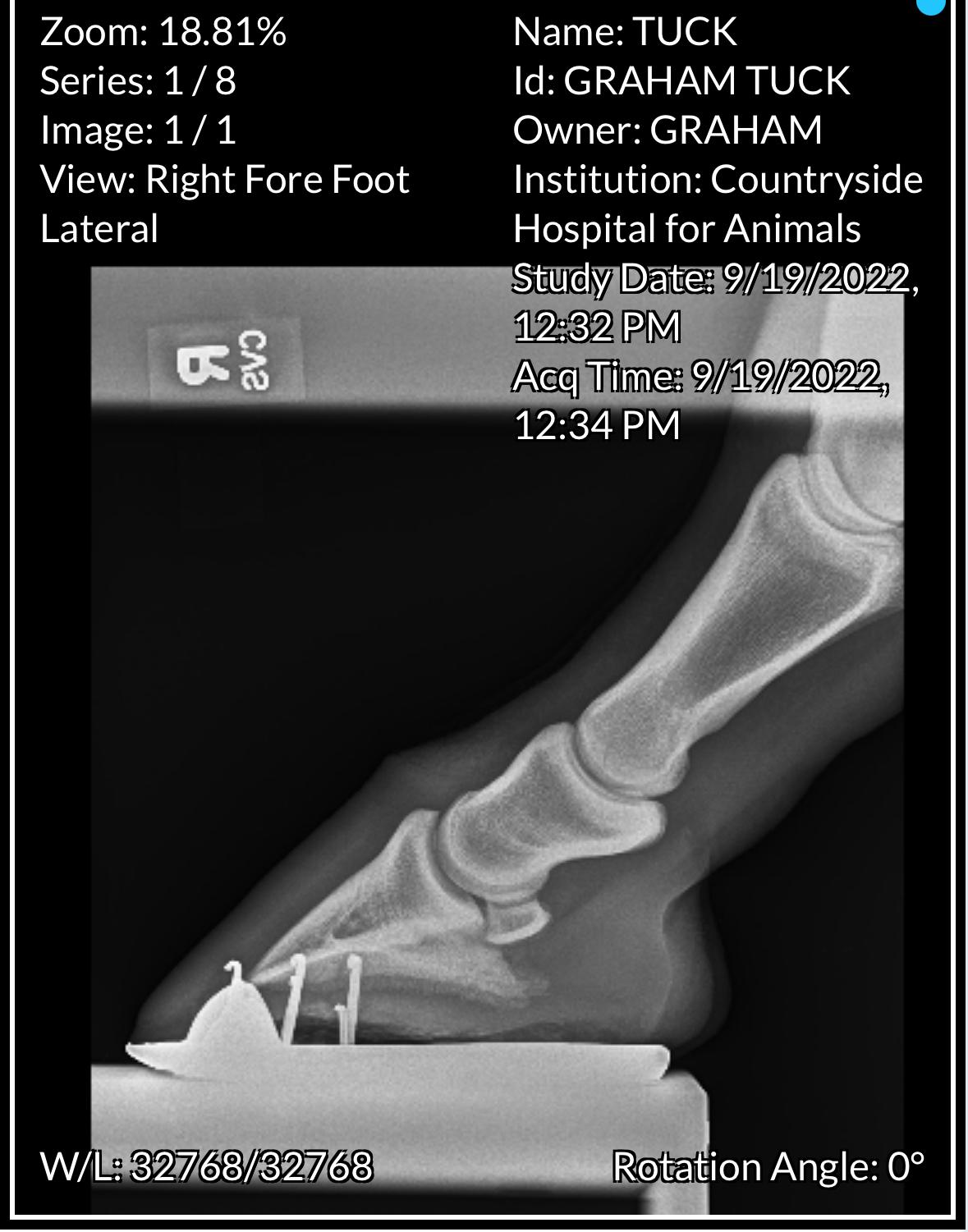
A view of Tuck (Louisiana Bling)’s still negative front (back in 2022). This told us we had more work to do but also that we could bring the toe back more. His hinds were way worse, but I can’t find the rads… Radiograph by Countryside Veterinary Services.
Tuck (Louisiana Bling) is still probably my favorite example of improving horrific hoof angles. A few years back, I dipped out of a wedding weekend to go to the backside of the track (because don’t we all do that?) and ended up purchasing a stunning gray that I knew was going to be the bane of my existence for a while. Huge shoulder, great hip, but probably the worst angles I had seen on a racehorse… ever. He hauled from Texas to Georgia, walked off the rig and immediately started a six month rehab program for his feet. His back was so sore that he wasn’t really ridable. And in the field, his trot was super choppy — he preferred to do a tiny canter instead.
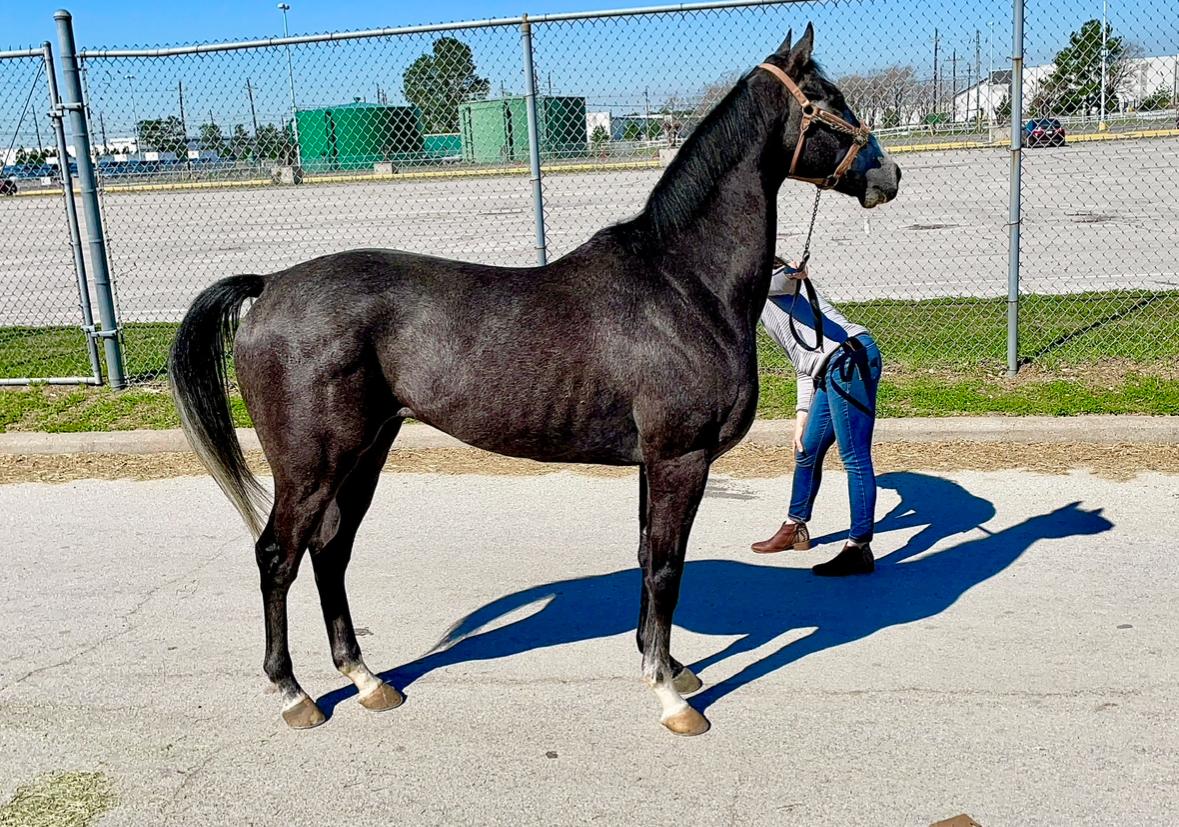
Taking a good hard look at Louisiana Bling’s hind angles at the backside of Sam Houston Track in Texas. Photo by Shane Drake.
So we took radiographs, had a gander at the exceptionally negative angles and started to “bring him up” (farrier jargon for shortening his toe and lifting/growing down his heel). He went in supportive pads behind while we pulled the toe back. Slowly at each five week cycle, we brought him up incrementally. And slowly, slowly his pain and soreness over his hind end and back dissipated and then disappeared.
Tuck is now cruising around Novice with his kid out in the mid-west. And his feet continue to hold the rest of his body in alignment.
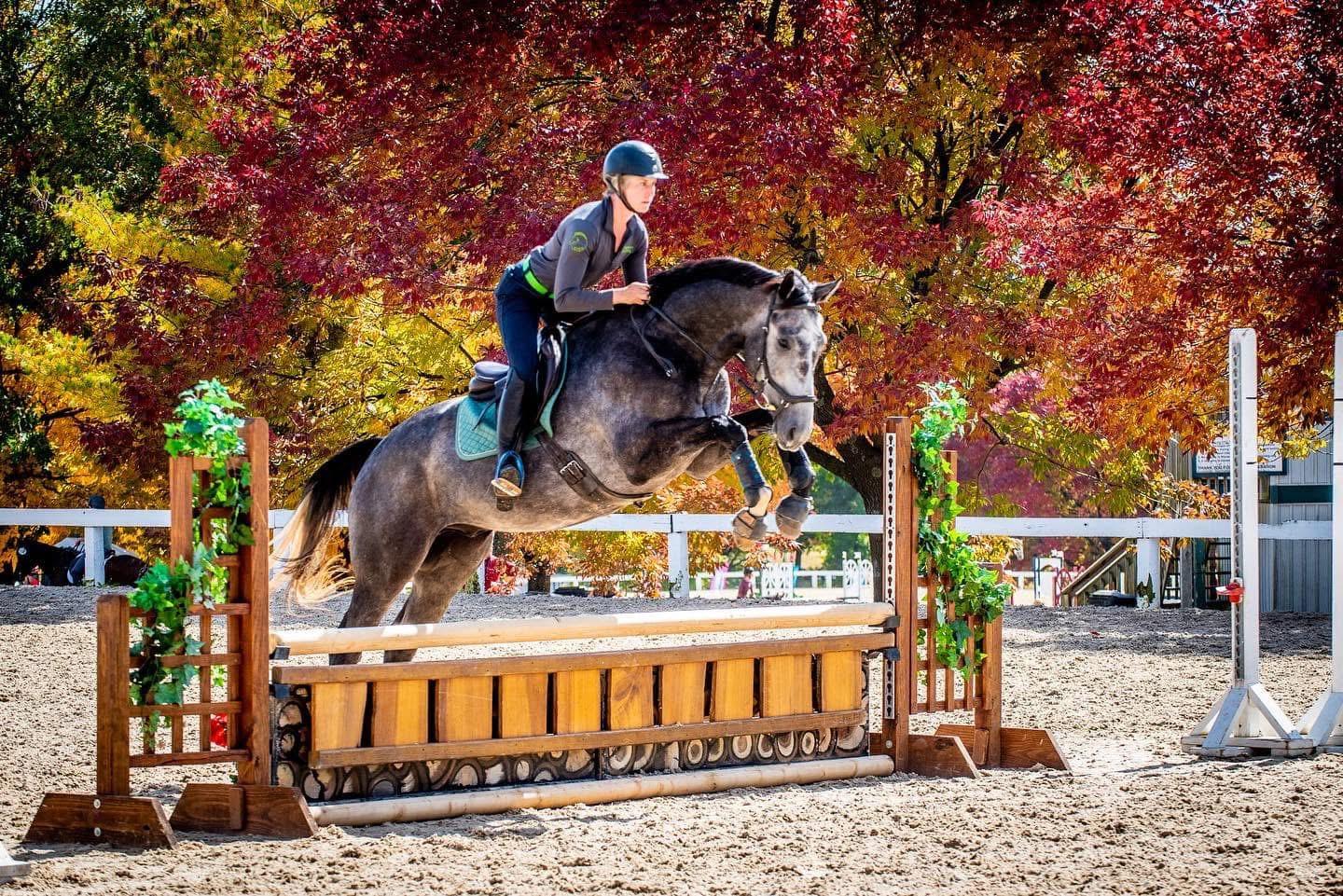
Tuck jumping around at the Thoroughbred Makeover in 2022 before his transition to his current owner (Savannah Byer) in Kansas. Photo by Lauren Kingerly.
Moral of the story: If a horse is body sore over its topline or simply wonky behind or up front, it is essential to look at the feet. With the help of a knowledgable, Thoroughbred-friendly farrier, diagnostics from your vet, and a bunch of patience, there is so much that can be fixed from the bottom up. Sure, improving the feet might not be a silver bullet to cure all body aches and pains, but it is a — if not the — critical place to start.
*Just a caveat: I have been lucky to have had (and have currently) wonderful farriers who know that we can improve even the worst NPA and pull back even the longest toes and under-run heels. (THANK YOU, Grace, Eric and Patrick). If your farrier believes that all Thoroughbreds have terrible feet and will always be low heeled and long-toed and simply shoes them like that, I’d recommend taking a look at which other farriers in the region might have different perspectives.
So go ride folks, and if there’s pain or soreness, have a look at your horses’ base of support and see what can be improved from the hoof on up.
About Kentucky Performance Products, LLC:
Omega-3 fatty acids have been proven to reduce skin inflammation and mitigate allergic response. Contribute delivers both plant and marine sources of beneficial omega-3 fatty acids. Feed one to two ounces per day, depending on severity of the allergy.
Need tips on how to manage allergies? Check out this KPP infographic: Got Allergies?
The horse that matters to you matters to us®. KPPusa.com

