



Thoroughbred Logic, Presented by Kentucky Performance Products: Abscess Season
Abscess season. It’s he worst. And sometimes it’s ongoing. Read this week’s logic on tacking the nasty buggers.
Welcome to the next installment of Thoroughbred Logic. In this weekly series, Anthropologist and trainer Aubrey Graham, of Kivu Sport Horses, offers insight and training experience when it comes to working with Thoroughbreds (although much will apply to all breeds). This week ride along as Aubrey shares her logic on fighting abscesses.
Turns out there is one season I like in central New York, and it is coming — fall. No, this has nothing to do with pumpkin spice anything. But rather, fall is the one season that doesn’t come with its own circle of hell. For the rest of them, there are the concentric rings of inferno called deep clay mud, green flies, and winter writ very large. Abscess season is one of these “fun” time markers that folks somehow don’t put on a calendar, but they should.
Technically, abscess season corresponds with Mud Season or what regular people call Spring. That said, we actually have had as many abscesses pop up here in the last few weeks as we have had around the time the mud was sucking everyone’s shoes off and keeping everything damp enough for bacteria to seep into the tiny crevices in the hoof.

Barbados (Sue Loves Barbados) is one of my favorite abscess victims. He’s a solid sensitive sally, but we love him all the same. Photo from his first mini horse trial by Lily Drew.
We’re currently mostly dry but the abscesses keep cropping up as it still gets wet at night, then dry during the day, then damp again. All this expanding and contracting of the hoof allows all sorts of fun bacteria to creep inside. And that hard dry ground during the day certainly doesn’t help with abscesses sneaking up from bruising, where blood pools near damaged tissue in the foot and creates environments friendly to outside bacteria.

Zeke (Analyzethisandthat) currently is working through another hind abscess, and we’re working to get his shoeing right so that he can avoid these as best as possible. Photo by Lily Drew.
As pretty much everyone reading this likely already knows, your average abscess is just bacteria that has snuck into the hoof capsule and created a pus-filled pocket of pressure. The pressure sends the average horse into a dead lame or three legged mode where owners squint and hope that it is effectively a hoof pimple not a broken leg. Once they burst through the surface, the pressure is released and usually a horse can go back to normal life and movement a few days later. But these things can be super pains in the asses in the meantime.
I got my first taste of the hopeful roulette (abscess or broken leg) during the first month of owning Forrest (Don’t Noc It) — my OG Thoroughbred. Not long off the track, we both were in Georgia and he was turned out in a field with a handful of other geldings. Usually, my normal mornings consisted of walking out to the gate and having him gallop up like a fool, but a very mobile fool.

Forrest (Don’t Noc It) on the right, many years later being a good kid babysitting Koops. Photo by Alanah Giltmier.
The temps during the Georgia fall can vary wildly and this night it dropped into the 20s. I headed to the gate first thing in the AM only to find him shivering along the fence line looking particularly pathetic. Walking in was more like dragging a sulking, three-legged cow than the fit TB I had walked out the day before. I found no heat or swelling, didn’t know to check for digital pulses, and called the vet. I was pretty certain catastrophe had hit.
Nope. Just a hoof pimple.
A few days of soaking in almost hot water and epsom salt, a few hoof packs with Magna Paste, and some time and he was good as new. And by that, I mean as much of an idiot as normal, bombing around like a long-legged teen, hell-bent on bothering every horse in the field. Fantastic.

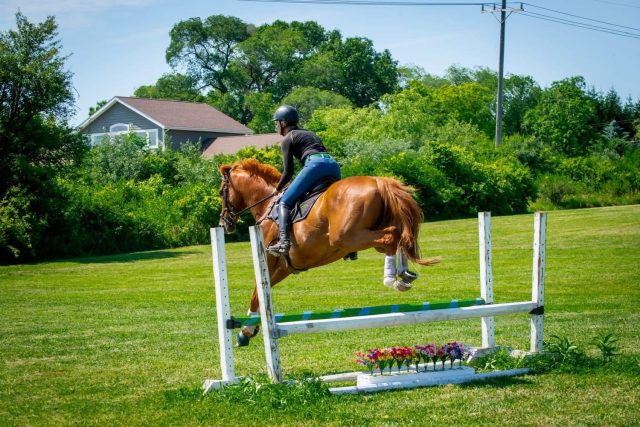
Neil (Lute’s Angel) has thin soles and jumps around Novice like this, making him more prone to bruising. We do the best we can with pads and proper break-over on his shoes to help him stay as abscess free as possible. Photo by Lily Drew.
Thoroughbreds and their delicate, not-always-bred-to-be-hearty feet are particularly prone to this fun process. While some Thoroughbreds do have good feet, many spend a lifetime dealing with thin or shelly walls, and equally thin, easy-to-bruise soles. Unsurprisingly, these features poise former runners to be particularly at risk.
Since Forrest, the number of hooves I have had to manage has expanded exponentially. And with it, abscess care — along with the soaking boot, the epsom salts, size two diapers, duct tape, and Magna Paste — has become common place. However, the anxiety that comes with the gamble of “here’s hoping this is just an abscess” hasn’t lessened much.

Explorer wears composites on the front simply because they have always kept him comfortable. Thus far (knock on wood) he’s been abscess free during this wild second abscess season. Photo by Lily Drew.
Hell, when Tamale (Looking Hot) showed up after a long haul from Georgia to NY, her former owner noted that she had been a little off. They had rested her and seen improvement, so felt comfortable putting her on the trailer. She walked off here pretty sound and turned out with my other mare that night. Her trot around the field was lovely. By morning, though, Tamale was three-legged.
And even though I do this day-in and day-out 365 days of the year, I was still worried. A mild lameness before shipping and a major lameness upon turnout could be a lot of things. I was hopeful it was an abscess… but hope only gets us so far. So, I made the hope active and began soaking. About four days later a soft spot appeared on her coronet band, a few days after that it burst, and the pretty mare resumed soundness. PHEW.

Tamale (Looking Hot) rocking around the GVH horse trials with her human Olivia Gmerek.
Besides anti anxiety meds for the humans, there is a lot that goes into minimizing abscesses. For Thoroughbreds, quality turnout with minimal mud, rocks, and the like goes a long way. But good turnout with dry soil doesn’t necessarily guarantee they won’t abscess either. Horses are going to horse regardless, folks. And like here, where my paddock terrain is rarely perfect, I still turn out religiously. Stalling them for the sake of their feet almost never does these horses any favors in the long run.
So paddock composition aside, one of the best things a rider can do is keep their feet healthy and happy and in shoes that support the needed bits (and keep them from bruising). Pads might be necessary, especially during the dry, hard times of year. But ultimately, just keeping shoes on (if they’re not already comfortable barefoot) is essential and the first step to winning the abscess battle before it starts.

Datesfreedom sports some fun thin soles and in this image a pretty long toe, which we’re managing with different farrier work and Impact pads. These should help keep bruise-related abscesses to a minimum and help him get back to work. Radiograph by Early Winter Equine.
I’ll tack shoes back on a horse, because with far too many Thoroughbreds in the barn, that’s sometimes the only way for them to stay sound and in work. But if someone isn’t willing to put a shoe back on, having good hoof boots on hand and a prompt-responding farrier can make the difference between a couple day or a couple week set back.
And hell, sometimes abscesses just stick around regardless of all of the best intentions and actions. They may need further soaking agents to help clear up, antibiotics, or a set of X-rays from the vet to see where the gas track has started to head in the foot. So if they seem to be hanging on longer than expected, this is always a good time to get a vet out and seek advice, even if it is just a suspected lowly abscess.

Tobi (Fernando) needed a few rounds go glue ons to help his thin soled, flat feet recover from a long term abscess. Photo by Lily Drew.
So now I’m off to 1) hoof test one horse’s hinds and see how his abscess is healing up and 2) make sure that the new horse who arrived barefoot with pancake flat feet is healing up well from the abscess that burst out of his heel bulb. If you need me, you’ll find me next to the soaking boot.
Go ride folks, and enjoy the weather as it cools down before we hit the one time of year that their feet love here (late fall into winter) and the weather that I don’t (everything that comes December – April around here).
About Kentucky Performance Products, LLC:
Girthiness. Sour attitude. Colic. Poor body condition. Little appetite. Does that sound like your horse? If your horse is consuming a high-grain diet, regularly under stress (i.e., competition horses, horses that travel, young horses in training) or prone to digestive issues, Neigh-Lox ADVANCED should be a staple in your feed room.
This supplement provides a scientifically advanced blend of ingredients that work synergistically to maintain a healthy stomach, small intestine, and hindgut. Horses with a robust GI tract don’t just feel better, they absorb optimal levels of nutrients and maintain body condition more easily. They aren’t just less prone to digestive problems—they have a stronger immune system overall. Don’t underestimate the role your horse’s gut plays in their overall well-being. Click here to learn more about Neigh-Lox ADVANCED.
Kentucky Performance Products creates scientifically proven supplements for your horse. Our supplements provide solutions to the everyday challenges facing your horse. The horse that matters to you matters to us®. Learn more about KPP at kppusa.com.

