



Thoroughbred Logic, Presented by Kentucky Performance Products: Keep It Simple (Stupid)
“[T]his is about not overcomplicating what doesn’t need to be overcomplicated.”
Welcome to the next installment of Thoroughbred Logic. In this weekly series, Anthropologist and trainer Aubrey Graham, of Kivu Sport Horses, offers insight and training experience when it comes to working with Thoroughbreds (although much will apply to all breeds). This week ride along as Aubrey shares her logic on not overthinking or overcomplicating things.
I have had a chance to put on a lot of first rides recently, and frankly that has been the highlight of this hellscape of a winter. And in each ride, the objective is always the same thing — get on, get in front of the leg, and get balanced. The rest is just icing on the cake.
It is really somewhat surprisingly simple. And the result is a horse that moves forward from the leg, starts to seek gentle contact, builds strength through their balance and starts to line up the parts of their body to be straight.
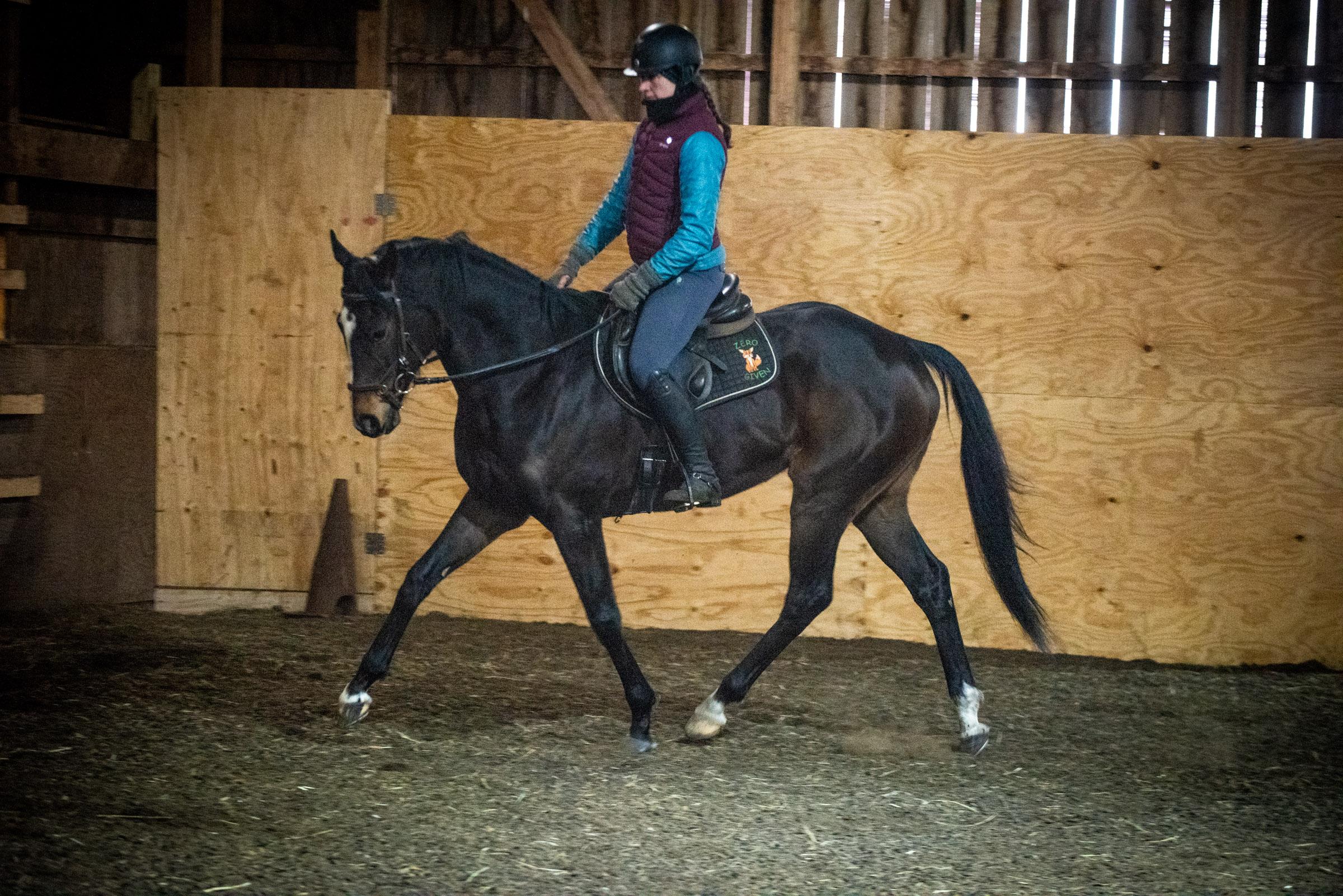
Shorty (Corrected Pedigree) being a good kid about “forward” during his first post track ride. Photo by Lily Drew.
There are no gimmicks. No extra aids to create shape. Just a pretty simple combination of good fitting tack, a soft bit, and the desire for a horse to be forward. I could jazz it up with extras — martingales and training aids, systems and attachments — but why when simple works so well?
A while back, my partner — who is categorically not a horse person — and I were discussing trying to find more mirrors for the arena (no, I’m not in the financial space to just get a bunch installed correctly, so the existing “found” mirrors it is for now). His response was to say, “Well, mirrors are expensive and hard to find, let’s just get you a ton of screens (they’re cheap) and a projector that real time follows you from the center and you can live stream the ride to the screens.”
“What? No.”
Mirrors are pretty simple and have one job. No need to convolute everything with wires, screens, and technology that, with my luck, might work once and then fritz. I suppose things glitching on and off might be a good way to desensitize some of these kids, but ultimately and absolutely no. End result — we’re still on the casual hunt for more (cheap/found) mirrors.
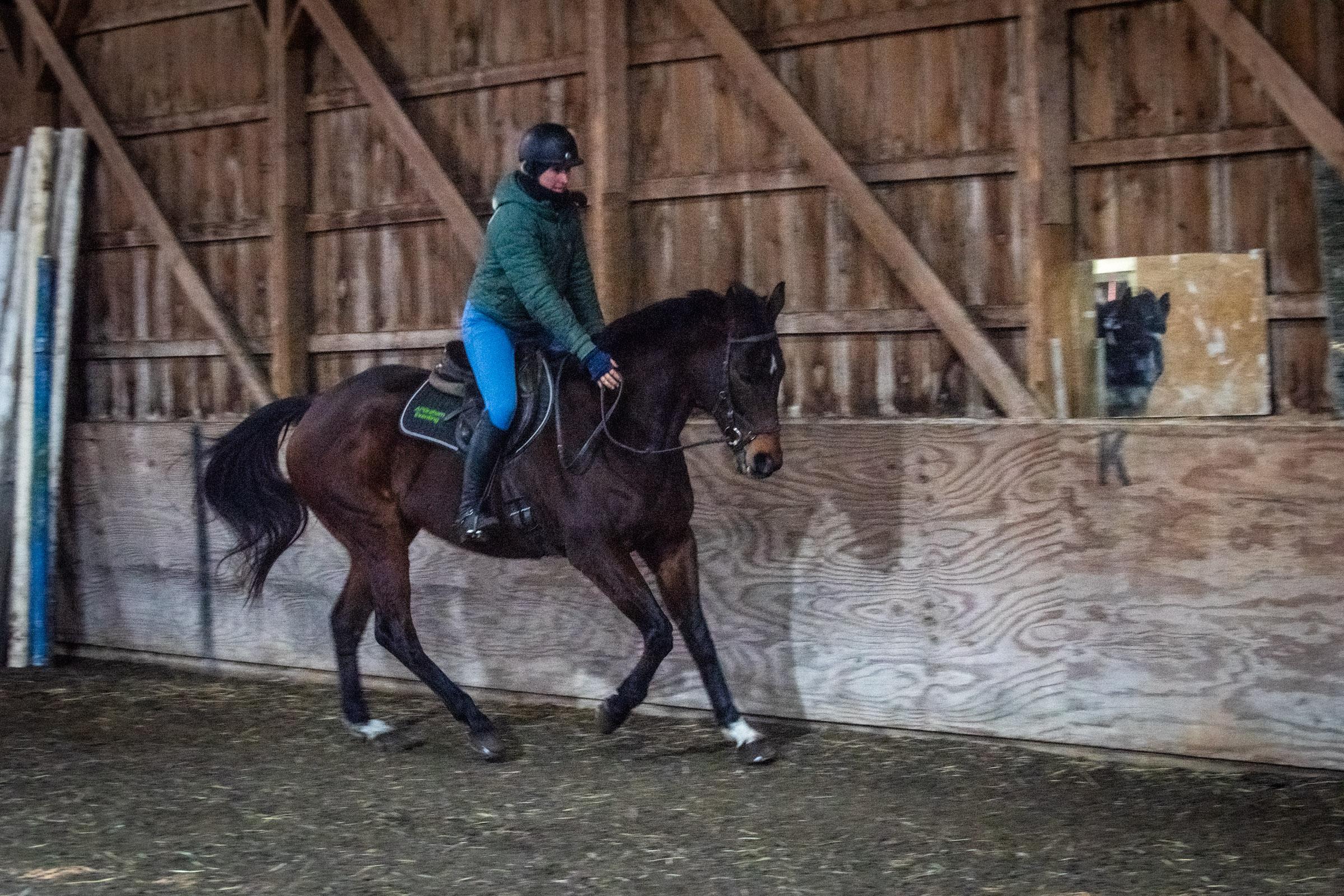
Bruce (Scotty Silver) heading towards the few ad hoc mirrors. Photo by Izzy Gritsavage.
This isn’t an article about mirrors — I mean, yes, they’re helpful. I can feel when a horse tucks just below vertical, or I’m getting chair seat-y, but it’s helpful to be able to give a quick sideways glance and confirm. Rather, this is about not overcomplicating what doesn’t need to be overcomplicated.
Go forward (generally speaking: leg). Help them find their balance (generally speaking: outside rein).
Without those two things, everything else is hard. Transitions are hard. Turning is hard. Slowing down is hard. Keeping them from doing comically dumb things — bucking, playing, popping up, etc. — is hard. And getting round is hard (because truly pushing from behind without being in front of the leg is hard if not utterly impossible).
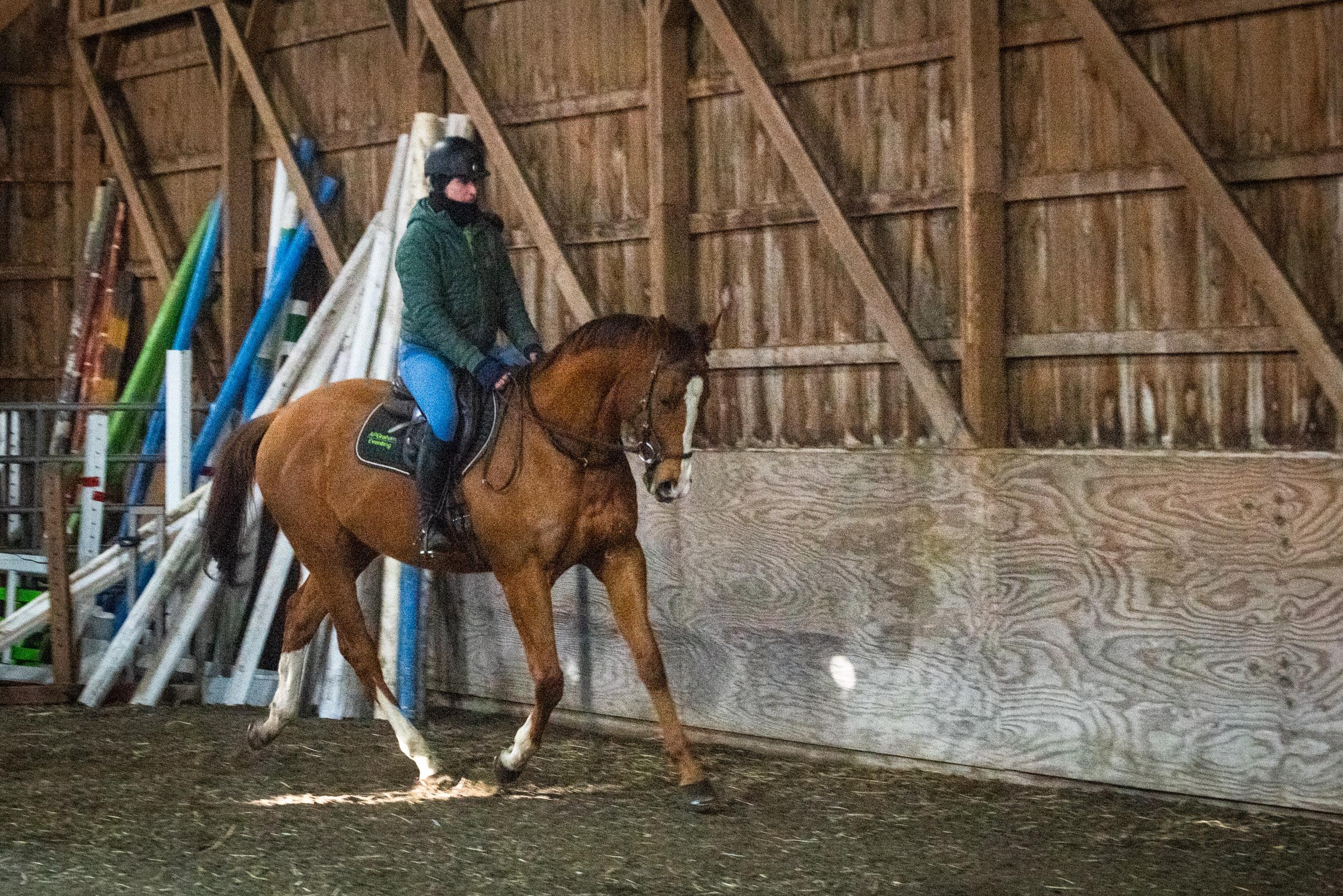
Fig (Ekati’s Verve) finding a steady rhythm and forward with balance. Photo by Izzy Gritsavage.
And I tend to feel that so often, we add a lot into the mix before either of those things (forward/balanced) are accomplished. Leg to a soft but steady outside rein. More support/squeeze/kick to get them forward — not running, but actually in front of the leg and pushing from their hind end. And yes, this can be accomplished in the first couple rides post track. And doing so sets riders up to then build on a foundation that is simple and (super importantly) safe. No figurative wires, gadgets, or tech needed.
I could use any horse as an example, but since I hopped on Tide (JC Moonset) yesterday, might as well dive in there.
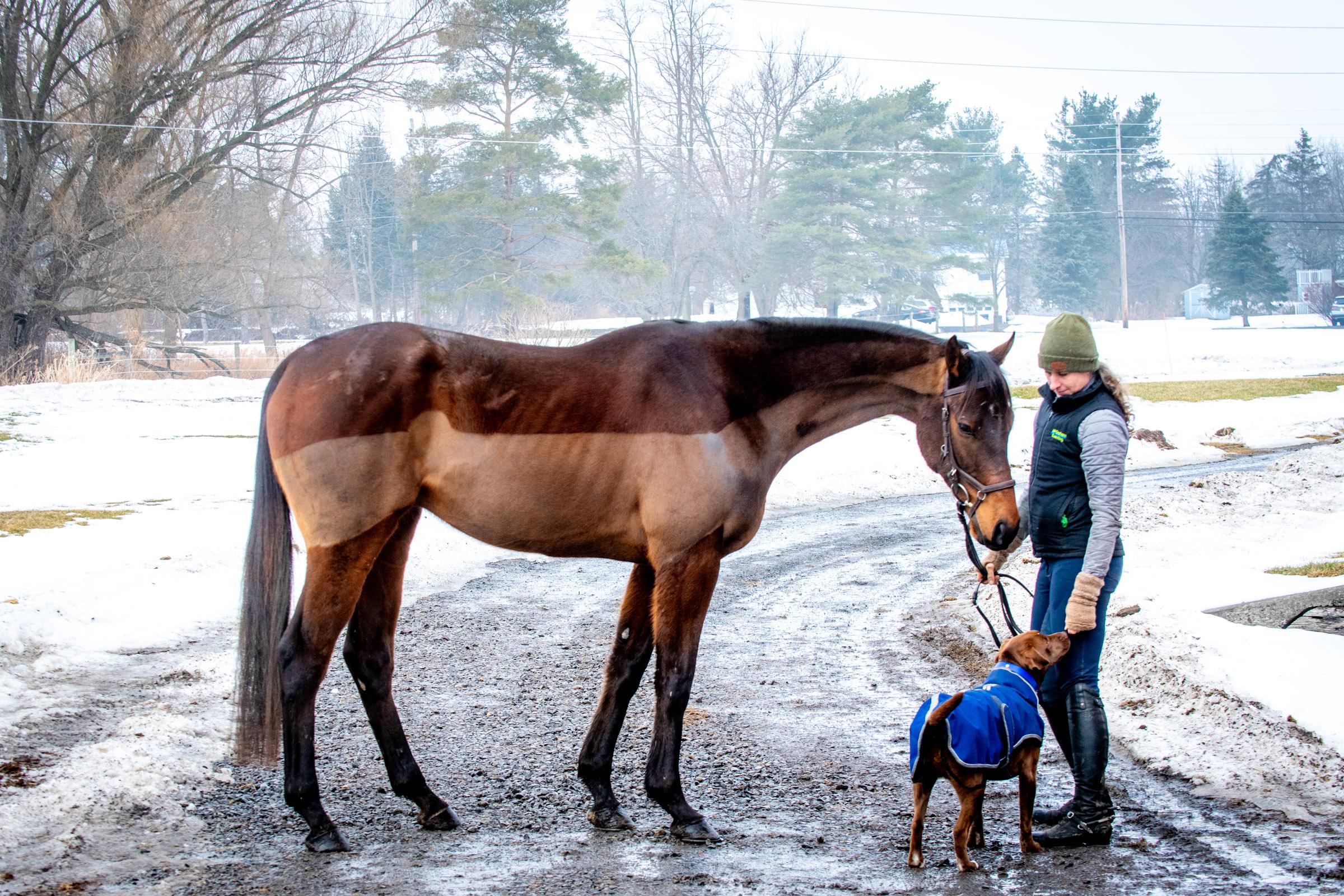
Tide (Moonset) with Little the dog helping out for the conformation photos. We’ll get him filled out in no time. Photo by Lily Drew.
Tide is a new addition to the barn — he showed up over the weekend after a pleasant hiatus at a friend’s farm while I made some room for him. This kiddo has a bit of an interesting history. He has trained over fences and was sold to me as a steeplechaser, though most of his record has him running on mostly fast dirt tracks for six furlongs to the mile. We have video of him schooling timber race style, so all good. He came off the track about a year ago and has since hung out, done some trail work and light riding, and been for sale for a few months before I picked him up.
So I mounted up, and he was largely a really, really good kid. But first things first — I had to get him out in front of my leg. Put leg on, he tossed his head around and did fast feet but not really forward motion. Put leg on, he shoved his haunches sideways. Put leg on, he sucked back and plowed sideways with his shoulder.
OK, that’s fine.
And because it is important to show the process (even if it worries me with all the Karens out there), here are a few snippets as examples of those evasions with continued, “Nope, go forward” pressure. Oh, and the laughing in the clip, that’s Lily. She has videoed enough of these to know that this isn’t dangerous, this isn’t bad, it is honestly just creative. You’re a good nut, Tide. Now go forward.
This was a pretty reasonably fast horse. Sure. But he has had ample downtime to lose his topline, demuscle and demotivate. We had to find the steady, quiet forward and let him remember that this is where work feels good. It took a few minutes and a whole bunch of laughing as he ticked through new minor antics to keep me from being able to get him going in a steady, straight rhythm, but he got it. And when he did, we got an “OOOOHHHHH, OK” moment and his whole body relaxed.
At that point (about 10 minutes into the ride), I had a horse with a go button who was willing to rely on my outside rein to hold himself together and stay straight. Ears up, alert and eager without being ridiculous. I’ll take it. And I’m excited to see how he goes by ride three, because this one is just going to get better and better as he gets stronger and more trusting now that he understands the assignment. And I can’t wait to see what he does over fences.
So in keeping with the theme, I’ll not overcomplicate things and will sign off here. Literally, get on, find a way to go forward safely and find balance. From there, everything is possible (and equally, without that, everything just stays so annoyingly difficult).
So go ride folks, and definitely kick on if needed.
About Kentucky Performance Products, LLC:
Do you know the signs of seasonal vitamin E deficiency? Researchers have confirmed that horses may need additional vitamin E when not consuming fresh, high-quality pasture grasses, such as over the winter months (Blakley et al., 1994). Vitamin E is crucial to maintain healthy muscle and nerve function, and immune response.
If your horse is stiff during warm-up, sore after work, lacking energy, and/or struggling to develop topline muscling, he could have a vitamin E deficiency. Elevate® is a highly bioavailable source of natural vitamin E that is preferentially absorbed and retained in a horse’s tissues compared to synthetic versions. Ask your veterinarian about supplementing with natural vitamin E.
Kentucky Performance Products creates scientifically proven supplements for your horse. Our supplements provide solutions to the everyday challenges facing your horse. The horse that matters to you matters to us®. Learn more about KPP at kppusa.com.

)