



Thoroughbred Logic, Presented by Kentucky Performance Products: Five Things To Bring From the Backside to the Barn
“Just a heads up, this isn’t a boarding barn.”
Welcome to the next installment of Thoroughbred Logic. In this weekly series, Anthropologist and trainer Aubrey Graham, of Kivu Sport Horses, offers insight and training experience when it comes to working with Thoroughbreds (although much will apply to all breeds). This week ride along as Aubrey shares her logic on what aspects of the track translate well to her barn.
“Just a heads up, this isn’t a boarding barn.” That’s the usual warning I give folks when they come to my place for the first time. On one hand it excuses the look of my tack room (effective but always a bit of a mess), and on the other hand, it hopefully shifts the perspective about the happy chaos they are about to enter from “What the hell?” to “Oh, that’s kinda neat.”
Well that, and there are rarely additional people coming through to ride or manage their horses. I run Kivu Sporthorses as a training center, which offers consignment board and training board akin to boarding school — kiss them on the cheek and drop them off then schedule visits later. Anyone who wants to board/be present with their horse daily is encouraged to board at the nearby Ithaca Equestrian Center (which caters to the human side of the riding equation) or other local barns. The set up allows me to operate an efficient barn full of happy Thoroughbreds and still teach lessons to folks who want to enjoy barn time and a non-chaotic break from the rest of everyday life. I wish I had figured out this set up when I lived in Georgia.
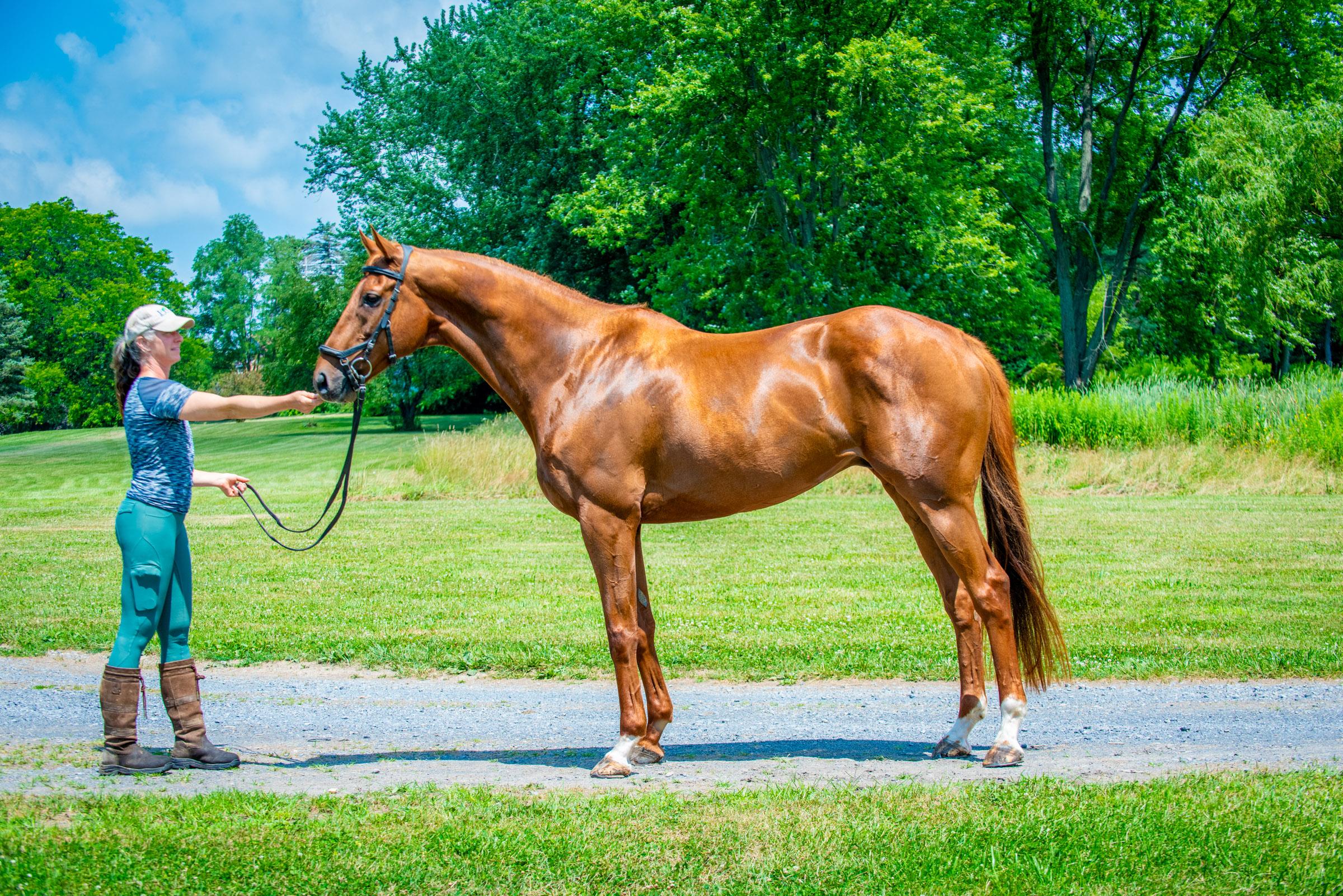
“Clifford” (Ice Rain) participating in the usual consignment activities here. Photo by Lily Drew.
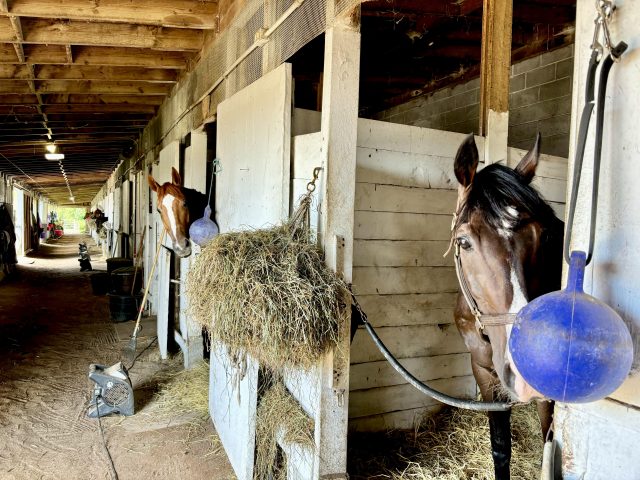
At my farm when you walk in, stall doors are wide open with a single stall guard holding horses in place. Hay hangs in slow feed bags in or next to the aisle. And most horses have their heads out, curiously waiting to greet the humans, dogs, cats and stuff that might be passing through. During the day, horses tie quietly on the narrow aisle crossties, and the Thoroughbreds in the stalls next to them tug on the crossties and snuffle their flanks (some tolerate this, some don’t… in which case, they get temporarily shut back in their stalls during grooming and tacking). Absolutely nothing is fancy, but each horse gets extra attention as the folks who are there walk down the aisles to grab tack, fly gear, halters, etc.
The narrow aisle of friendly horses and the hay jutting into the walkway (and thus on the ground below) is all part of highly calculated chaos. The set up comes in part from the design of the farm — built in upstate New York to be compact and viable in the cold– and some comes from what I have learned since the last time I set up a farm (in 2019). And a lot of that learning comes from spending time on the backsides of the track.
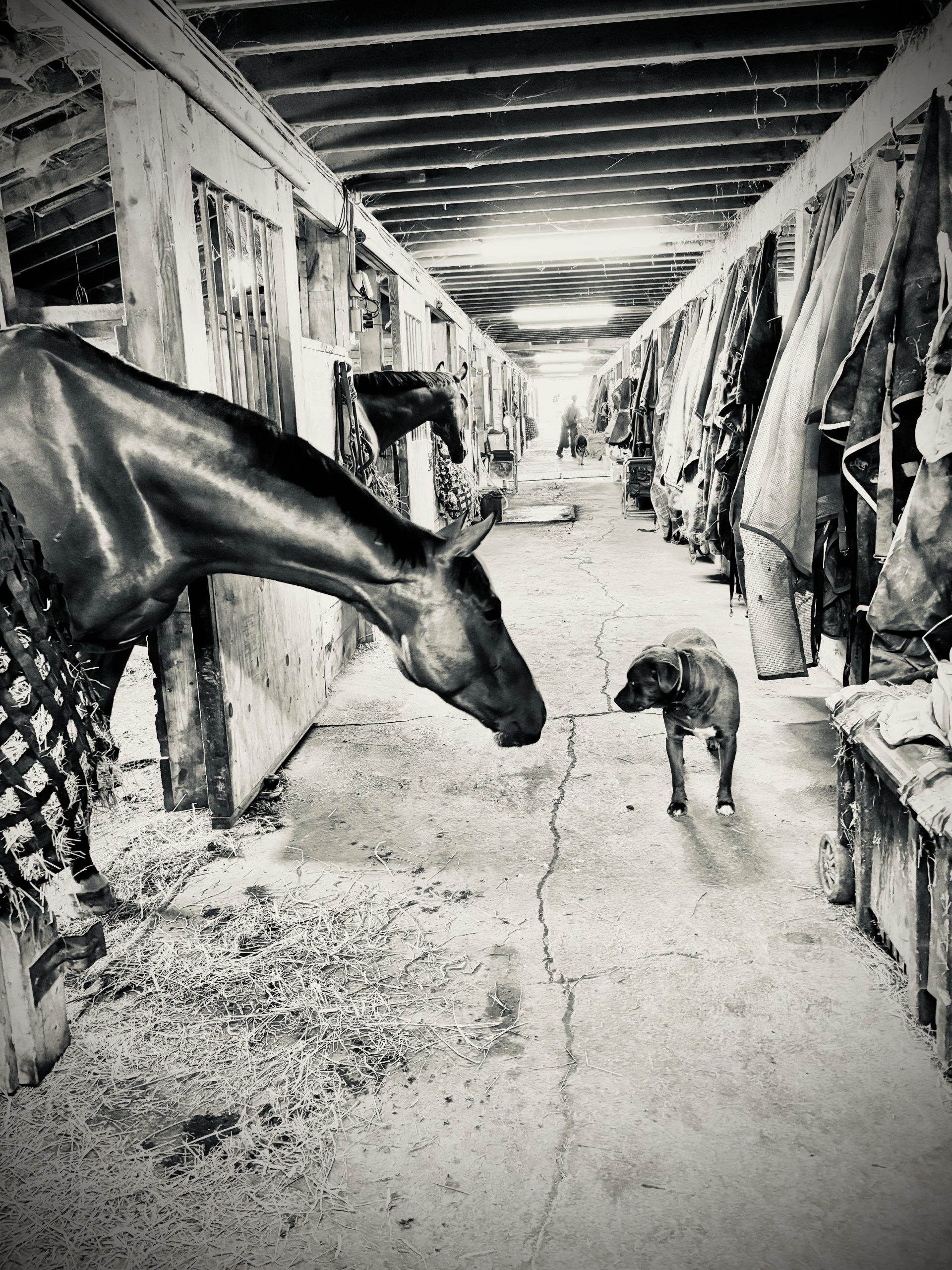
A good overview of the aisle set up at Kivu Sporthorses. Photo by author.
The backside has, in part, shaped the following five things:
1. Open stalls: When you go back to the shedrow barns where horses are housed between races, nearly all of the doors are open… or rather, those stalls don’t come with doors. The completely contained, sliding door stalls frequent in most boarding barns are nowhere in sight. Instead, most horses have a stall guard or two hanging across their open doorway, sometimes twisted together for stability. Some might have hinged metal gates that allow the horses to hang their heads and necks out but don’t encourage barging through. Either way, on most backsides where the horses are quiet and happy, they spend their days milling about between workouts and walks, grooming and feeding with easy ability to see their neighbors and interact with the world that comes through the aisle.
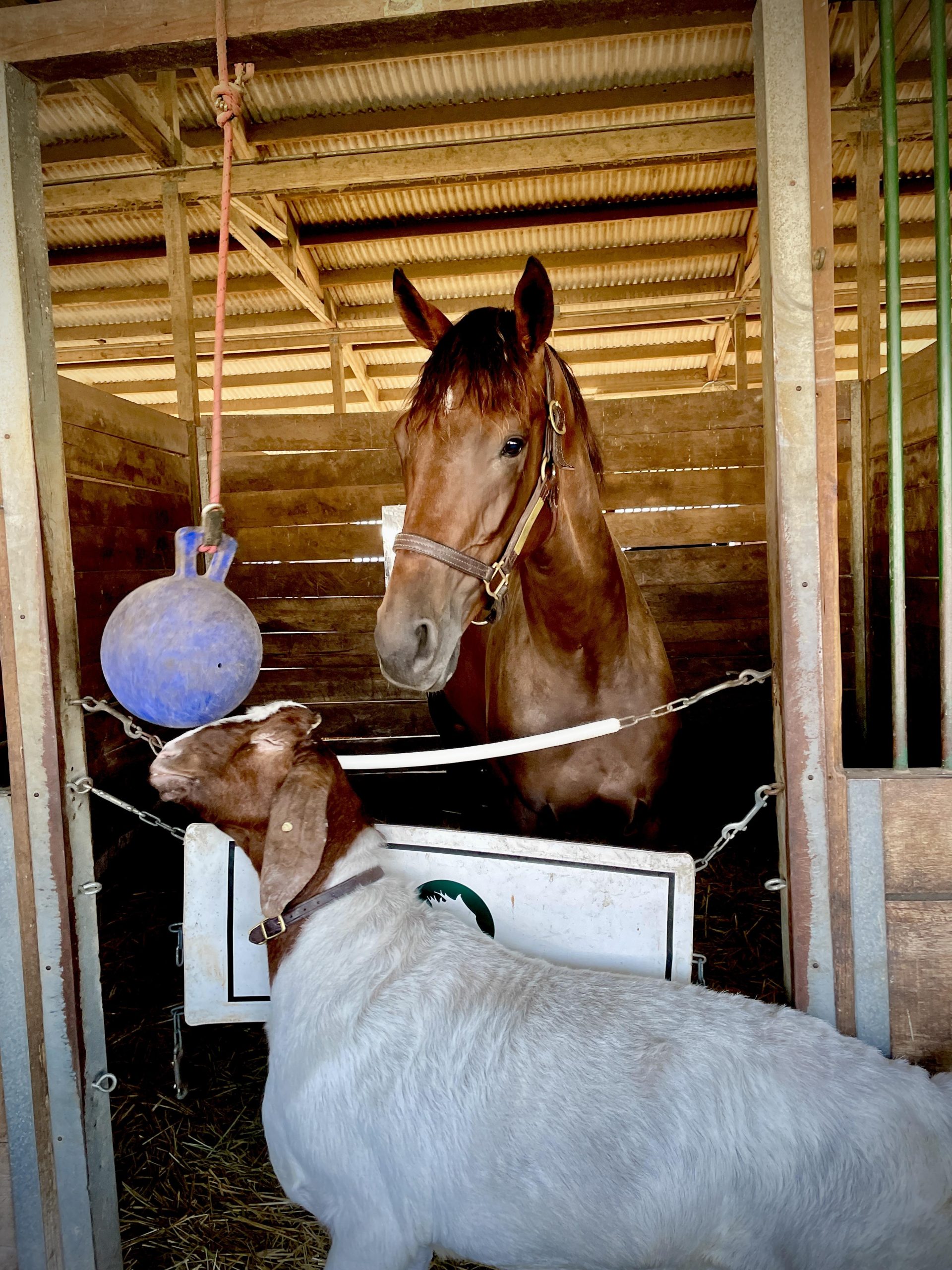
Rikki (Tiz So Fine) hanging out with the resident goat at Michael Ann Ewing Racing at the Thoroughbred Training Center in Lexington, KY. Photo by author.
The first barn I set up had lovely-made metal and wood sliding doors. There was a small window on the side for dropping feed into corner feeders, but there was no intention for the horses to spend time with their heads outside of their enclosed spaces. And due to the fact that I had a pig who would wander into stalls and steal food, I couldn’t drill through the metal and hang stall guards. I tried that once or twice to situate guards and leave doors open and each morning would find Pig (yes, that was his name) and his 200+ pounds of happy stubbornness stealing snacks from around the horses’ feet. The horses were happy enough, I suppose, but I hated that they were so shut in.
When I set up the new place, I was lucky enough to work with spaces where the stall doors do slide and latch, but it was easy to use what had been left over and lay new eye bolts for stall guards. And while it doesn’t look like a single guard will hold a 1200 pound horse, they rarely feel inclined to test them.
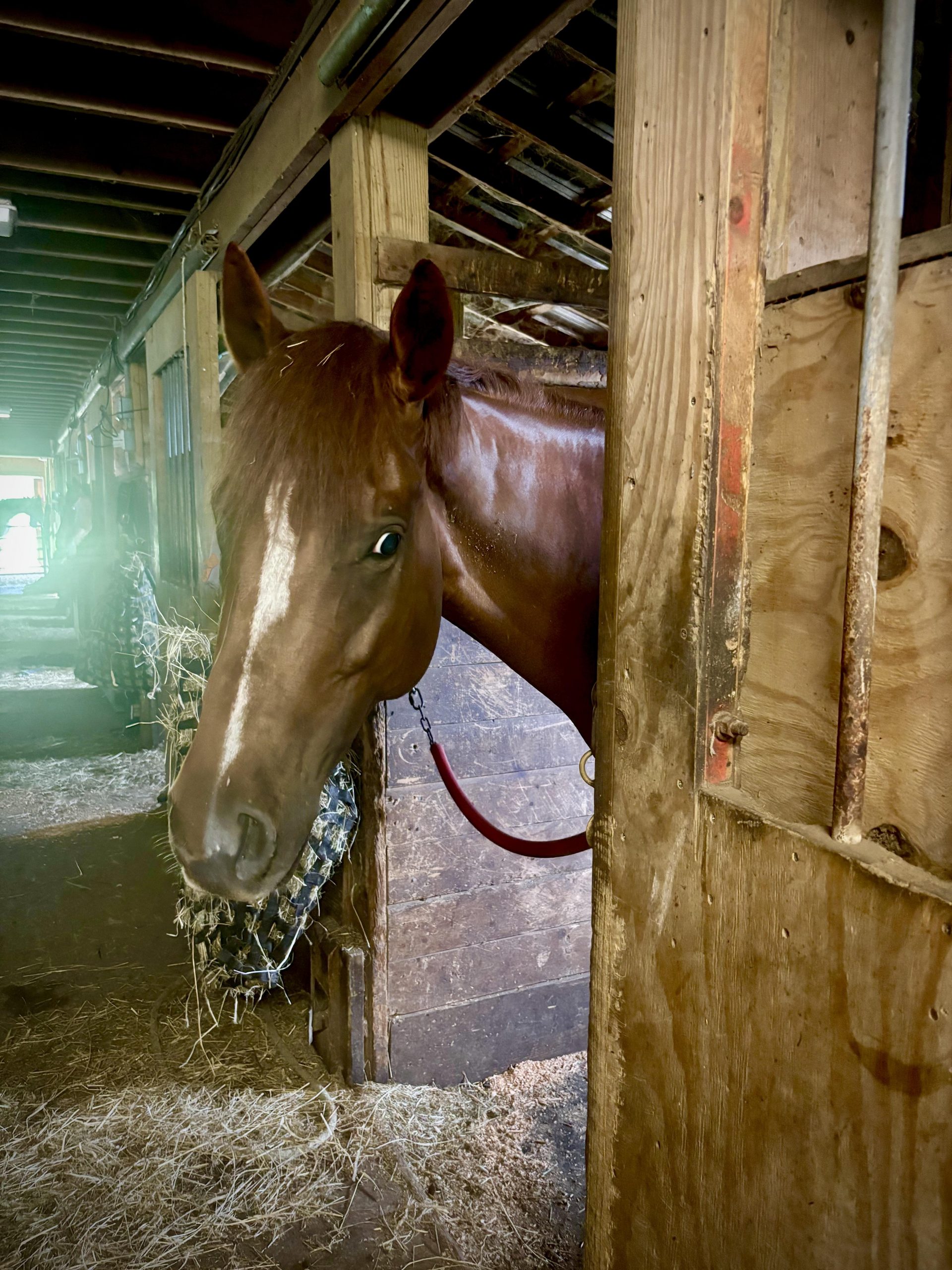
Pint (King Swansboro) arrived last week and immediately settled into the set up. Photo by author.
2. Hay that hangs outside the stalls: Another aspect that I brought from the backside was hay that hangs next to the stalls. Not all barns on the backside do things this way, but I have found that many do and the horses seem to be quite happy and social when that’s their set up. Yes, this makes a mess — hay drops out of the bags and creates small piles on the floor. But the horses don’t care. They can eat and be social and secure. It’s rare in turnout settings that horses eat alone, choosing to graze in pairs or small herds.
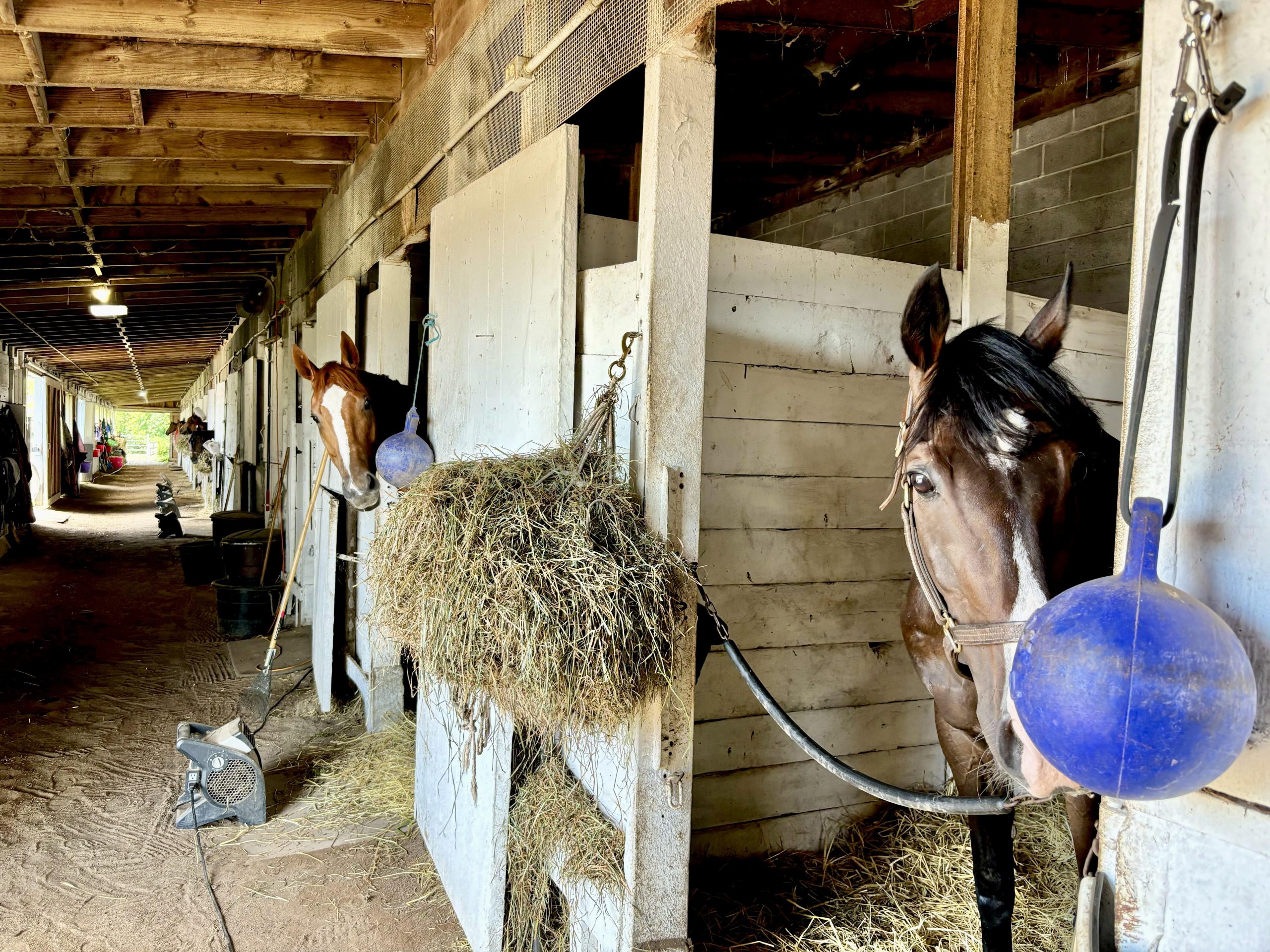
An image from the backside of Finger Lakes Raceway. Photo by author.
It didn’t take long in my last farm to realize that tying hay at the back or side of the stalls didn’t encourage them to eat (there were solid wood walls between stalls so no ability to see friends except through the front window). When I moved the bags and the loose hay to the front, the horses ate more, and their temperaments unsurprisingly improved. So when I set up the farm up here in the north, we clipped hay bags to hooks just outside the stalls. The hay mess on the ground drives me a little bit nuts, but the Thoroughbreds confirm it’s a good set up by chowing through multiple bags a day while able to see friends and the goings-ons of the farm.
3. Tie in spaces that are comfortable: The set up of my current farm includes a wash stall/grooming stall that is at the end of the row, but visually isolated from the goings on of the barn. For the first month here or so, I tried using it for my everyday crossties and for the farrier. Even my most trained creatures were terrible in that space. They danced and called, shuffled their hips left and right with high heads. While I liked the space it gave me in an otherwise very compact barn, something had to give. I clipped crossties back on the O-rings near the stalls and moved the horses into the more social space where they could see their buddies. Guess what? The issues disappeared entirely.
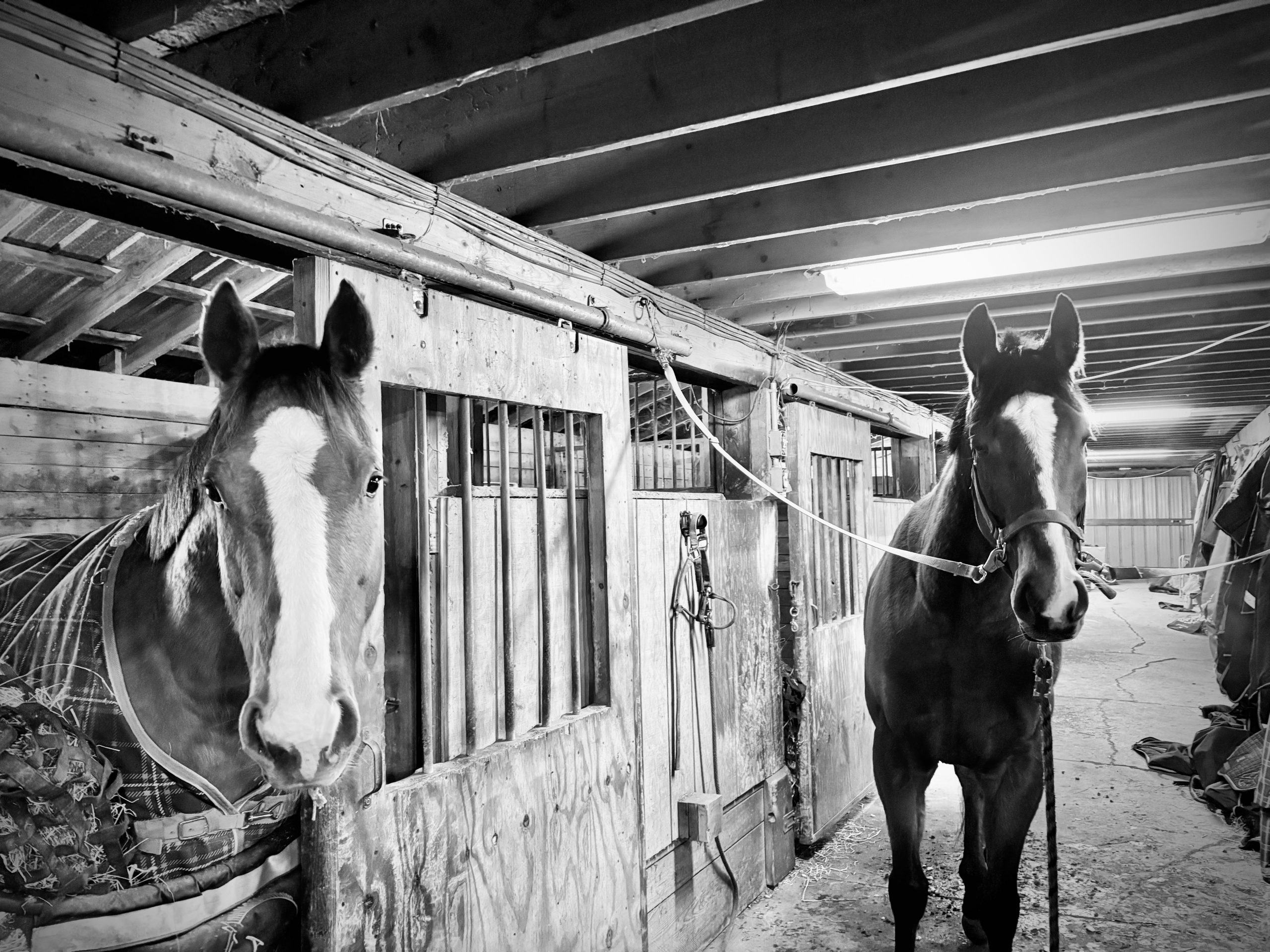
Bowing Snowman and Fig (Ekati’s Verve) hanging out. Photo by author.
Yes, it is annoying to crosstie in a narrow aisle. Yes, it means that we’re vying for space against hay bags and overly social horses in the stalls. But, my horses are able to move directly from the track – where they usually straight tie in stalls for tacking and grooming – to cross tying with next to no issue.
4. Provide daily attention: This point pretty much goes without saying for any farm. On the backside of the track, horses are handled multiple times a day. They are groomed, moved outside of their stalls to the hot walkers, hand walked, and on days they go for workouts, they are tacked and ridden out. It’s a rarity that they are only touched every couple days when someone wants to ride. In good barns on the backside, the horses shine, their weight is good and each is accustomed to a frequent level of attention.
When they transition to life off the track, in some ways horses need to adjust to a new life of less. Less handling, less feed, less hands-on-humans. In most boarding situations, horses on full care are led to and from the paddocks and fed. If their owner shows up, they will likely have an hour or two of intense attention, but mostly they’re handled to move them around and then left alone. On full turnout board, they are fed, looked over and left for the day. There’s nothing wrong with these ways of horse management, but it is different from the near constant eyes on them and care that is doled out at the track.
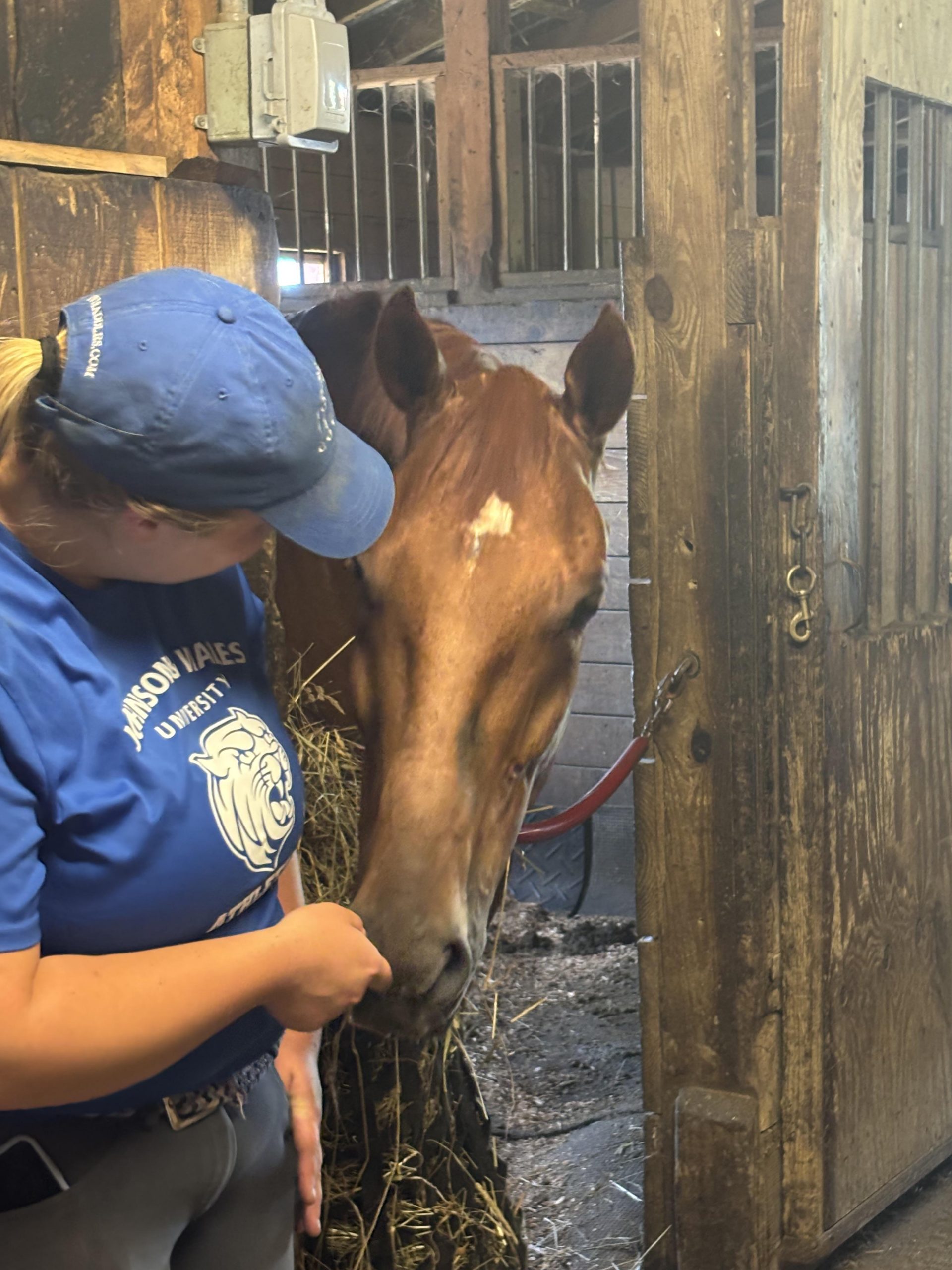
Artie (Reunion Tour) getting some attention from working student Lily Drew last week. Photo by author.
Another great thing about open stalls is that it is easy to interact with these guys. As I walk down the shed row, everyone gets pets and attention. Some get told not to nip. And last night the first four had a chance to try the grapefruit radler that I wandered down to the barn with after hours. Neil (Lute’s Angel) thinks it is pretty fantastic.
Most of the horses are groomed daily, engaged and handled. That said, without a high number of grooms, it is hard to get horses the level of human interaction they get at the track. But we aim to come close. I rotate stalls so that horses at the far side of the barn aren’t always stuck there. Stall rest horses take the stalls next to the crossties to ensure the most attention and activity during the day. Usually, and with decent efficiency, horses come out of their shells and the comfort with the space and people makes them feel comfortable letting their personalities pop out and allowing them to embrace their individual level of weird.
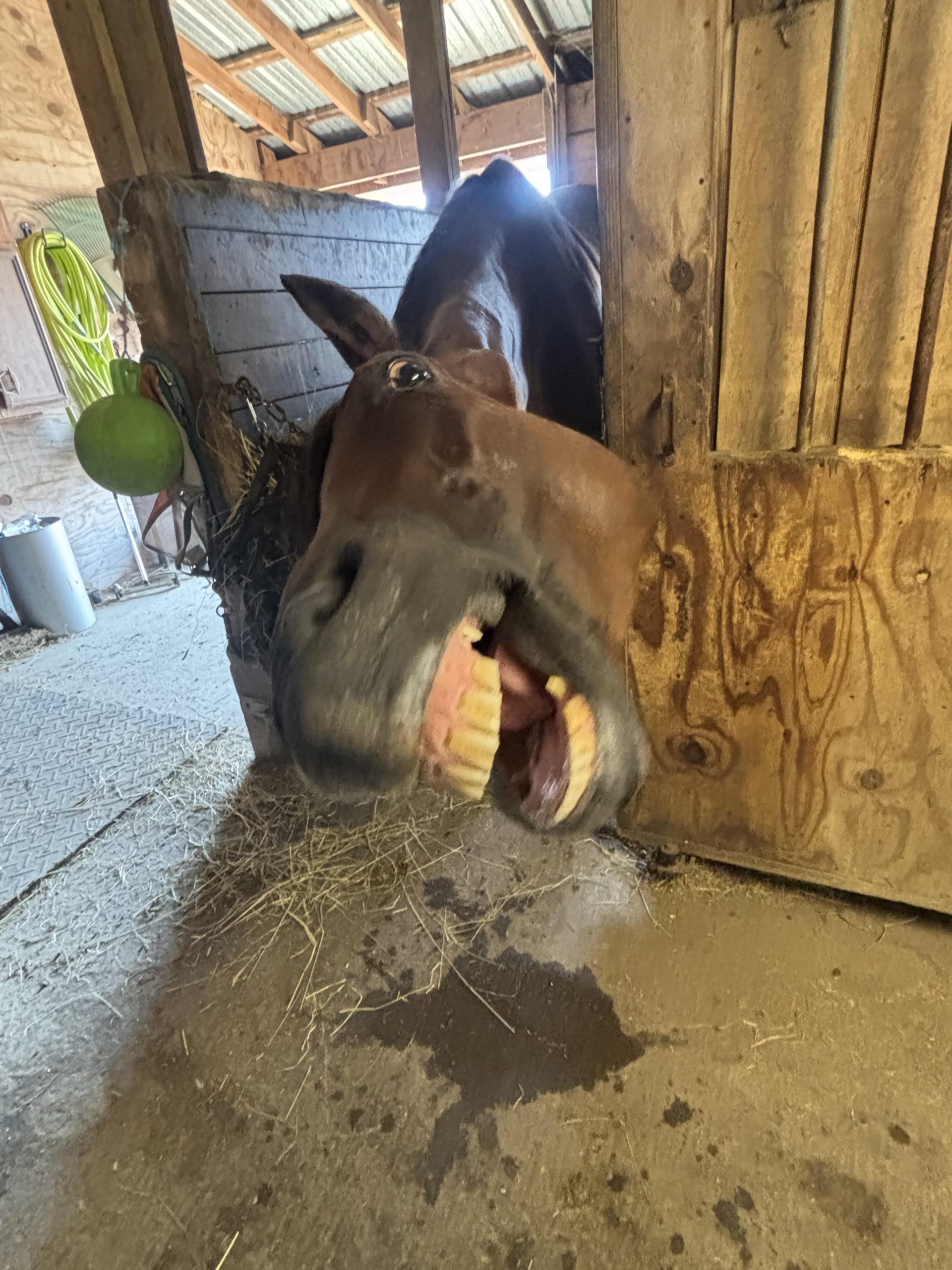
Emmett (Oboy) is a fantastic example of how a very buttoned up horse ends up coming out of their shell with a little time and a lot of interaction. Yes, he’s being friendly here – just weird. Photo by author.
5. Chaos is good: Finally, the backside is full of movement. Grooms pass by, horses are walked and sometimes jogged in the sand aisles next to the stalls. Trainers and pony horses move through, grain carts are pushed along, and there’s all sorts of regularized chaos, especially during the morning hours when the track is open for workouts. So day in and out, Thoroughbreds are exposed to all manner of traffic, other horses, and other things. They get used to the circus.
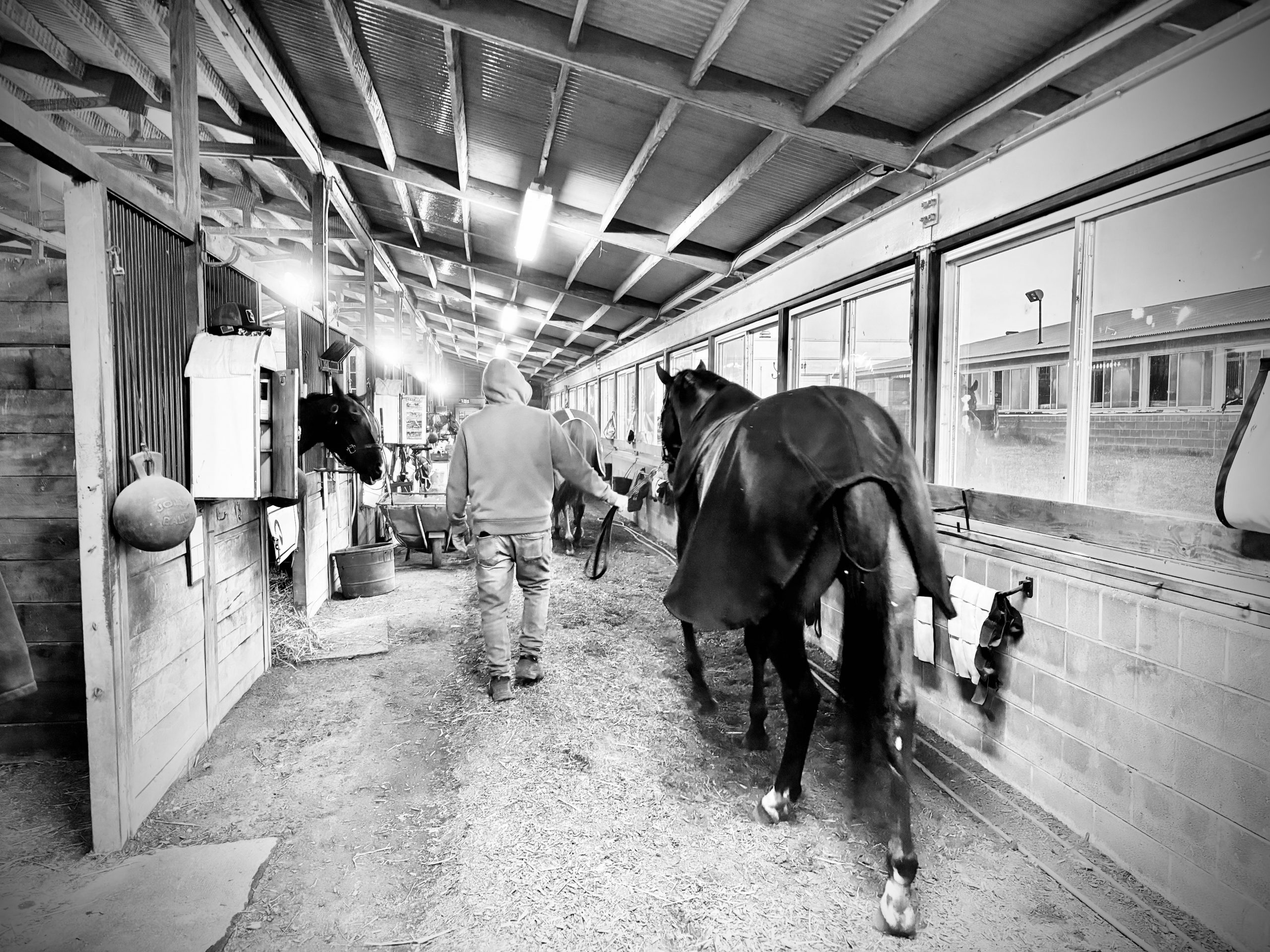
The backside at the Thoroughbred Training Center in Lexington. Photo by author.
I love mild amounts of chaos for these horses. And in this barn, there’s no good way to get away from it even if I wanted to — everything is just in a little bit tighter proximity. The hay truck pulls in and unloads, the skid steer operates outside moving the manure pile, my farrier sets up outside the door and occupies the second aisle crosstie, other horses are walked past the stalls and so on… Curious and smart, Thoroughbreds do well with all the curfuffle while also enjoying the quiet moments where they can take themselves out of the fray, head to the back of the stall and take a nap. It makes for a space where I don’t have to worry about what happens when there’s a lot of movement near an arena when riding and I can trust that the madness of going to a show only builds on their existing “chaos is fine” foundation.
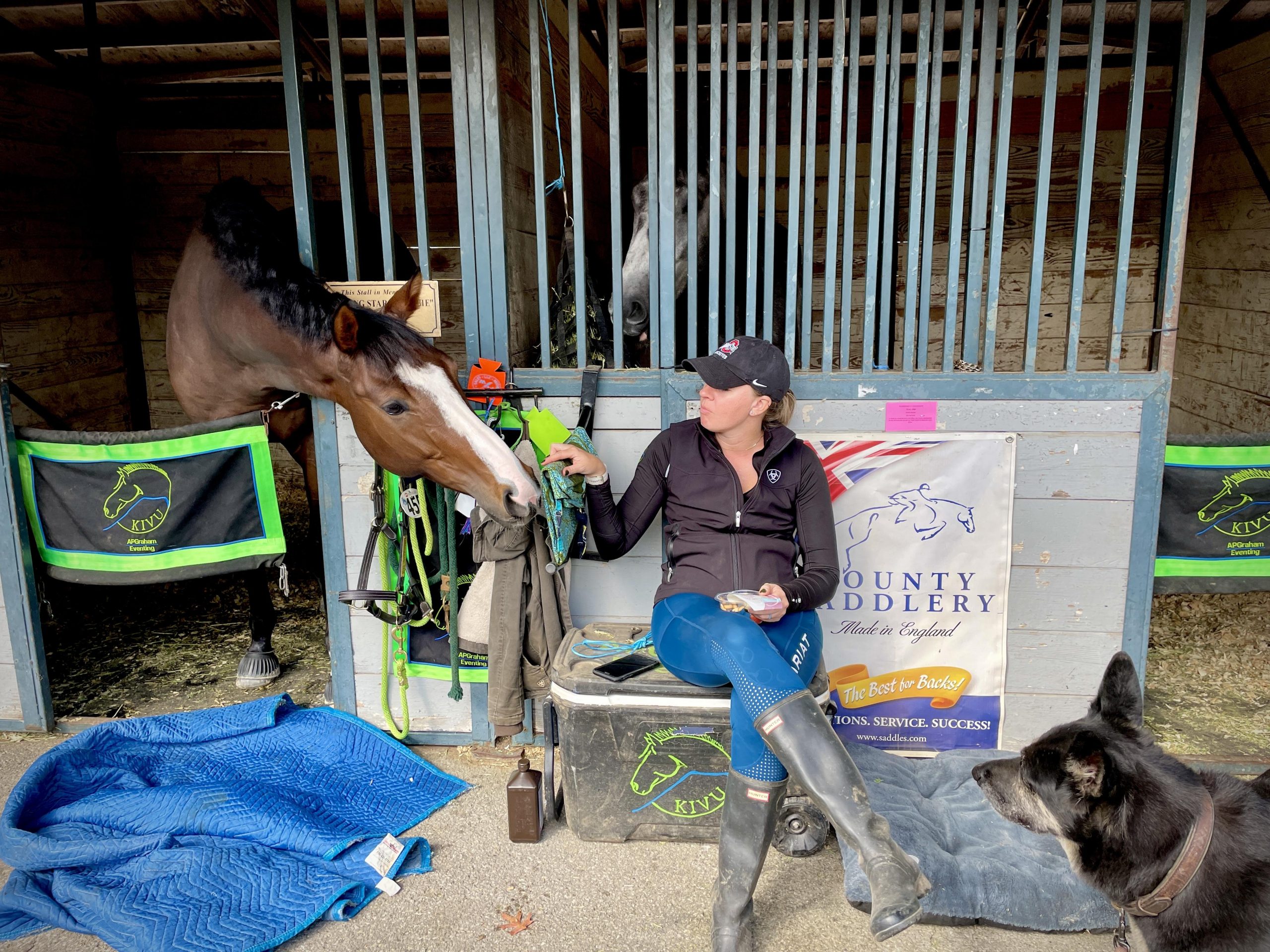
Louis (Unbridled Bayou) having no problem with the chaos at the Thoroughbred Makeover in 2022. Photo featuring Lauren Kingerly by author.
There may be such a thing as a barn that is too quiet. This one, like the backside of most tracks, is no such thing. That said, the chaos is calculated and the horses find space in the set up to let their guard down, come out of their shells, and settle in like they have been here their whole lives.
So go ride folks, and who cares if there’s a bit of hay on the ground outside the stalls so long as the horses are happy.
About Kentucky Performance Products, LLC:
Omega-3 fatty acids have been proven to reduce skin inflammation and mitigate allergic response. Contribute delivers both plant and marine sources of beneficial omega-3 fatty acids. Feed one to two ounces per day, depending on severity of the allergy.
Need tips on how to manage allergies? Check out this KPP infographic: Got Allergies?
The horse that matters to you matters to us®. KPPusa.com

