



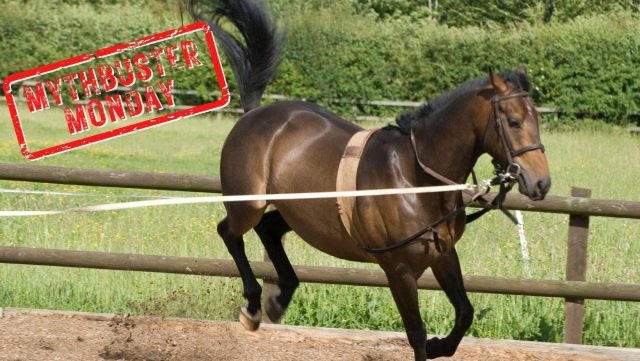
Mythbuster Monday: You Can Break A Bad Habit With More Intense Training
On Mythbuster Monday, we tackle a variety of equestrian myths to either bust or confirm. Today’s discussion: Can you break a horse’s bad habit with more intense training?
It’s Mythbuster Monday, where Horse Nation dives into different equestrian myths and provides research-based evidence to either bust or confirm those myths.
Today’s Mythbuster Monday was inspired by a debate that popped up on a horse coaching social media page asking whether more intense training will break all bad habits. It sparked enough debate that we decided to dig deeper, look at the science and physiology behind it, and separate myth from fact. So, here it is — can you break a bad habit with more intense training? Is bad behavior always due to a lack of training? Why do horses act undesirable? Read on to find out!
Myth: You can break a bad habit with more intense training
Myth or Fact: Myth
In horses, a “bad behavior” typically is defined as any repeated action that interferes with handling, riding, care, or safety — but that definition is rooted in human expectations, not the horse’s intent. These behaviors can include resistance under saddle, avoidance, aggression, anxiety-driven reactions, or stereotypic actions such as weaving or cribbing.
But, can you break these bad habits with more intense training?

Photo by Marcella Gruchalak
A peer-reviewd article published by Melissa Starling in Animals in 2016 presents equitation science as an evidence-based framework for understanding and improving horse training and behavior, grounded in scientific knowledge of equine learning, cognition, and ethology (the study of natural behavior). Instead of relying on forceful or punitive training, equitation science emphasizes working within the horse’s cognitive and physical abilities and using clear, well-timed cues and appropriate reinforcement to shape behavior. Horses can easily become confused, frustrated, or highly aroused when cues are inconsistent, unclear, or threatening; such states are associated with defensive or flight responses that are harder to extinguish and can persist or even worsen if the underlying cause isn’t addressed.
The authors highlight that punishing or applying aversive stimuli to suppress behavior doesn’t truly “fix” a bad habit — it can shift the horse’s focus toward safety and relief from pressure, increasing stress and defensive reactions rather than promoting understanding of what is desired. This may make a behavior seem suppressed in the moment but entrenches avoidance or fear responses that are counterproductive and potentially dangerous.
Instead of more intense training, the article promotes a set of training principles that prioritize training that matches the horse’s natural behavior and learning capabilities, minimizing confusion and conflict by using simple, discriminable signals, reinforcing desired responses in ways the horse understands, and avoiding provocation of flight or fear responses that are resistant to extinction. Under this scientific framework, a “bad habit” is less something to be hard-trained out of the horse through intensity or punishment, and more something to be understood and reshaped by addressing the communication breakdowns and emotional states underlying the behavior.

Photo by Marcella Gruchalak
Melinda Story writes in her article, Dangerous Behavior and Intractable Axial Skeletal Pain in Performance Horses: A Possible Role for Ganglioneuritis, that what is often labeled as dangerous or undesirable behavior in performance horses (such as bucking, rearing, refusing to go forward, or becoming progressively difficult under saddle) is commonly attributed by owners and trainers to poor training or a “bad attitude.” However, in this case series of 14 horses that developed severe behavioral problems, the researchers found consistent evidence that chronic, neuropathic axial skeletal pain was a likely underlying cause of these behaviors rather than a simple training defect.
The article emphasizes that these horses often initially appeared to behave normally in basic care situations, but exhibited dangerous or resistant behavior when asked to perform work. Veterinary examinations revealed significant spinal pathology, particularly ganglionitis (inflammation of sensory nerve ganglia) and associated lesions, that would produce persistent pain and potentially unpredictable or aversive reactions.
Importantly, many of these horses had already undergone traditional training interventions and therapeutic trials (including non-steroidal anti-inflammatory drugs and repeated work) without lasting improvement. The study suggests that continuing to increase training intensity without identifying and addressing the underlying pain reinforced the misconception that a horse’s “bad behavior” was simply training-related, and may actually exacerbate pain-driven responses.
In relation to the myth, this research demonstrates that what may appear as a learned “bad habit” can instead be a behavioral expression of chronic pain, and that intensifying training in such cases fails to resolve root causes, and may worsen the behavior or welfare outcomes.

Photo by Marcella Gruchalak
Another article by McGreevy and McLean on punishment in horse training and the concept of ethical equitation directly challenges the idea that “more intense training” is an effective way to break a so-called bad habit. The authors explain that punishment, defined as any consequence that makes a response less likely in the future, is different from well-timed negative reinforcement and often arises inadvertently when pressure isn’t released at the correct moment. Because horses are primarily trained through negative reinforcement (pressure + release), poor timing can unintentionally punish the horse, decreasing desirable responses rather than strengthening them.
The article highlights how non-contingent or improperly applied punishment (e.g., delayed or misplaced pressure) does not teach the horse what to do but instead may create confusion, fear, frustration, and a reduction in motivation to respond. In extreme cases, repeated exposure to aversive stimuli can lead to learned helplessness or experimental neurosis, where the horse stops attempting to solve the “training puzzle” altogether and becomes dull or disengaged.
Rather than escalating intensity or pressure to suppress unwanted behaviour, the authors introduce ethical equitation, which emphasises clear, consistent signals, skilled use of negative reinforcement, and minimising unnecessary aversives. This approach recognizes that forceful punishment neither reliably eliminates behavior nor promotes learning — it often undermines welfare and can entrench resistance or stress responses instead of creating understanding.
Overall, the article relates to the myth by showing that increased intensity or punishment is not an empirically supported method for correcting behavioral issues; effective training is grounded in timing, consistency, and ethical application of learning theory, not escalation of force.

Photo by Marcella Gruchalak
Understanding and Treating Equine Behavioral Problems highlights that undesirable behaviors in horses arise from a variety of underlying causes — not simply poor training or a need for harsher methods. It explains that behaviors perceived as “bad” can be linked to physiological issues such as pain, fear, anxiety, frustration, and conflict, as well as inappropriate management or handling practices — which include poorly applied training techniques. Successfully reducing or eliminating these behaviors requires first identifying and addressing medical and management causes, then applying welfare-oriented behavior modification rather than assuming that stronger, more intense training will fix the issue. The review underscores that a methodological investigation of causes and tailored, evidence-based interventions have a far greater likelihood of success than escalating training intensity, which can overlook the root causes and simply mask rather than resolve the behavior.

Photo by Marcella Gruchalak
These sources collectively debunk the myth that a horse’s bad habit can be resolved simply by applying more intense or forceful training. Across equitation science, veterinary research, and behavioral studies, a consistent theme emerges: unwanted behaviors are most often symptoms, not problems in isolation. The literature makes clear that behaviors commonly labeled as resistance, disobedience, or defiance frequently originate from pain, fear, anxiety, confusion, or unmet physical and psychological needs, and that escalating pressure or punishment fails to address these root causes. Rather than eliminating the behavior, increased training intensity often suppresses warning signals, heightens stress responses, or exacerbates underlying discomfort, leading to greater welfare risks and safety concerns. Far from being an effective solution, “harder training” is repeatedly shown to undermine learning and trust, while evidence-based approaches that prioritize diagnosis, clear communication, appropriate reinforcement, and welfare-centered management are far more effective at producing lasting behavioral change.
Do you have an equine myth you’d like us to tackle? If so, send it our way! Email your suggestions to [email protected]. Put Mythbuster Monday in your subject line.
