



Training in the Right Way: An Ode to the Snaffle…
…Or why you may not need the trendy, majikal bit to achieve your riding goals. Let’s discuss why your bit might actually be hindering your training.
Dressage training is supposed to be the process of training ANY horse to be a better riding horse. The more the horse learns, in theory, the easier it is to communicate with and therefore complete more complex tasks with. Although competition dressage training often is more focused on training for the dressage test, that is not what the original intention (and original judging requirements) were for competitive dressage. Initially, it was designed to give riders and trainers a way to determine how their training measured up to the theoretical ideal of the training process. That said, it is critically important to understand the meanings and reasons for some of the terms we use to describe dressage training and what to look for when observing training and competition (and videos and photos), regardless of whether you intend to compete or just train your horse to be a better whatever you do with him. That, ultimately, is the main purpose of my articles. To provide education and knowledge for riders to understand and improve their eye and understanding of what dressage training is supposed to be. While there will always be some differences in practice and theory, good horse training is always recognizable to the educated eye. That said, it absolutely is necessary that we remember and understand that limited knowledge is limited judgment.
* * *
Bits are funny things; they make all the difference in whether a horse goes well or goes poorly, but not always in the way you might think. Essentially, the bit is a tool for communication and, generally speaking, the different types are not inherently “good” or “bad,” but when used without knowledge and education can be entirely ineffective or even cause immense suffering. In order to ride and train effectively, it is important to use a bit that actually allows for that (and that’s very often NOT some majikal, fancy specialty bit marketed as the thing that will suddenly make Dobbin a trained rock star—you know, because that’s what the training should be doing).
I find that many riders either learn to be fearful of using a bit or become entirely too cavalier about it. At the same time, most riders do not know what individual bits are meant to produce as an effect, which often means they don’t select the most appropriate bit.
In fact, different bits produce different effects and when you are choosing a bit, you should understand what your horse’s natural responses are to being ridden with a bit and then choose a bit that assists the horse in understanding what is expected of him. That said, this does not mean it is a “bit free-for-all” out there. Some bits are used for specific purposes because they ALLOW THE RIDER TO PRODUCE specific effects. A bit is not the answer to your training problems, but the properly chosen bit can make it possible to solve your training problems. (Read that last sentence again.) Which is basically to say that you still have to know how to train the horse and then put in the time, but having the right bit will allow you to be effective at doing it.

This bit is is defined as a snaffle. It has a fixed ring and is designed to create leverage on the horse’s poll and jaw bone. It is acceptable in USEF dressage competition. It is probably a lot sharper than most peopled realize. Photo (c) Gwyneth McPherson
Many riders understand that thin bits are sharper than thicker bits and that straight bars (as opposed to jointed bits) can cause a horse to be more submissive (more flexion at the poll and giving in the jaw, if used correctly), especially if it has a port, and/or fixed cheek pieces, and perhaps a chain attached to it to go under the chin, like a curb bit, or kimberwick, or pelham. But then, that’s generally where their knowledge ends…which is problematic.

This bit is not accepted in USEF dressage competition. It is a widely used bit outside of dressage training, however. Because of the port in the middle of the bit, the chain and the fixed cheek, it is a leverage action bit and is not a snaffle. It does not promote suppleness even in an expert’s hands. This does not make this bit “bad”, it is just not a tool for suppling and getting the horse to “seek” the bit. Photo (c) Gwyneth McPherson
‘ There is a reason that the USEF has a bunch of rules surrounding what types of bits are allowable in competition. Yes, it is (and should be) based in an attempt to prevent cruelty, but also, it is meant to provide guidance to riders to help them understand what certain bits are used for. In other words, in dressage competition, we see only snaffle bits at the lower levels and a snaffle paired with a curb bit may be introduced after the horse is proficient at a certain level of collection (the upper levels). Specifically, this tells us that a curb bit does not create collection but can only be used after a horse has an understanding of collection (if you are using it for collection or as a means of control, you need to reconsider your approach).
Given all of that, the vast majority of horses being ridden in dressage are in some form of snaffle bit (I hope, anyway) and, for better or worse, what a vast array of snaffles there are these days! It seems there’s a bit for every problem and every mouth shape and a few extras thrown in for greater profit for some bit companies…but I digress. What you should know about a snaffle bit is that it is for communicating the rider’s aids and is the only bit that can be used for suppling (which basically makes it the most necessary, and often most appropriate, bit for many horses).

This bit is a snaffle and is acceptable in USEF dressage competition. The straight, fixed cheeks make this bit more “dull” in terms of creating a useful contact. There are reasons (good reasons) to use a bit like this, but it is not the best bit for training suppleness, seeking the bit and putting the horse on the aids. Photo (c) Gwyneth McPherson
As mentioned above, there are many variations on the snaffle bit, but I would suggest that the basic loose ring snaffle (single or double jointed) is the most universally useful bit for training. In comparison, the fixed ring snaffles are less useful for developing the aforementioned qualities because of their “fixedness,” which decreases the subtlety of the rider’s aids (which makes the horse’s mouth more dull). Is there a purpose for fixed snaffles? Yes. But it is transient. The horse should become trained enough to need/accept more subtle aids as he develops greater understanding of his job. In other words, there are times when a horse must go in a bit that is not some form of a loose ring snaffle, but you must understand the inherent potential negative results it might create, and have a plan for how you are going to solve those issues.

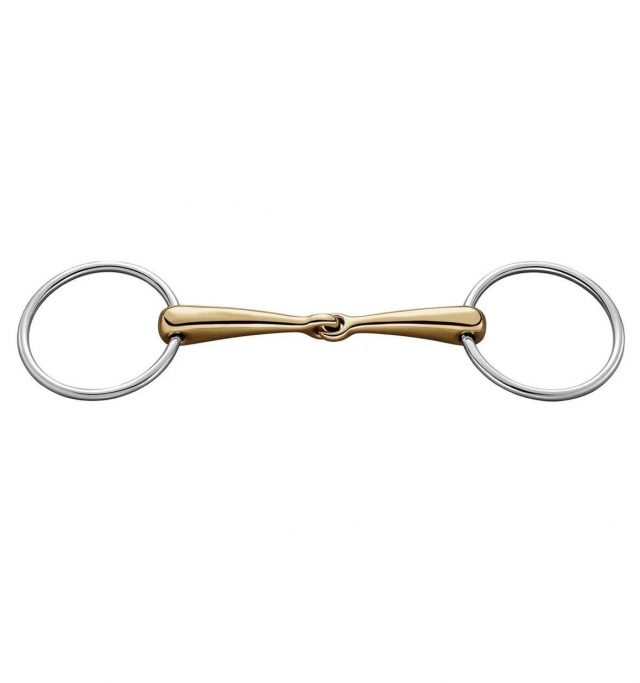
This is a typical loose ring snaffle bit. This type of bit (it has variations from this specific bit shown) provides the greatest degree of subtlety in the contact, the rider’s aids and promotes suppleness and seeking the bit in the hands of an educated rider. This isn’t a matter of it being “my favorite” bit. It isn’t a matter of opinion. It is simply how this bit works in horse’s mouth. Sometimes a horse needs a different type of bit than this, and in the right hands, the horse may indeed flourish. Photo (c) Gwyneth McPherson
To circle back, though, the bit should help the rider create suppleness (and therefore make the horse more “on the aids”), even more significant is that it is supposed to allow for effective communication (perhaps the most important point of my bit tirade here). Often, I find riders using bits (generally in the name of fixing a behavior problem or needing more control) that actually cause a horse to brace against or drop the bit due to the discomfort created by the bit itself, and they don’t even realize it. They think that the bit is supposed to make the horse softer or lighter when it is actually doing the opposite at worst, or preventing the horse from seeking the bit at best.
In fact, it’s key to remember that we want the horse to meet our hands in the connection through the bit (take or seek the bit). If the bit is too sharp or painful, the horse will brace against the discomfort (pull or lean) or try to avoid it (go behind the vertical). A loose ring snaffle, properly fitted to size and shape of the horse’s mouth, and made to be not too high or too low in the mouth, and handled with hands that are not too bouncy, too light, or too much pulling backward, will allow the horse to “seek” the rider’s hands and go forward to the bit when ridden forward. This is what a snaffle ALLOWS. It cannot create this contact. The rider must do that, but a rider cannot create contact, even with excellent riding, if the bit does not allow it.
So, take a moment to consider your horse’s bit and the effect you’re trying to create and ask yourself if it’s allowing you to effectively communicate or if it is, in fact, hindering that. Sometimes you just need to simplify and go back to the basics.
Remember: Limited knowledge is limited judgment.

Gwyneth and Flair in competition at Grand Prix. (c) flatlandsfoto.
Gwyneth McPherson has over 35 years experience competing, training, and teaching dressage. She began her education in in the late 1970s, riding in her backyard on an 11 hh pony. Her first instructor introduced her to Lendon Gray (1980 and 1988 Olympian). who mentored Gwyneth for a decade during which she achieved her first National Championship in 1984, and her Team and Individual Young Rider Gold Medals in1987.
In 1990 Gwyneth began training with Carol Lavell (1992 Olympian) who further developed Gwyneth as an FEI rider and competitor. Gwyneth achieved a Team Bronze in 1991 and a Team Silver in 1992 in the North American Young Riders Championships, and trained her stallion G’Dur to do all the Grand Prix movements while riding with Carol.
In 2008, while Head Trainer at Pineland Farms, Gwyneth began training with Michael Poulin (Olympian 1992). Michael was trained by Franz Rochowansky (Chief Rider for the Spanish Riding School 1937-1955). Michael has shared much of Rochowansky’s knowledge and wisdom with Gwyneth, completing her education as a Grand Prix rider, trainer, and competitor.
Gwyneth’s teaching and training business, Forward Thinking Dressage,is based in Williston, FL. In addition to teaching riders and training, Gwyneth also loves sharing her knowledge of the sport and art of dressage as well as discussing relevant topics pertaining to the training itself and the current competitive landscape.

