



Training in the Right Way: Tack vs. Training Problems
It’s never the tack, it is always the training. Except sometimes, when it is the tack. Sounds fun, huh? Let’s discuss.
Dressage training is supposed to be the process of training ANY horse to be a better riding horse. The more the horse learns, in theory, the easier it is to communicate with and therefore complete more complex tasks with. Although competition dressage training often is more focused on training for the dressage test, that is not what the original intention (and original judging requirements) were for competitive dressage. Initially, it was designed to give riders and trainers a way to determine how their training measured up to the theoretical ideal of the training process. That said, it is critically important to understand the meanings and reasons for some of the terms we use to describe dressage training and what to look for when observing training and competition (and videos and photos), regardless of whether you intend to compete or just train your horse to be a better whatever you do with him. That, ultimately, is the main purpose of my articles. To provide education and knowledge for riders to understand and improve their eye and understanding of what dressage training is supposed to be. While there will always be some differences in practice and theory, good horse training is always recognizable to the educated eye. That said, it absolutely is necessary that we remember and understand that limited knowledge is limited judgment.
* * *
If you have been reading along with my other articles, you will already know that I believe firmly in the training process. I also believe firmly that vendors of the newest, fanciest gimmick that comes on the market make a mint on riders who have training problems and don’t have the training answers for it. For the most part, the standard of saddle and bridle-fitting (including girths and bits) has not changed dramatically in my lifetime. Some small details and maybe some new materials have made some differences, but the basics are the same. While I think the efforts to make horses more comfortable while doing their work is necessary and commendable, I don’t think it is a replacement for good riding and proper training.

This is a photo from 1988. Saddles, bridles, bits, girths and pads have all evolved since then — materials have been improved and we have more scientific ways of measuring pressure points and hopefully, therefore, comfort. Yet they still have the same basic fitting principles. Photo (c) Gwyneth McPherson.
That being said, there’s also no way around the importance of having the correct tack that also is correctly fitted to your horse (as a sidenote, if you don’t know how to correctly fit saddles, pads, girths, bits, and bridles, you must get educated help). Using appropriate tack is so significant, sometimes changing an ill-fitting piece of equipment makes a miraculous difference. Because of this, often riders start to believe that if they just change the bit, or change the bridle, or get that new saddle, or a new girth, their horse will perform better. Sometimes they are right (as we are about to explore below), but most of the time it’s a problem in the training that needs to be addressed (it also can be a physical problem that a vet or body worker needs to attend to).

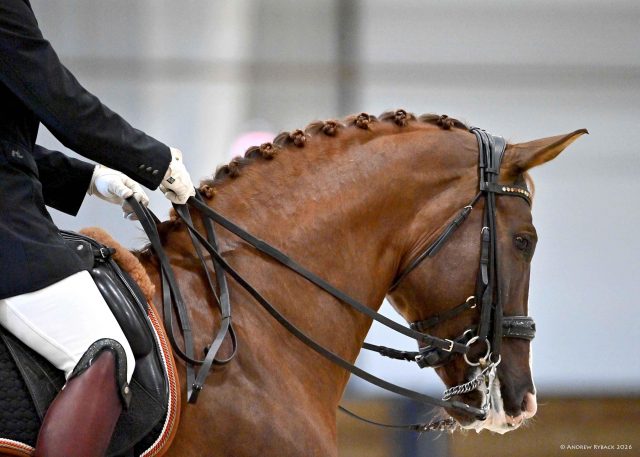
Fitting tack correctly is ultimately meant to create the most comfortable fit for the horse so the horse can perform at its highest capability. Photo (c) Andrew Ryback Photography.
Even so, sometimes a horse and rider, who are very educated and capable have a legitimate tack issue that interferes with the training process. Here’s my most recent, though entirely familiar, example: A rider has a horse that is schooling Fourth Level quite well, with a competent trainer. The rider has been using one of the trainer’s saddles due to needing to replace their old saddle. Things are going well, with solid training progress for months, so the rider decides to buy the same brand of saddle and has the fitter come out to fit the new saddle.
The fitter takes measurements and determines that the horse really ought to be in a tree that is slightly wider than the one he has been competing and training in successfully for the past six or so months. So, the saddle is fitted correctly by measurement. But when the rider tries riding in it, the horse immediately loses his freedom of movement and suppleness and is fussy with the bit. Nothing else is different — the only thing that changed was the new saddle (that is absolutely correctly fitted by the trainer’s, rider’s, and fitter’s standards but is wider than the one he was working well in before). When the horse is put back in the old saddle that the trainer had lent to the rider, he is “normal” again and has no problems.
The additional piece of information that is important is that the rider noted that they felt as if the new saddle was a little lower in the front than the borrowed saddle. The fitter assured her that this not unexpected as they made the tree wider to properly fit the horse and that will lower the pommel. Ultimately, the wider saddle was rejected by the rider and a saddle that was identically sized to the borrowed saddle replaced it and there were no further problems. The first question to consider is which saddle was fit properly? In my opinion, the horse is often the expert in these matters. This is why there can be so much success in making a minute change in a bit, bridle, or saddle. And likewise, why it can be a total failure (because it is not as exact a science as we might hope and horses haven’t exactly read the rule book, so to speak).
In this case, the horse involved is a very sensitive fellow. He does not tolerate changes in his balance and gets tense when he has a different rider (even a very competent one). So, the small shift in balance from the saddle that he has been performing well in that maybe, technically, is slightly (not a lot) too narrow to a properly fitting (sightly wider tree) was too much for him. His rider noted the change in her own balance in the new fit and determined that he probably also felt her weight placement changing (which was an accurate assessment). His response was pretty dramatic, and he was fortunate that he had a rider and trainer that knew him well and advocated for him. AND the fitter listened and resolved the fitting issue.
The moral of the story is that riding equipment vendors are often highly skilled at fitting tack to a wide variety of horses (and riders), and most equipment is designed with the horse’s comfort and performance as the top priority. But ultimately, the horse and rider are the ones most directly affected by how that equipment fits, making them the true experts on how it feels and functions in practice. In dressage, where training is centered on developing athleticism, balance, and harmony, properly fitted equipment becomes an essential part of supporting — or unintentionally hindering — that development. So it is vital that you pay attention to how your tack fits — just don’t assume that it’s a magic bullet for what are likely training issues.
Remember: Limited knowledge is limited judgment.

Gwyneth and Flair in competition at Grand Prix. (c) flatlandsfoto.
Gwyneth McPherson has over 35 years experience competing, training, and teaching dressage. She began her education in in the late 1970s, riding in her backyard on an 11 hh pony. Her first instructor introduced her to Lendon Gray (1980 and 1988 Olympian). who mentored Gwyneth for a decade during which she achieved her first National Championship in 1984, and her Team and Individual Young Rider Gold Medals in1987.
In 1990 Gwyneth began training with Carol Lavell (1992 Olympian) who further developed Gwyneth as an FEI rider and competitor. Gwyneth achieved a Team Bronze in 1991 and a Team Silver in 1992 in the North American Young Riders Championships, and trained her stallion G’Dur to do all the Grand Prix movements while riding with Carol.
In 2008, while Head Trainer at Pineland Farms, Gwyneth began training with Michael Poulin (Olympian 1992). Michael was trained by Franz Rochowansky (Chief Rider for the Spanish Riding School 1937-1955). Michael has shared much of Rochowansky’s knowledge and wisdom with Gwyneth, completing her education as a Grand Prix rider, trainer, and competitor.
Gwyneth’s teaching and training business, Forward Thinking Dressage,is based in Williston, FL. In addition to teaching riders and training, Gwyneth also loves sharing her knowledge of the sport and art of dressage as well as discussing relevant topics pertaining to the training itself and the current competitive landscape.

