



Thoroughbred Logic, Presented by Kentucky Performance Products: What Did You Do This Time?
“If you’re not winning, you’re learning.”
Welcome to the next installment of Thoroughbred Logic. In this weekly series, Anthropologist and trainer Aubrey Graham, of Kivu Sport Horses, offers insight and training experience when it comes to working with Thoroughbreds (although much will apply to all breeds). This week ride along as Aubrey shares her logic on the variety of ways horses like to leave us asking what they’ve done to themselves.
I love horses.
Pick any tone you want to read that sentence and it’s probably true. When it is read dripping in sarcasm with a huge teenage-like eye roll, that would also be accurate. And I reserve that tone for the moments of, “Oh, FFS, what did you do this time?”
Barbados (Sue Loves Barbados) is an easy example. I think this horse is ridiculously awesome. He’s super talented, kind and has developed a pretty solid sense of humor since he came to me in the late fall. He is also pretty sensitive under saddle and extremely sensitive out in the elements.

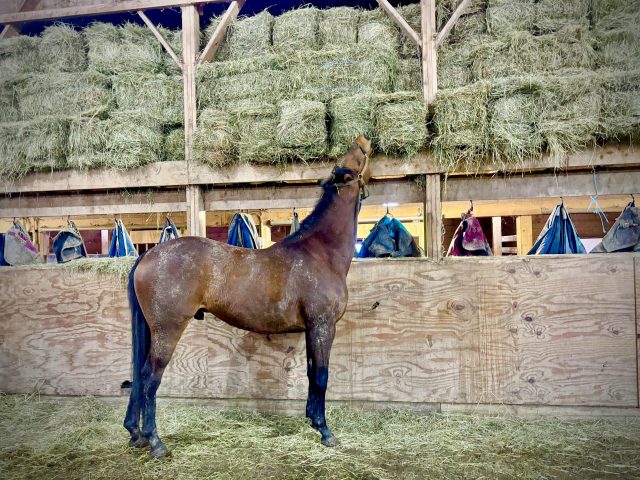
This is Barbados (Sue Loves Barbados) back when he arrived in the late fall. Photo by Lily Drew.
I pulled Barbados off the sale market when I realized that he needed more time. He didn’t need different people trial riding him, and he didn’t need to land with someone who didn’t fully know what they were doing with a warhorse who is also a delicate flower. And he needed a few months to settle into the off-track life and himself. That’s all fine. It helps that I quite like this horse.
Turns out that Barbados also hates the cold. Well that was a hell of lot of fun from December to March. He entered NY just before the most brutal winter in Central New York in the last 23 years. And when Barbados got cold, he would get colicky. And this horse would get cold wearing 800 fill of blankets. I mean, me too, but I digress. Yes, the goal is to get him south before next year’s arctic arrives.

Barbados was only outfitted in 650 fill in this photo. Poor cold kid. Photo by author.
Barbados, the sensitive flower that he is, also has had a fun spate of minor dents and dings which has meant that I have put maybe two rides on in the past two months. This is pain any horse owner knows way too well.
A lost shoe turns into a sore foot, turns into an abscess, which then heals. He then gets kicked, and while it had a minor golf-ball sized hematoma on day one, I get a note from my assistant on day four (when I was in Maryland showing) that “Barbados is broken.” That golf ball became a beachball, complete with cellulitis, and took over his whole front end. Lots of cold hosing and SMZs later, Barbados is back out with friends in the field, with a hematoma that has drastically reduced in size. Yesterday, he walked out of his stall on his left hind toe. The shoe is still on but he won’t weight it. Another abscess is literally afoot.

That’s one hell of a hematoma (in the process of being cold hosed), Barbados. Eeeesh. Photo by author.
If I ever get to ride this horse consistently, I’ll be thanking my lucky stars and also trying to market him to the best riders in the south as soon as possible. Not because I don’t love him, but because between the cold and the mud, I look at him and say, “What did you do this time?” about every four days.
So because I know all of the riders out there know what this is like, here’s a quick list of the common answers to that question. And I can tell you one thing, with Thoroughbreds, it is very much a game of “If you’re not winning, you’re learning.” In these cases, winning is just the simple ability to ride a sound, healthy horse, and learning encompasses all of the veterinary and management knowledge that I have accumulated over the years. Might as well have gone to vet school at this point…
Here goes:
1. Lost shoes
We have hit mud-season in central NY and I have honestly never seen anything like it. The worst part is that while one suffers through spring, there is very little that can be done management-wise until things dry up. In which case, one will use summer to try to fix and prevent some of the mucky hell that arises when the winter cold stops and things warm up.

Mud season is simply impressive up here. I find it depressing to say the least, but Nimbus (Wicked Cloud) thought it was absolutely fabulous. Photo by author.
Currently, I don’t know if I would be riding almost anyone if I didn’t know how to tack on shoes. My excellent farrier will shoe one (ahem, Barbados) on Wednesday and on Friday he will pull a shoe. I get it back on on Saturday, and then he’ll pull the other front one on Monday and so on… And then there’s the fun of when they take some of the wall off. While I might have the skill to put shoes back on, I am patently not a farrier and can’t reconstitute the hoof or create appoxy places to nail to. So we wait and make sacrifices to the farrier gods so that they might be able to glue it back together and keep something on long enough for me to get some rides in or for the pastures to dry up.

Thank goodness for a stellar farrier who both understands Thoroughbreds and doesn’t yell at me for tacking on in between her weekly visits. Thanks, Grace. Photo by author.
2. Unexplained lameness
Gotta love this one. It’s that feeling of simply not having any idea why they are lame. Pick out the feet. Check the legs, cold and tight. Check the shoulders, stifles, hips. All free from cuts, bumps, and bruises. OK great. Then stand and stare at the horse and hope that whatever is going on is an abscess. Stall rest and wait and watch and hope. And a lot of “Well, we’ll see what that looks like tomorrow.” Followed by the need to go pour a stiff drink.

Pinhook is never a bad choice, especially with a Tiznow kiddo and their classic expression on the front to remind you why you are drinking. Photo by author.
3. Abscess
‘Tis the season. The wet-dry shift between damp outside (even just dewy grass in places not blessed with hell mud) and dry shavings can create the expand and contract of the hoof which opens spaces for bacteria to transform into an abscess. And suddenly that non-weight bearing lameness has you wondering if there’s a broken bone or torn ligament somewhere, or if simply we need to go grab the epsom salts and soaking boot to treat an overgrown hoof pimple.

Tamale (Looking Hot) was pretty sound on day one when she arrived from Georgia, but came in three legged lame the next morning. The lameness remained unexplained for a week before she blew a huge abscess out her coronet band. Thank goodness. Photo by author.
4. Hematoma
These are fun. Mud, I am finding, makes it harder for humans and horses to get out of the way of others. Everyone just get more stuck, and annoyingly, that comes with more playful kicks connecting when the dodge just isn’t fast enough. For hematomas, I usually will cold hose with a beverage. Sit on a bucket and drink my coffee or beer and question my life choices while letting the cold water do its work.

The number of small things that make me shake my head and ask “What now???” also make me extremely grateful for days like this. Photo by Lily Drew featuring Shorty (Corrected Pedigree).
5. Leg wounds
These are always fun and run the gamut from “Meh, not a problem, just clean it out” to “This had better not be career ending.” Anything near a joint should have folks running to a vet, while forearm and cannon bone dings and wounds just mean honing the art of wrapping (or stack wrapping) and the zen of daily care an patience. Hurry up and heal without getting infected, please and thank you.
6. Got kicked
So many of these dents, dings, and “What did you do this times” are from playing with friends. I have mostly geldings on the property and they sometimes (who am I kidding — often) play dumb gelding games and win dumb gelding prizes. Paddocks are organized by personality so that the horses who need confidence can gain it with easy going friends, and those who need to not be a bully have bigger bullies to help keep them in check. It works most of the time, but they still play and scuffle. And I still watch and yell, “Do not hurt your friend!” as if my yelling it into the universe will make a difference.

No shenanigans about to go on here. Nope. Photo by author.
7. Eye ulcer
Eyes are never something I like to mess with, but for minor things we’re equipped with saline, neo-poly-bac, and Banamine. And when a horse comes in with the eyelashes pointing down and protecting the eye, it’s an immediate, “Dammit. How bad is it?” At one point in Georgia we had a year of so many eye ulcers (mostly from poking themselves in the eye with their hay… yep) that I got pretty good at efficiently determining when it was at-home treatable or when the needed some contrast dye and a true professional (ahem an actual vet) to get it cleaned up and on the right road back to clear vision.
8. Cellulitis
I honestly wonder if there are parts of the country where horses rarely get cellulitis. Because maybe it is the dirt of Georgia or the mud of New York, but it sure seems like these Thoroughbreds like to binge on my SMZs. Sometimes even the most minor of scrapes (cleaned and treated as soon as it is identified) creates a hot, uncomfortable leg. Ten years ago I thought I could wrap legs. Those wraps don’t hold a candle to the way-too-much-experience-driven skill I’ve got now. Yep, that’s the best I have for a silver lining.

Ignore the mud that got groomed off later… but wrapping hocks is by far one of my least favorite pastimes. Photo by author.
Oh and for fun, my favorite cellulitis case (yes, there’s enough of them to have a favorite) was when Wolf (Louisiana Moon) got a tick in his ear in Georgia and rubbed it so violently that he gave himself cellulitis of the ear and surrounding part of his head.
Cellulitis of the head, folks.
It took a LOT of drugs to be able to dig the tick out and others to get the left side of his head (around his ear) to not look like baby fat rolls. Don’t worry, Wolf is fine. He has had plenty of years to test the ability for his ears to swivel from “Oh, hey, friend” to “GO AWAY” in a microsecond.

Wolf (Louisiana Moon) showing off his current problem solving skills. Photo by author.
9. Scuffs from tussling with friends
Yep, in an extension of dumb gelding games, I am really enjoying the one where their “Who is in charge” antics lead to scuffs and bites right about where I need to put the saddle. The gelding (it is always the geldings) will be otherwise sound and healthy as a horse (whoever created that idiom clearly never owned horses) but there might be a three inch scuff right where I need it not to be. No riding today, alas. Groom gently and return them to the stall or field and ask them to make better decisions next time. Dammit.
10. Fever
This is always a fun finding. Suddenly Mr. Hungry Hungry Hippo goes off his feed. He might even seem sweeter than usual. Dammit. Take his temp. Fevers, of course, can be related to a ton of things: cellulitis can cause them, so can ticks and their various diseases. Viruses that pass between horses account for others (we’ve been pretty lucky on that front, as I know of other barns who have had Equine Corona viruses swing through with a vengeance… immediately I’m over here knocking on wood). A fever always leads me back to the original question: What did you do this time? While trying to assess whether or not to call a vet or to simply head to the bottle of Banamine and check again in the morning.

Here’s aiming for more days like this and less where I’m asking, “What did you do this time?” on repeat. That said, Scooter (Star of the Beast) did throw his right front about ten minutes into this ride… Photo by Lily Drew.
I love horses. Right.
Right.
Go ride folks, and if you’re not managing dumb dents, dings, abscesses and lost shoes, count your lucky stars (and quick, go sign up for that show, but don’t tell them or the law of horses and poorly timed tomfoolery will prevail).
About Kentucky Performance Products, LLC:
Maintain your easy keeper’s health this spring with InsulinWise®. Available through your veterinarian, InsulinWise maintains normal insulin levels and metabolic function, supports a healthy body weight and fat distribution, and promotes the structural integrity of the laminae within the hoof.
Kentucky Performance Products creates scientifically proven supplements for your horse. Our supplements provide solutions to the everyday challenges facing your horse. The horse that matters to you matters to us®. Learn more about KPP at kppusa.com.

