



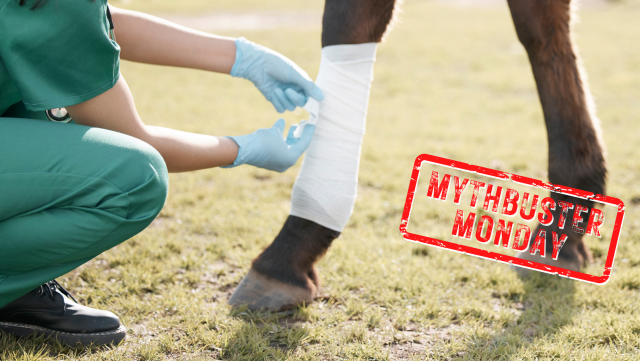
Mythbuster Monday: Wounds Should Be Covered When Temperatures Are Below Freezing
On Mythbuster Monday, we tackle a variety of equestrian myths to either bust or confirm. Today’s discussion: Should wounds be covered when temperatures are below freezing?
It’s Mythbuster Monday, where Horse Nation dives into different equestrian myths and provides research-based evidence to either bust or confirm those myths.
Today’s Mythbuster Monday was inspired by facts shared by an equine social media page. We decided to dig deeper, look at the science behind it, and separate myth from fact. So, here it is — do wounds need to be wrapped in below freezing conditions? Is it only certain types of wounds? What happens if they’re not covered? Read on to find out!
Myth: Wounds need to be covered in below freezing temperatures
Myth or Fact: Myth (sort of)

Canva/CC
An article published by DoDerm explains that wound healing in horses during winter often is delayed due to a combination of cold temperatures, moisture, and environmental stress on the skin. The article highlights that cold weather reduces blood circulation, limiting the delivery of oxygen and nutrients necessary for tissue repair. At the same time, wet and muddy conditions increase the risk of infection, while dry stable air weakens the skin barrier by pulling moisture away. Reduced movement in winter can further slow circulation, compounding the issue.
In relation to the common myth that horse wounds must always be covered in below-freezing temperatures, this article actually supports a more nuanced approach. It emphasizes that the primary goal is to keep wounds clean, protected, and dry, rather than automatically covering them in all cold conditions. Although protective bandages can be beneficial (especially to shield wounds from mud, bacteria, and environmental exposure), the article makes it clear they should be used “when necessary,” not as a blanket rule.
The underlying science presented reinforces why this myth is misleading. Cold itself is not the only problem; instead, it’s the combination of reduced circulation, moisture imbalance, and environmental contamination that delays healing. Covering a wound can help prevent infection and protect fragile tissue, but if a bandage traps moisture or is not properly maintained, it can actually disrupt the skin microbiome and increase infection risk, working against healing rather than supporting it.
Ultimately, the article suggests that winter wound care should be case-by-case, focusing on cleanliness, dryness, and supporting the skin’s natural barrier. This directly challenges the idea that all wounds need to be covered in freezing temperatures, showing instead that proper management — not automatic bandaging — is what truly promotes healing.

Canva/CC
Another article by Chewy PetMD states that proper wound care in horses focuses on cleaning, assessing, and appropriately bandaging wounds to prevent infection and support healing, rather than automatically covering every wound in all conditions. The article emphasizes that wounds — especially on the legs — are common and should be thoroughly cleaned and bandaged when necessary, particularly if there is bleeding, contamination risk, or tissue damage.
In relation to the myth that horse wounds should always be covered in below-freezing temperatures, this guidance clearly supports a situational approach, not a blanket rule. Bandaging is recommended based on wound severity, location, and risk of contamination, not simply because temperatures are cold. For example, lower leg wounds or those with significant bleeding benefit from bandaging to keep tissues clean, while larger body wounds may only need temporary covering or protection from irritation.
The article reinforces that the primary purpose of covering a wound is to protect it from dirt, debris, and bacteria, not specifically to shield it from cold. In fact, improper bandaging — such as wrapping too tightly or failing to maintain cleanliness — can cause complications like tissue damage or infection. This highlights that how a wound is managed is more important than whether it is covered at all.
Overall, the article challenges the myth by showing that bandaging decisions should be based on medical need, not temperature alone. Covering a wound can be beneficial in winter, but only when it supports cleanliness and healing—proving that automatic bandaging in freezing weather is not always necessary and can sometimes do more harm than good if done incorrectly.

Canva/CC
Another article by Chewy PetMD further stated, that in winter conditions, moisture — not just cold — is one of the biggest threats to a horse’s health and healing process. The article explains that when a horse becomes wet, it loses its natural insulation, and moisture trapped against the skin significantly increases the risk of irritation and infection.
In relation to the myth that horse wounds should always be covered in below-freezing temperatures, this reinforces an important distinction: covering a wound is only beneficial if it stays dry. A wet or damp bandage can trap moisture against the wound, creating the perfect environment for bacterial growth and delaying healing. In contrast, a clean, dry bandage can help protect the wound from contamination and support recovery.
This directly challenges the idea that wounds must automatically be covered in cold weather. Instead, it shows that improper bandaging — especially in wet winter conditions — can be more harmful than leaving a wound uncovered. The real priority is not simply covering the wound, but ensuring that whatever protection is used prevents moisture buildup and maintains a clean, dry environment.
Ultimately, the article supports the idea that winter wound care should focus on moisture control rather than temperature alone, debunking the myth and emphasizing that a wet bandage is far worse than no bandage at all.

Canva/CC
RSPCA states in their article, that wet winter conditions significantly increase the risk of skin breakdown in horses. When skin is constantly exposed to moisture (such as mud or snow) it softens and weakens, making it much easier for bacteria to penetrate. This is why conditions like mud fever are so common in winter, as damp environments create the perfect entry point for infection.
In relation to the myth that horse wounds should always be covered in below-freezing temperatures, this article helps clarify that the real concern is environmental exposure, not just the cold itself. Leaving a wound uncovered in wet, muddy, or snowy conditions increases the risk of contamination and infection because the skin and surrounding tissue are already compromised by moisture.
However, this doesn’t mean all wounds must automatically be covered due to temperature alone. Instead, it supports a more accurate understanding: covering a wound is beneficial when it protects against wet, dirty conditions, helping to keep the area clean and shielded from bacteria.
Ultimately, the article reinforces that wet + cold conditions—not cold alone—drive infection risk, and that proper wound management should focus on protecting against moisture and contamination, rather than blindly covering wounds just because temperatures are below freezing.

Canva/CC
These sources collectively debunk the myth that horse wounds should always be covered in below-freezing temperatures. Across veterinary guidance, wound care recommendations, and winter management research, a consistent theme emerges: proper wound care is determined by conditions like moisture, contamination risk, and wound type, not temperature alone. The sources make it clear that while covering a wound can be beneficial in certain situations, it is not universally required and can even be harmful if it traps moisture or is not properly maintained. Cold weather may slow circulation and healing, but it is the combination of wet conditions, bacteria exposure, and poor bandage managementthat poses the greatest risk. Far from requiring automatic bandaging, effective winter wound care depends on keeping wounds clean, protected when necessary, and most importantly dry, reinforcing that thoughtful management — not blanket rules — is essential for promoting healing and preventing infection in horses.
Do you have an equine myth you’d like us to tackle? If so, send it our way! Email your suggestions to [email protected]. Put Mythbuster Monday in your subject line.
