



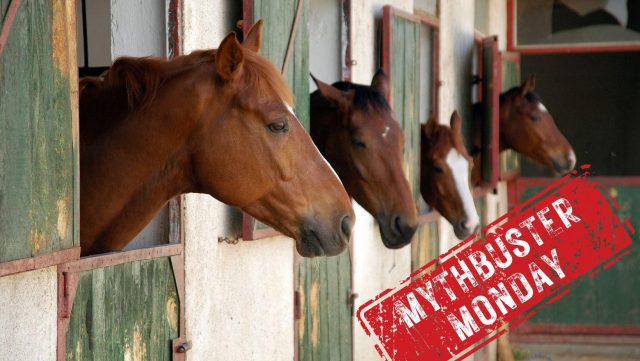
Mythbuster Monday: Performance Horses Shouldn’t Be Turned Out
On Mythbuster Monday, we tackle a variety of equestrian myths to either bust or confirm. Today’s discussion: Should performance horses be turned out?
It’s Mythbuster Monday, where Horse Nation dives into different equestrian myths and provides research-based evidence to either bust or confirm those myths.
Today’s Mythbuster Monday was inspired by an Instagram post stating that a performance horse, valuable horse, or “fancy” horse needs to stay in the training program with no turn out.
It sparked enough curiosity that we decided to dig deeper, look at the science and physiology behind it, and separate myth from fact. So, here it is: Should performance horses be turned out? Read on to find out!
Myth: Performance horses shouldn’t be turned out
Myth or Fact: Myth

Canva/CC
A performance horse is an athlete whose body, mind, and training come together to excel at a demanding discipline. Whether they are competing in barrel racing, mounted shooting, reining, cutting, roping, eventing, or another sport, performance horses are asked to demonstrate strength, speed, agility, balance, coordination, endurance, and responsiveness. Behind every successful performance is a combination of genetics, conditioning, nutrition, proper management, training, and a strong partnership between horse and rider. Like any athlete, a performance horse requires thoughtful care and preparation to stay healthy, sound, confident, and capable of performing at its best.
But, should they be kept in their stall 24/7?

Canva/CC
A cohort study examining 146 riding horses with a median age of 17 years compared horses receiving less than 12 hours of turnout per 24 hours with horses receiving 12 or more consecutive hours. The results showed 50.6% of horses receiving less than 12 hours of turnout experienced a soft-tissue injury, compared with only 24.6% of horses receiving 12 or more hours of turnout. The difference was statistically significant.
The authors concluded that there was an inverse relationship between the amount of paddock turnout and soft-tissue injury risk. More turnout was associated with less, rather than more, soft-tissue injury. This directly challenges the common argument that keeping a performance horse confined to its stall protects its tendons and ligaments. The study also provides an important physiological explanation: maintaining a baseline level of fitness may help protect against injury, while changes in workload and fitness are recognized contributors to soft-tissue injury.

Canva/CC
Another study found that horses receiving limited turnout per day had a 4.6-fold higher rate of musculoskeletal injury compared with horses turned out 24/7. They also found that every additional acre of average daily turnout area during the fourth month of life was associated with a 24% reduction in the rate of musculoskeletal disease or injury.
The authors specifically discuss the biological importance of appropriate movement during development. Experimental evidence indicates that moderate increases in locomotor activity can increase bone size and strength and support development of cartilage and tendon. Conversely, too little activity — including prolonged confinement — may leave musculoskeletal tissues less prepared for athletic demands. The important takeaway is that movement isn’t inherently the enemy of soundness. Appropriate, progressive movement can actually be part of developing and maintaining a resilient musculoskeletal system.

Canva/CC
A study titled “Effects on the Behavior of Competition Horses Housed in Single Stalls” addresses the exact argument commonly made about competition horses: that turnout increases injury risk and that training provides all the exercise a performance horse needs. The researchers compared competition horses receiving no turnout with horses receiving free exercise before or after training. The horses without turnout demonstrated more restless behavior in their stalls, while turnout resulted in calmer behavior. Importantly, the researchers found no significant difference in willingness to perform between the turnout and no-turnout treatments.
That matters because one of the arguments against turnout isn’t simply injury, it is that a horse will “waste energy,” become too fresh, or lose its competitive edge. This study didn’t support that assumption. The horses remained willing to work, while turnout produced a more relaxed behavioral state. The authors concluded that horses were more relaxed in the stable when turnout was provided and that turnout did not negatively affect their performance willingness.

Canva/CC
Another study compared horses maintained on pasture with horses kept stalled. The pasture horses demonstrated greater lateral bone density at the end of the study. The pasture group also showed lower heart rates during portions of the standardized exercise test, while the stalled/no-exercise group had higher one-minute recovery heart rates.
This challenges the idea that a performance horse needs to be confined in order to maintain athletic fitness. The horses getting free movement through pasture were able to maintain, and in some measures improve, aspects of their fitness and skeletal status. For performance horses, this suggests that low-intensity, self-directed movement can complement structured training rather than necessarily interfering with it.

Canva/CC
Although turnout can introduce opportunities for injury, the evidence does not support the belief that performance horses are inherently safer when confined to their stalls. Research demonstrates that appropriate turnout and voluntary movement can support musculoskeletal health, maintain fitness, reduce physiological stress, and may be associated with a lower incidence of soft-tissue injury in performance horses. Collectively, the research demonstrates that the relationship between turnout and injury is influenced by several factors. Therefore, describing turnout as inherently dangerous for performance horses oversimplifies the complex interaction between movement, conditioning, environment, and injury risk. A performance horse’s management should instead be evaluated in the context of the individual horse, its training and fitness, the quality and safety of its turnout environment, and the consistency of its routine, not whether the horse spends time outside of its stall.
Do you have an equine myth you’d like us to tackle? If so, send it our way! Email your suggestions to [email protected]. Put Mythbuster Monday in your subject line.
