



Thoroughbred Logic, Presented by Kentucky Performance Products: The Laundry List
When full disclosure becomes a deal-breaker, good horses can be overlooked—not because of what they can’t do, but because buyers fear what they already know.
Welcome to the next installment of Thoroughbred Logic. In this weekly series, Anthropologist and trainer Aubrey Graham, of Kivu Sport Horses, offers insight and training experience when it comes to working with Thoroughbreds (although much will apply to all breeds). This week ride along as Aubrey shares her logic on selling horses with full disclosure.
I find Thoroughbred buyer behavior to be both fascinating and frustrating. As an anthropologist, I am often intrigued. As a professional reseller I end up smacking my head and wondering what time is a good time to pour a stiff drink.
The piece of human behavior that I have been intrigued about recently is the laundry list — the list of dents and dings that have to be disclosed. Sometimes disclosure is before the pre-purchase exam if things are known. Other times it is during the PPE that this list comes to light. The list might contain any number of things: old scars and a history of surgeries, splints, cosmetic blemishes, and minor arthritises, etc.

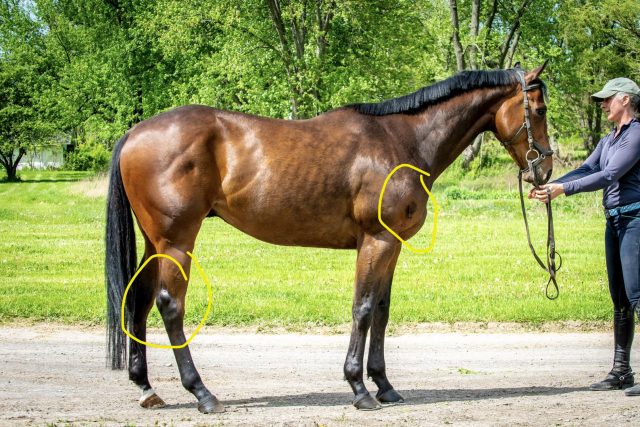
Hamster (Bromista) thankfully only had a few little things to list from his PPE and had a very smart horseman for a buyer, who got a steal of a deal on a really, really nice horse. Photo by Lily Drew.
Right now what I’m trying to figure out is this: for buyers, how many list items is too many? This is, of course, horse and human dependent, but there is a general trend here… I think three or four is where we start to get into the “that’s just too much” territory.
Let’s take Artie (Reunion Tour) for instance. He has been PPE-ed a few times in the past and everyone has walked away due to the laundry list, not really due to any one particular thing.

Artie flying around Novice stadium at GVH two weeks ago. Photo by Lily Drew.
- Some fill in his ankles
- Reactivity to palpation at his SI
- Minor hock arthritis
- Occasionally footsore depending on farrier situation (and we do inject his coffins)
- Very minor heart murmor
- Thickening at his medial sesamoids from old interference
- Minor parrot mouth
For me, I look at all of that and go, “What really matters there?” And when I ask that question, I tend to aim it in the direction of “what does he need so I can help him perform most comfortably?” But for some, that list of things is not just the items themselves, but the collective list that kills the desire to buy the horse.

Ignore me, look at him. Artie has turned into quite the beast in the process of training up the levels. Photo by Lily Drew.
But let’s think about it. Is any one of those things going to stop him from having a low to mid level career, as the folks PPE-ing were hoping? Not likely.
Frankly, I’m starting to wonder if any of that will keep him from an UL career — he’s running Novice currently and working steadily towards Training… So we’ll just keep heading up the levels until he tells me he’s not interested in anything higher. Frankly, I’m thrilled all those folks passed; I’m quite a fan of this little red oddball.
Ready? I’m going to bore you. Here’s the list extrapolated into if it matters or not:
- Fill in the ankles? Not really that important to me. He might need maintenance eventually, but he flexed well, so it’s an observation not a clinical finding.
- Reactivity to the SI? This is likely due to compensation from things that need fixing from his hind feet up. I’d look to get shoeing right and make sure all joints in the hind limbs are happy. I don’t usually worry too much. Instead, I approach it with an “OK, what maintenance do you need?” approach.
- Hocks need help for arthritis. Cool. Artie ran many seasons and 47 races. No shock that there’s arthritis. I expect to maintain my horses if they need it and there are so many great steroidal and non-steroidal options these days.
- Footsore sometimes? OK, One PPE I had tacked a shoe back on because he had tossed it a day previous. All this says is that a buyer should get some rads of the feet and chat with a knowledgable farrier to shoe him well.
- Heart murmur? Thoroughbreds often have them. A very minor heart murmur doesn’t bother me. Sure it could be something to be checked out by a cardiologist if it seems to impact anything at all, but many racehorses have physical murmurs due to the large size of their hearts and their fitness. I’ll need to write a more specific article on this at some point. But a grade one (according to two sets of vets I use here) usually is not concerning. That said, for liability sake, they cannot make guarantees without a cardiologist workup. Vets definitely don’t love getting sued if things go wrong in the future, so a murmur will always be an “open question.”
- A parrot mouth is just a little big of an overbite. It simply means that the front teeth don’t line up and you’ll have to stay on top of your annual dentals. If you already do that, this usually has no change or consequence. Great.

None of those things are keeping him from absolutely cruising around XC. Photo by Lisa Michelle Dean Photography.
OK, here’s the thing — you just read all of that and are probably bored. That’s the point. It is a list. It is a lot. And it is long. And it often scares buyers away.
To perhaps make the case clearer: While showing a really lovely woman a horse the other day, I pointed out the things I needed to say to do my due diligence. Sequestrum surgery here, old scar here, thoroughpin here (a cosmetic swelling of the deep digital tendon flexor sheath in the hock), will stock up in stall on this leg, and we know there is minor arthritis in the hock because a vet looked at one point and I have been shown the rads. Cool. None of this causes him to flex poorly, present as lame on lunge or under saddle, and none of it currently needs any maintenance.

Taxi (Price of Peace) with his couple of cosmetic blemishes. Photo by Lily Drew.
I pointed these things out on the horse. The buyer was with me until I said the second to last “and” and I saw the “that’s too much” creep across her face. She was moving on and backing away before I finished the list. “My husband would never let me bring one home with all of those things,” she politely commented to end the discussion and sale.
So here’s the thing. For the job asked (a lower- to mid-level career), with literally the most ammie friendly personality in the barn, that horse was set to be someone’s favorite horse of all time. But person after person passed because of the length of the list. Now, he did recently sell to a great home who is excited about him despite dents and dings, but getting to that willing buyer took months of folks whose interest took a cold shower in list-land.

Taxi being fancy out and about in the field. Photo by Lily Drew.
As a reseller, I don’t feel that I can simply not disclose things — especially the cosmetic things that will need an explanation lest someone see a huge thoroughpin and think the horse is broken.
So how do we as an industry handle this?
One option: We could present the data differently (or as an unrecommended option, not present it at all).
I need folks reading to know that I don’t like this option … at all. I know more resellers who disclose as much as they know than those who omit info. But conceivably, one could let buyers find things on PPEs on their own without disclosing potentially anything. In which case, one simply shortens or negates the list, keeping interest high. Perhaps limiting the list “helps,” too, but I like to be thorough.

Neil (Lute’s Angel) also had a bit of a laundry list on his PPE a few years ago. The nail in the coffin was his glowing personality (he spent the whole time trying to kick the vet). I couldn’t be happier that he “failed” and I got to hang onto him. Photo by Lisa Michelle Dean Photography
Option 2: Educate
Unsurprisingly, I like this better. A laundry list asks for an educated horseman. It asks for a realistic human who can, with the help of an equally realistic vet and trainer, suss out what is important, weigh that against their goals and finances and make educated decisions. The decisions come from the ability to understand the horses’ issues not from the overwhelming nature of a list that has more than two… or three… items.
Frankly, I feel like we have a whole population of folks hunting for Thoroughbreds a bit the wrong way. People at all skill levels are often looking for Thoroughbreds with the hope of finding the perfect specimen whose body has no red flags at the time of buying. Instead, I’d argue that we need people who understand the process and who are prepared to help their horses along the way. In other words, we need more horse people who think of flags more as those that delineate paths forward rather than encourage one to run for the hills.
Those folks exist. I just think we need more of them.

Tino (JC Narcissistic) is coming along super well. Thankfully, he’s been so sound since the track that we don’t have much to disclose on him as I have no sense of if there are issues or what they might be. Photo by Lily Drew.
This laundry list problem is probably interesting enough for me to do an anthropology deep dive on (AKA I could literally write a book about this). This issue opens up a lens to a nexus of issues: education and horsemanship, the anxiety-ridden American culture and the hunt for perfection, the economy, and optimistic buying behavior based often on, I hate to say it, what one doesn’t know yet (I’d say “ignorance,” but that seems a bit harsh).
When I have a new horse, fresh off the track, I often know next to nothing about them. They might move nicely, probably need new shoes and some proper farrier work, and likely need to let down from their track fit, greyhoundish body. In this stage, unless they are sporting edema somewhere or have obvious lameness, I have nothing to disclose. I don’t know anything. I am ignorant of what is or is not under the surface.

Frosty Maya is a stunning mare who came in and only stuck around for a few weeks. She vetted well and due to no knowledge of other issues, out the door she went to a lovely eventing home in the mid-west. Photo by Lily Drew.
Now… let them hang out for a bit, let them let down, drop their track muscle, and let their body try to figure out a whole new lifestyle, let me put a bunch more training on, and suddenly we might know a bit more. They might have an initial PPE which might have findings. They might be sore through their hind end, which is exceptionally common, and sometimes prompts radiographs and the oh-so-common finding of hock arthritis. In other words, the longer a person is involved in their let down, the more that person will know.
And the more you know, the longer that list of “what has to be disclosed” grows.
So it’s a bit of a catch 22. The “perfect specimens” sell quickly because we simply don’t know anything…yet. If anything comes up, the buyer will be the one figuring all of that out and deciding whether or not they can accept, afford, manage, and treat it all later. But if I or another reseller or first buyer have done the figuring out and it’s more than two things, the list factor takes over and the price often reduces as does the interest.

Artie at GVRDC earlier this season, showing off his spice and hind end. Photo by Lily Drew.
See, that is what I find fascinating. Realism and the “known” with these horses comes with a cost. The optimistic unknown (the blank slate horse) on the other hand, is what sells. Huh…
So go ride, folks. I’m off to an early morning of hacking my show string of horses, all of whom have substantial laundry lists. But I can tell you one thing: I’m sure glad the list won out on these guys as Neil and Artie (both of whom had list-y PPEs) are still here, and I am having a fantastic time producing them up the levels, despite the list of dents, dings, and need for maintenance.
About Kentucky Performance Products, LLC:
Girthiness. Sour attitude. Colic. Poor body condition. Little appetite. Does that sound like your horse? If your horse is consuming a high-grain diet, regularly under stress (i.e., competition horses, horses that travel, young horses in training) or prone to digestive issues, Neigh-Lox ADVANCED should be a staple in your feed room.
This supplement provides a scientifically advanced blend of ingredients that work synergistically to maintain a healthy stomach, small intestine, and hindgut. Horses with a robust GI tract don’t just feel better, they absorb optimal levels of nutrients and maintain body condition more easily. They aren’t just less prone to digestive problems—they have a stronger immune system overall. Don’t underestimate the role your horse’s gut plays in their overall well-being. Click here to learn more about Neigh-Lox ADVANCED.
Kentucky Performance Products creates scientifically proven supplements for your horse. Our supplements provide solutions to the everyday challenges facing your horse. The horse that matters to you matters to us®. Learn more about KPP at kppusa.com.

