



Training in the Right Way: “My Horse Hates Dressage.”
He doesn’t. I promise. Story time.
Dressage training is supposed to be the process of training ANY horse to be a better riding horse. The more the horse learns, in theory, the easier it is to communicate with and therefore complete more complex tasks with. Although competition dressage training often is more focused on training for the dressage test, that is not what the original intention (and original judging requirements) were for competitive dressage. Initially, it was designed to give riders and trainers a way to determine how their training measured up to the theoretical ideal of the training process. That said, it is critically important to understand the meanings and reasons for some of the terms we use to describe dressage training and what to look for when observing training and competition (and videos and photos), regardless of whether you intend to compete or just train your horse to be a better whatever you do with him. That, ultimately, is the main purpose of my articles. To provide education and knowledge for riders to understand and improve their eye and understanding of what dressage training is supposed to be. While there will always be some differences in practice and theory, good horse training is always recognizable to the educated eye. That said, it absolutely is necessary that we remember and understand that limited knowledge is limited judgment.
* * *
Does your horse hate dressage? Many people tell me their horse prefers to jump or hack (or do just about anything else) than do dressage. Sometimes the reason is because the horse thinks dressage is too hard. Sometimes they are just happier out on the trail or likes to go more forward over fences. Sometimes riders tell me that the horse just fights with me the whole time we work on the flat.
But here’s the thing, in my 40 year training career, while I have definitely met horses that do not enjoy practicing dressage training principles, the reasons that people tend to attribute this to are most likely not actually correct.

Horses have no way of knowing that they are “doing dressage”. They just know they are being ridden. Photo (c) Gwyneth McPherson.
In general, dressage or not, reasons that horses don’t do what we want them to do, or do things we don’t want them to do, boil down to essentially four things:
- Improperly fitting tack
- Pain (eg. tooth problem, ulcers, kissing spine)
- Lack of training
- Improperly given aids (misunderstanding).
The fifth and most unlikely reason is deliberate disobedience. It can happen, but in comparison to the other four, it is extremely rare.
The good news for all dressage enthusiasts and folks who may not be enthusiastic about dressage but have to do it anyway (looking at you, eventers), is that horses have ABSOLUTELY NO WAY OF KNOWING THAT THEY ARE “DOING DRESSAGE.” When they are in a riding arena, they only know that they are being ridden, and they can clearly see if the sticks are set up to jump over, or not. And when they are being ridden on the trail or on the cross-country course, they have the same recognition. After that, and assuming that they have properly fitting tack and no pain issues, it is entirely the rider’s responsibility to be asking the horse to do things that his previous training supports and give the proper aids and timing of the aids to develop the balance and responses that the rider wishes to create. This is, coincidentally what dressage actually is (training). I know this makes it sound very easy. I also agree it is not that easy. But it is still true.
Now I have a much abridged, with names and details redacted to protect the innocent, personal history story to tell. Once upon a time, way back in the 1980s, I had a horse that was an excellent jumper and became my dressage horse. He did really well at Training Level and First Level, but as he developed into a Fourth Level/FEI horse I had a lot of trouble with collection, suppleness, and impulsion. Regardless, we were pretty competitive and this horse did accomplish some wonderful things, and I am very indebted to him. But we could never quite make it to the point of competing at Grand Prix. This is one of those scenarios of if I only knew then what I know now and I would give almost anything to have this horse back again and do it better. But I did learn (eventually) a very important and (to this day) painful lesson from him.

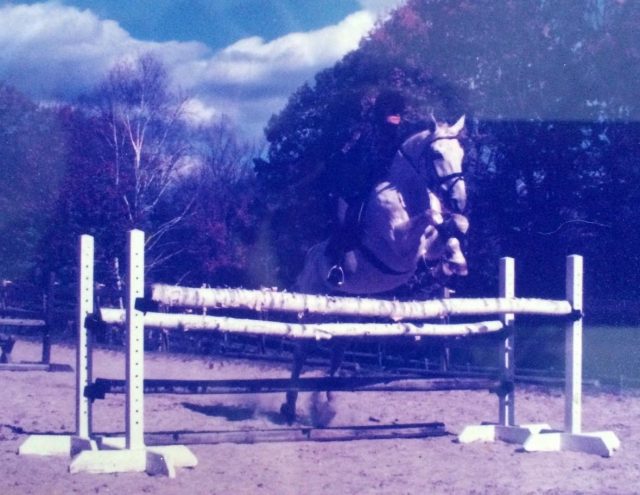
If your horse willingly performs other tasks without a struggle, maybe you should pay attention to how you are riding him in those moments. Photo (c) Gwyneth McPherson.
Remember, this horse was a jumper before I had him. And even though my competitive eventing career only lasted from age 9 to 12, I had continued developing my skills over fences and was pretty competent riding a 3’ 6” to 4’ stadium course. So, I did occasionally take this horse over fences AND he loved it (so did I).
We also could ride out into the woods and fields at any gait with no problems. But when we were schooling for dressage competition, it was often not fun for both of us. I know why now, I could easily help that kid and that horse make it to Grand Prix today. But during that time period I wrestled with the question: why is it so easy to ride this horse out in the woods and fields or over fences in the arena, but I can’t get him to be that easy in the hand and light to the leg when I’m schooling our FEI work?
The short answer was that it was me. I was the reason. I was giving the wrong aids, or the right aids with wrong strength or timing, and I was not getting the results I thought I should get, and I just got tougher on him. To his credit, he put up with me and kept going. But when we were jumping and cavorting out in the woods and fields, I was riding COMPLETELY DIFFERENTLY. Not because it was not dressage, but because I was in a different mindset, and I was riding with much more appropriate (kinder) aids. The same kind of aids I should have been using in the dressage arena to create the effort I wanted from him. But I hadn’t gotten the memo on that. I was convinced that dressage was harder than the other stuff and needed to be ridden differently. I am not that kid anymore. I am very fortunate to have gotten the training to do it a better way, and although I can’t go back and train that horse better, I can pay it forward.
So, does your horse hate dressage or does he just hate how you are doing it? I can tell you the answer. If his tack fits correctly, and he is free of pain issues, most likely it is the rider needing to change the way they do dressage.
Remember: Limited knowledge is limited judgment.

Gwyneth and Flair in competition at Grand Prix. (c) flatlandsfoto.
Gwyneth McPherson has over 35 years experience competing, training, and teaching dressage. She began her education in in the late 1970s, riding in her backyard on an 11 hh pony. Her first instructor introduced her to Lendon Gray (1980 and 1988 Olympian). who mentored Gwyneth for a decade during which she achieved her first National Championship in 1984, and her Team and Individual Young Rider Gold Medals in1987.
In 1990 Gwyneth began training with Carol Lavell (1992 Olympian) who further developed Gwyneth as an FEI rider and competitor. Gwyneth achieved a Team Bronze in 1991 and a Team Silver in 1992 in the North American Young Riders Championships, and trained her stallion G’Dur to do all the Grand Prix movements while riding with Carol.
In 2008, while Head Trainer at Pineland Farms, Gwyneth began training with Michael Poulin (Olympian 1992). Michael was trained by Franz Rochowansky (Chief Rider for the Spanish Riding School 1937-1955). Michael has shared much of Rochowansky’s knowledge and wisdom with Gwyneth, completing her education as a Grand Prix rider, trainer, and competitor.
Gwyneth’s teaching and training business, Forward Thinking Dressage,is based in Williston, FL. In addition to teaching riders and training, Gwyneth also loves sharing her knowledge of the sport and art of dressage as well as discussing relevant topics pertaining to the training itself and the current competitive landscape.

