



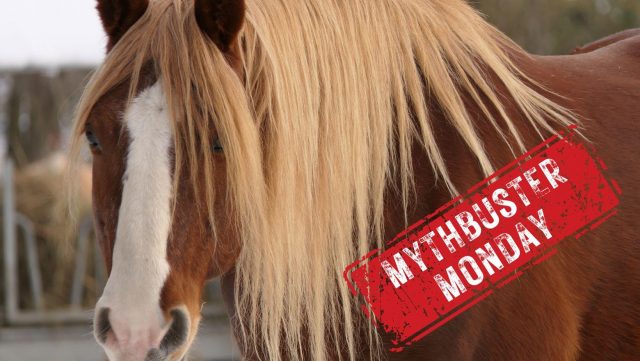
Mythbuster Monday: Cutting a Horse’s Hair Makes it Thicker
On Mythbuster Monday, we tackle a variety of equestrian myths to either bust or confirm. Today’s discussion: Does cutting a horse’s mane and tail make it grow back thicker?
It’s Mythbuster Monday, where Horse Nation dives into different equestrian myths and provides research-based evidence to either bust or confirm those myths.
Today’s Mythbuster Monday was inspired by a social media debate.
It sparked enough curiosity that we decided to dig deeper, look at the science and physiology behind it, and separate myth from fact. So, here it is: Does cutting a horse’s hair make it grow back thicker? Read on to find out!
Myth: Cutting a horse’s mane and tail will make it grow back thicker
Myth or Fact: Myth

Canva/CC
A horse’s mane and tail are made up of long, coarse hairs that grow from specialized follicles along the crest of the neck (the mane) and from the dock, or tailbone (the tail). While they certainly add to a horse’s beauty and breed character, they also serve important purposes. The mane helps provide some protection from insects, rain, and the sun along the neck, while the tail acts as a highly effective fly swatter, helping keep biting insects away from the hindquarters. Horses also use their tails and ears together to communicate emotions, making the tail an important part of their body language.
Although the mane, tail, and coat are all made of keratin, the same protein found in human hair and nails, they are not the same type of hair. Mane and tail hairs are much thicker, stronger, and have a longer growth cycle than the finer hairs that make up a horse’s coat. Coat hair is designed to shed and regrow seasonally to help regulate body temperature, while mane and tail hair grows continuously for years before naturally falling out. This difference in structure is why mane and tail hair can grow so long and withstand daily wear, making proper grooming and nutrition essential for maintaining their strength, shine, and overall health.
But, if you cut a horse’s mane or tail, will it grow back thicker?

Canva/CC
A 2020 BMC Genomics study provides strong scientific evidence that debunks the common myth that cutting a horse’s mane or tail causes it to grow back thicker. Rather than examining the hair shaft itself, researchers studied the biology of the hair follicles in the mane, tail, body, and fetlocks of Mongolian horses. They found that mane and tail hair naturally originate from larger, specialized hair follicles with unique structures, growth cycles, and patterns of gene expression. These characteristics are determined by the follicle itself, not by the portion of hair that extends above the skin.
The researchers also identified biological pathways, including stem cell activity, Wnt signaling, IGF signaling, and angiogenesis, that regulate hair follicle development and determine how hair grows in different regions of the horse’s body. Because trimming or cutting only removes the dead hair shaft and does not alter the living follicle beneath the skin, it cannot change follicle size, density, or genetic programming. While a freshly cut mane or tail may appear fuller because the hair has blunt ends instead of naturally tapered ones, the study demonstrates that hair thickness is controlled by the biology of the follicle, making the belief that cutting a horse’s mane or tail makes it grow back thicker a myth rather than a scientifically supported fact.

Canva/CC
The study “Distribution Densities of Hair Follicles in Racehorses” examined how hair follicles are distributed across different areas of the horse’s body. Researchers collected skin biopsies from 46 locations on seven Thoroughbred horses to measure follicle density and determine whether different regions naturally contain different amounts of hair-producing structures. The study found that hair follicle density varies depending on the body region, with some areas naturally having more follicles than others. This demonstrates that the amount and thickness of hair a horse can produce is determined by the number and arrangement of follicles in the skin, not by what happens to the hair shaft after it grows.
This research helps debunk the myth that cutting a horse’s mane or tail will make it grow back thicker because trimming does not create new follicles or increase the density of existing ones. A pair of scissors only removes the visible portion of the hair above the skin, while the living follicle responsible for producing hair remains unchanged. A trimmed mane or tail may appear fuller as it grows because the ends are blunt rather than naturally tapered, but the actual thickness, growth rate, and density of the hair are still controlled by genetics and follicle structure. This study supports the understanding that a horse’s natural hair characteristics come from its biology, not from cutting or shaving the hair.

Canva/CC
The study “Changes in Hair Coat Length and Diameter in Blanketed and Nonblanketed Adult Horses in the Winter” provides additional evidence that hair growth and thickness are controlled by biological processes within the horse, not by cutting or trimming the hair shaft. Researchers evaluated 16 mature horses over the winter months, comparing horses that wore blankets with horses that did not. They measured changes in hair length and diameter over time and found that coat growth followed a seasonal pattern, with hair length and diameter naturally increasing during the colder months and decreasing as seasons changed. The researchers identified factors such as daylight changes (photoperiod) and environmental temperature as important influences on hair growth cycles.
Although this study focused on the horse’s body coat rather than specifically the mane and tail, it supports the same biological principle behind why the belief that “cutting a horse’s mane or tail makes it grow back thicker” is a myth. Hair diameter and growth are regulated by the living hair follicle and the horse’s natural growth cycle, not by cutting the ends of the hair. The study showed that changes in hair characteristics occurred because of internal and environmental signals, not because the hair was shortened. When a mane or tail is trimmed, the blunt cut ends can make the hair appear temporarily fuller or thicker, but the actual structure, density, and growth potential of the hair remain unchanged because the follicles themselves are not altered.

Canva/CC
These sources collectively debunk the myth that cutting a horse’s mane or tail will cause it to grow back thicker. Across equine hair follicle research, veterinary hair biology, and studies examining factors that influence hair growth, a consistent message emerges: hair thickness, density, and growth rate are determined by the structure and function of the hair follicle, not by cutting the visible portion of the hair. Research has shown that mane, tail, and coat hair have unique follicle characteristics, and that the number, size, and activity of those follicles are established biologically through genetics and physiological processes. Because trimming only removes the dead hair shaft above the skin, it cannot create new follicles, increase follicle density, or change the natural thickness of the hair produced.
While a freshly trimmed mane or tail may appear fuller as it grows because the ends are blunt rather than naturally tapered, this is only a visual change and does not represent an increase in actual hair thickness. The evidence supports focusing on factors that truly influence mane and tail health, including genetics, nutrition, minimizing breakage, proper grooming practices, and maintaining healthy skin and follicles. Collectively, the research demonstrates that cutting a horse’s mane or tail can change its length and appearance, but it does not change the biology that determines how thick that hair can grow. A healthy, full mane and tail come from supporting the horse’s natural hair growth cycle, not from cutting it in hopes that it will grow back thicker.
Do you have an equine myth you’d like us to tackle? If so, send it our way! Email your suggestions to [email protected]. Put Mythbuster Monday in your subject line.
