



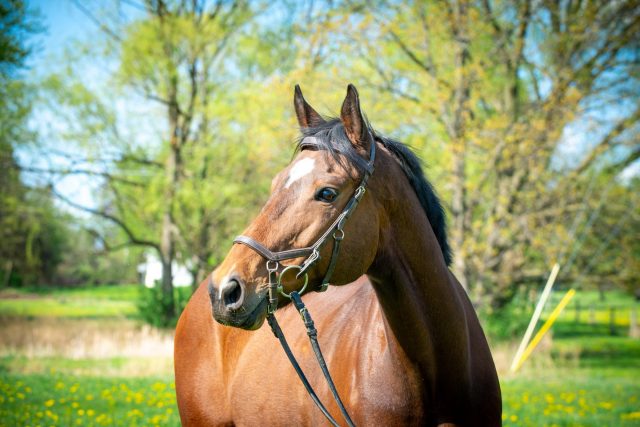
Thoroughbred Logic, Presented by Kentucky Performance Products: Generosity and Data Sharing
“I am reminded daily that the more we know, the better we can do… And because there is no standardization of how information moves with horses, data sharing requires generosity.”
Welcome to the next installment of Thoroughbred Logic. In this weekly series, Anthropologist and trainer Aubrey Graham, of Kivu Sport Horses, offers insight and training experience when it comes to working with Thoroughbreds (although much will apply to all breeds). This week ride along as Aubrey shares her logic on how sharing information ultimately is in the horse’s best interest.
Generosity is one seriously underrated trait. And honestly, because so many people in the circles I run in simply tend to be generous by default (perhaps this is why no one has any actual money…), I am always kinda stunned when folks are not.
The Thoroughbred world is an interesting one on this front. On one side of it — a side where I spend a lot of time — you have organizations like the Retired Racehorse Project and their annual Makeover. In the eight years I have gone, that organization’s employees and volunteers have busted their behinds to keep that show living up to its moniker as ‘the happiest horse show of the year.’ Folks are supportive. They’re kind. And while sure, a few bad competitor eggs here or there patently suck, the rest are there for their horse, and more -importantly, for the breed. It is an environment in which I found like-minded people for the first time in my horse showing life. I found friends, colleagues, and mentors. And it is there that I found the help to get my business going and grow it in the Thoroughbred-forward direction I have. Because of generosity.

Looking like an idiot, waiting to go in to the championships at this past year’s Makeover with some of my favorite humans that Thoroughbreds have brought into my life. Photo by Aly Ratazzi.
There, there remains a sentiment of, “If you win in the pursuit of helping the Thoroughbred, we all win.” Generosity (and the information sharing that comes with it) was somehow built into the culture of transitioning the Thoroughbred from the races to the sport horse life.
The gritty reality and politics for the employees, the fundraisers, and their long, often thankless and underfunded hours, days, weeks, months and years, is I’m sure far less perfectly rosy than the consumer side we access. But that organization and its drive for Thoroughbred-based community that prioritizes the horses and the breed nonetheless set a standard.
The more I operate in the further corners of the Thoroughbred world, the more I realize how complex and fractious that world is. And part of that complexity is that the idea of ‘Thoroughbred community built on generosity’ does not extend as far as I would like.
Data sharing becomes an easy example.

A radiograph for a mare recently returned to my program. Thanks to the generosity of her former owner, we’re able to use this data to shoe her correctly and address any veterinary needs. Image courtesy of Rachael Crews.
These horses (Thoroughbreds) do better if we have data. Hell, that applies to all horses. The more we know, the better we can do.
Today, one of the only ways to access a horses’ veterinary history is through the well-intentioned sharing of records from individual to individual.
HISA (Horseracing Integrity and Safety Authority) keeps veterinary records on each of their racehorses that run in the states that are signatory to the organization. Louisiana, Texas, and West Virginia tracks do things differently and do not play by HISA rules. But what that means is that every time a horse is examined by a track-appointed vet (private veterinary records are not held there), every time a horse is injected or vaccinated while at the track or in relation to their runs, it shows up on their HISA account. That is helpful info.

A Thoroughbred breezing on a very chilly morning at Finger Lakes Track. Photo by author.
And yet, as a horse moves from track to its second career, it is only track-related veterinarians and racing-affiliated others who can access the horse’s record. As a private sport horse trainer, even with the horse in my barn, I have no access to its veterinary history on the track. Nor does my quality sport horse vet. In fact, during a PPE the other day, when needing to get vaccine data on on sales horse, a private vet was able to phone a friend who is affiliated with the track and have them access the horses’ account, screenshot it, and send it back to the buyer. That’s a whole lot of dubious hoop jumping to access vaccine records.
Similarly, for horses already off the track, or who have been attended to by private veterinarians, the is no publicly accessible record database. The active, intentional willingness to share records is the only way that the veterinary history on these horses follows them.
Certainly, I get why folks would want to keep certain records quiet, and why HISA keeps them centralized. The desire to keep past medical history from influencing value, and simple privacy count. But equally, I am reminded daily that the more we know, the better we can do.

Mr. Magico is quite upright through his hinds and it would be great to know if he was maintained on the track. Regardless, he’s getting the maintenance he needs here and his records will travel with him when he finds a new human. Photo by Lily Drew.
Why, for example, when a horse has had routine hock injections every six months for the past two running years, should that information not follow the horse from private owner to private owner, or from the track to a new non-racing home? I hear it all the time when new owners look at the six- or eight-year-old well-raced Thoroughbred and decide that they are simply too young for maintenance. I mean, they didn’t start injecting their Warmblood until they were 14, so why would this whipper snapper of a Thoroughbred need something different? And when said horse is crabby and their back is sore because the mild arthritis in their hocks causes them to travel just differently enough, folks blame the Thoroughbred for their temperament or difficult nature under saddle, increase their bit severity, or look past their limbs and commonly zoom in on their back (the symptom) to explain the cause.
Would more regular or open-source record sharing perfectly unite the diverse and divisive Thoroughbred industry? No. Of course not. But it would provide more information that could reduce redundant diagnostics and help the horses receive the care they need when they need it. Records, radiographs, explanations of time off, etc., all are small pieces of a very complex puzzle that help us start to understand who the horse in front of us was, and who they may be able to become. Sharing records from track vet to off-track vet, from owner to buyer, from new owner to consignment home, from agent to new owner, and from someone who did a PPE but passed to the owner or agent, ultimately is helpful for the horse.
And because there is no standardization of how information moves with horses, data sharing requires generosity.

Due to the kindness of his former owner, I have a few snippets of data on Poe (Edify)’s veterinary history. Those helped us place him in an appropriate home. Photo by Lily Drew.
Data sharing should probably just be standard. It oughtn’t need morality attached to it. But in the day of privately held information, sharing data is a choice. And thus, to do so willingly is generous. To refuse to do so, equally, just makes someone an ass.
Yep. It’s that simple.
What I don’t understand is the logic that because someone paid for something of their own accord, with no expectation or agreement of reimbursement, that they should be unwilling to share beneficial information on a horse without payment. See the last statement above about what that makes someone.
The PPE is a great test of character. Someone willingly desires to buy a horse and chooses to vet them. They listen to the heart, lungs, gut, look in eyes, palpate every tendon and joint, flex and potentially take radiographs. Due to the findings, life circumstances, or other discussions with trainers, vets, husbands, or whatever, they decide to pass. Not a problem. Yet, that person, who likely will never have another interaction with that horse in their lifetime, may have more information on said horse than the owner does. Let that sink in.

Despite passing on Taxi (Price of Peace) because the morning after his PPE he was kicked and fractured a chip off his shoulder (totally fair reason to pass), the buyer willingly shared the report and the radiographs, which will help us to place him in an appropriate home in the future. Photo by Lily Drew.
The “I paid for it, so you should have to, too” is wild to me. But it is also quite common. It’s the same logic of teachers who make it hard because it was hard for them. It has never made sense. Perhaps I’m simply not a good capitalist.
Information sharing is for the good of the horse, folks. Sometimes, these things aren’t that hard, but they become hills folks decide they’d rather die on than be kind or helpful. And it drives me nuts, because a good portion of the time, those folks digging that trench to hunker into on that damn hill are those with the financial ability to support the breed and the horse.
Because when the horse wins, we all win, right?
Ok, enough ranting for the morning. Go ride, folks. And pat your ponies — they are, in fact, the reason we all are here.
About Kentucky Performance Products, LLC:
Strong bones start with smart management and targeted nutrition. A well-balanced bone supplement is beneficial to maintain normal bone development for horses in utero, horses showing signs of developmental bone diseases, young horses going into training, horses confined to a stall or laid up, mature horses recovering from skeletal injury or returning to training, or older horses with a demanding competition schedule.
BoneWise® supports strong, resilient bones throughout a horse’s life. It contains a unique form of highly digestible calcium (Lithothamnion) that is research-proven to sustain optimal bone mineral content, bone density, and bone remodeling, which ensures a strong skeletal system. It also contains several trace microminerals and vitamin D, which play a role in bone turnover.
Ask your vet if BoneWise is right for your horse.
Kentucky Performance Products creates scientifically proven supplements for your horse. Our supplements provide solutions to the everyday challenges facing your horse. The horse that matters to you matters to us®. Learn more about KPP at kppusa.com.

