



Training in the Right Way: Learning to Ride Well Takes Time…
And a process. How much time? Longer than you think and with more oversight than you’ve probably been lucky enough to have. Let’s discuss.
Dressage training is supposed to be the process of training ANY horse to be a better riding horse. The more the horse learns, in theory, the easier it is to communicate with and therefore complete more complex tasks with. Although competition dressage training often is more focused on training for the dressage test, that is not what the original intention (and original judging requirements) were for competitive dressage. Initially, it was designed to give riders and trainers a way to determine how their training measured up to the theoretical ideal of the training process. That said, it is critically important to understand the meanings and reasons for some of the terms we use to describe dressage training and what to look for when observing training and competition (and videos and photos), regardless of whether you intend to compete or just train your horse to be a better whatever you do with him. That, ultimately, is the main purpose of my articles. To provide education and knowledge for riders to understand and improve their eye and understanding of what dressage training is supposed to be. While there will always be some differences in practice and theory, good horse training is always recognizable to the educated eye. That said, it absolutely is necessary that we remember and understand that limited knowledge is limited judgment.
* * *
Contrary to popular belief, it takes a long time to learn how to ride… well. I don’t mean that serious riders think that they can just hop on and go do what they want to do. What I see consistently out in the world of teaching and clinicing is a belief amongst most riders that the specific aids for a movement or a specific correction can be simply explained or described and then the rider can just produce the result. Although this does work better on a previously well-trained horse, it definitely is not the answer for someone learning how to ride on a horse with less training. Let me back up a bit to give some background.
Everyone who rides horses is restricted by financial and time constraints. This applies to professionals, amateurs, and young riders. These constraints dictate the rider’s access to good instruction, good horses, and training/learning time. Which limits or enhances their ability to learn and be exposed to high quality training and instruction and trained horses to ride. With that in mind, I am going to explain how we are supposed to learn to ride, which is absolutely not how most people learn to ride. But it does give one some perspective on why things don’t always work out well.
The right way to learn to ride (and when I say “right” I mean to best produce trained riders who can carry on the tradition of training horses for high quality performance of upper levels skills. This can be applied to jumping as well, but, as you know, dressage is my “thing” so I’m going to focus on that discipline).
First the rider ought to be taught only in longe lessons. This is where the rider develops the seat (how to balance on the rider’s pelvis and follow the horse’s movement without using the arms or legs to maintain balance or hold on). This produces the rider’s ability to have an independent seat and independent aids.

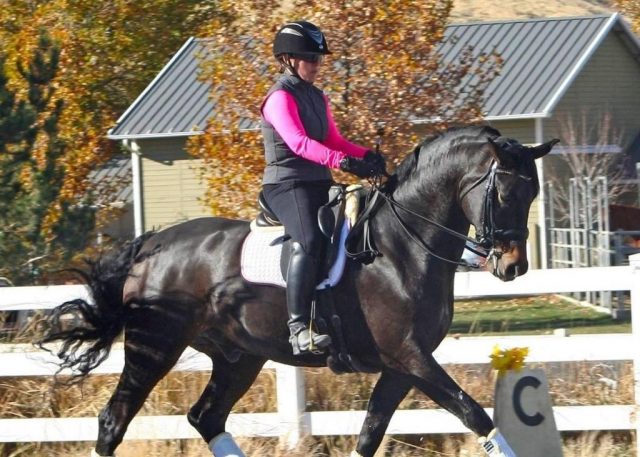
Riding with independent aids and an independent seat is a skill set that must be developed in advance of trying to train a horse to do anything. Photo (c) Morgane Schmidt
Once the rider has completed this phase of training, they should move to riding a trained horse. Trained as in knows how to do everything (or most everything) in the Grand Prix. Which would mean trained to perform (confidently and willingly) piaffe, passage, multiple changes, pirouettes, and extended gaits, as well as all the lateral work. This horse does not need to be a competitive quality horse, he just needs to know his stuff and be supple enough to do it. The rider then should learn how to produce ALL of these movements under careful guidance and instruction (preferably on more than one horse that is trained similarly).
Once the rider is proficient on highly trained horses, they are allowed to ride lesser trained horses — something around Third Level-ish. This allows them to learn how to APPLY their knowledge of the upper level movements to lesser trained horses. It is only after this process that riders then get to ride young horses.

Often people think that training young horses is a young person’s job. While that has some truth to it, the young person needs to have been educated in training horses in general before attempting to train a baby. Photo (c) Morgane Schmidt.
Throughout this process, riders are still under the supervision of the Grand Prix trainer who is responsible for their education. It is only after experiencing all of this supervised riding that the student may be allowed to start training a horse themselves, also still under the supervision of the teacher.
Now, I know that this is not what happens currently for most people (largely due to all the constraints I mentioned earlier). It was more common when I was learning, and even more common before that.
So when I say that a rider cannot learn, in one lesson, or one “boot camp,” or one clinic how to rectify a training problem or learn how to do a high quality flying change or piaffe based on a description of the aids, it is because it takes balance, knowledge of the movements and why we use them, independent aids and the experience of riding multiple horses with similar problems and learning curves to become a capable trainer/rider. Even if that rider is very talented, and very keen, a simple description of the aids or correction will not teach them how to simply ‘ride well’ and certainly not to solve the training problem (in its entirety) because they need the foundational knowledge and experience that the system is built upon to get the most out of it.
Another factor is that even if you are capable of producing the exercise of the Grand Prix on a trained horse, you will not have the depth to teach a horse those exercises or have the experience to solve the training problems along the way (if you have not worked through the entire process on lesser trained horses with guidance). Training is a separate skill set from riding the exercises (even excellently). Most riders get trapped in a cycle of having a problem and making a correction, instead of creating and producing a solution. So, the horse—who is very good at learning things through repetition—becomes very practiced at repeating the problem and getting corrected. We know the correction did not work, because the problem keeps re-occurring. A training solution prevents the problem from happening, and the problem, because it is not repeated, goes away. Training solutions are dressage exercises but used in experienced hands to prevent problems by building balance, suppleness, muscle, and confidence in the horse. If you don’t know how the exercises work, what order the horse needs to learn them in, and how to produce them, you cannot train successfully.
I say these things because I have recently had multiple conversations with a variety of earnest, capable, and very ambitious riders who think that they should “just be able” to train their horse without all the background and experience that is necessary. This does not mean they should not try or cannot have some success, but mostly it means that they put too much pressure on themselves to produce success when they are still learning the way to produce that success. Although the above process is not available to most (if not all) riders in this country, it does not make it less valuable or necessary in a rider’s development. That being said, just because most aren’t afforded the luxury of starting this process in an ideal (ordered) system, doesn’t mean that they can’t enter it at a different point and learn the necessary skills and foundational knowledge. It just takes time, commitment, and giving themselves some grace that it is building a process not simply memorizing a handful of tools.
Remember: Limited knowledge is limited judgment.

Gwyneth and Flair in competition at Grand Prix. (c) flatlandsfoto.
Gwyneth McPherson has over 35 years experience competing, training, and teaching dressage. She began her education in in the late 1970s, riding in her backyard on an 11 hh pony. Her first instructor introduced her to Lendon Gray (1980 and 1988 Olympian). who mentored Gwyneth for a decade during which she achieved her first National Championship in 1984, and her Team and Individual Young Rider Gold Medals in1987.
In 1990 Gwyneth began training with Carol Lavell (1992 Olympian) who further developed Gwyneth as an FEI rider and competitor. Gwyneth achieved a Team Bronze in 1991 and a Team Silver in 1992 in the North American Young Riders Championships, and trained her stallion G’Dur to do all the Grand Prix movements while riding with Carol.
In 2008, while Head Trainer at Pineland Farms, Gwyneth began training with Michael Poulin (Olympian 1992). Michael was trained by Franz Rochowansky (Chief Rider for the Spanish Riding School 1937-1955). Michael has shared much of Rochowansky’s knowledge and wisdom with Gwyneth, completing her education as a Grand Prix rider, trainer, and competitor.
Gwyneth’s teaching and training business, Forward Thinking Dressage,is based in Williston, FL. In addition to teaching riders and training, Gwyneth also loves sharing her knowledge of the sport and art of dressage as well as discussing relevant topics pertaining to the training itself and the current competitive landscape.

