



Thoroughbred Logic, Presented by Kentucky Performance Products: Learning Comes From the Tough Cases
“…if the ride is tough and the horsemanship required to muddle through is even more challenging, I guarantee you’re learning. And the value in that might not be obvious at the time, but it’s there, I promise.”
Welcome to the next installment of Thoroughbred Logic. In this weekly series, Anthropologist and trainer Aubrey Graham, of Kivu Sport Horses, offers insight and training experience when it comes to working with Thoroughbreds (although much will apply to all breeds). This week ride along as Aubrey shares her logic on horses that have good brains and building horses with good brains.
This past week has been split between two main preoccupations: going through hundreds of thousands of photos and the mud. Oddly, there’s some overlap.
The photos are for the book that I’m working on — yes, a book on training Thoroughbreds. I’m excited about it, but right now it is in the exhausting phase of finding images, for examples. On Sunday, I sat in the house and scrolled back through countless photographs: conformation pictures, riding photos, headshots of specific horses and the places I have been, travel, dogs (lots of photos of Walker), and ex-boyfriends. It was an interesting, accidental retrospective of my last decade.

Random selection of photos from 2023, photographed during a Thoroughbred Logic Clinic by Cora Williamson Photography.
For many photos, I knew what I was after. I need Tuck (Louisiana Bling) for the chapter on hoof angles. For sharing good and bad conformation photos, I need Needles Highway. Forrest (Don’t Noc It) comes in all over the place in the book, so I am after as many images of that lovable doofus as I can find.

Tuck taking his first spin at Kivu in 2022 and being mighty body sore due to those hind angles sore. Photo by Alanah Giltmier.
But I wasn’t just cherry picking. I was going back through to see what I didn’t know I needed. I found photos of Uno lumbering over his first cross rail — that will help. Images of Curry slinging his head (I had forgotten that he was ever anything but perfect at home), and others. I found countless sunsets and grassy fields from Georgia that made me want to pack the trailer and go back home. There were now-laughable images of suffering through southern winter that look positively balmy. (Yes, I’m grumpy as hell when it is “feels like 8” and is snowing on the mud in April in New York).

I thought this was cold. It was likely 35-40 degrees. Photo featuring Hudson (Primetime Spy) and Neumann (Bubba Bob) by Amanda Woomer.
Of the hundreds of horses I have swung a leg over in the past 10 years, I recognized the vast majority of them. But then there were a few images where I’d pause and wonder, “Who the hell was that?” I’d look at the head shape, the movement under saddle, and squint. What was the horse’s name? Am I getting that old? It felt about the same as when I ran into images of ex-boyfriends and went, “What the hell was I thinking?”
Those horses I forgot? They were the easy ones. The ones who were in and out of the barn in short, successful periods.

I had to squint at this one to remember Artie (Art I Rich). He was a good egg. Photo by Alanah Giltmier.
And the outcome of going through all of those images and that incidental retrospective was that I realized that it wasn’t the easy horses who shaped my past and my horsemanship. It was not the fancy, lovely, easy-to-sell Thoroughbreds who have taught me things. It was the tougher ones — the ones who lingered at the farm, the ones who needed unexpected work-arounds, those who fell apart, took time, required rehab, a reset, retraining that tested and expanded my understanding of the breed and the process.

Amelia’s Map after she filled out and figured out the job. Photo by Alanah Giltmier.
It was unexpected horses like Amelia’s Map who taught me a so, so much about bloodlines, movement, and s0undness (she was very sound despite finding a forgotten-about screw in her ankle upon hoof X-rays), or horses like Q (Quality Step) who took a long time to transition out of the boxed-up racehorse mindset to the soft, quiet, easy going kid that he became.

Q (Quality Step) at the track. Photo courtesy of Cheryl Nations.

Q nearly a year later. Photo by Alanah Giltmier.
Uno (Hold Em Paul) and Mountain (Mountain Holiday) taught me far more than I ever thought I wanted to know about feet and creative shoeing (and also cribbing). Tetris (Not A Game) and his initial “feels like riding a 2×4” was critical to the ability not only to ride a horse into softness, but also to be able to put words to it and teach it.

Tetris (Not A Game) the two-by-four. Photo by Alanah Giltmier.
And thus, that fun lesson hits harder than expected: it is not the easy times and sunny days that shapes who one is, but the challenges. I’m sure there are innumerable memes and idioms for that. (If you’re not winning you’re learning???) And I’m sure that others say it even better. But the important take away was that the hard horses taught me far more than the easy ones. And it certainly gets teleological, but it seems like they show up when needed and stick around until the lesson is fully learned.
So now I’m sat here, staring at the mud, craving a week of real sun (which we have not had since October), and wondering what I’m supposed to learn from this.

That folks, is a stunning horse (Wildcat Bill) who looks far less impressive considering it is way too cold to bathe still, he’s standing in the least amount of mud we have, and there is no sun to be found to add great lighting. He’ll likely be here until the mud dries up or we get a few sunny days. Fighting the elements this way is definitely not something I factored in to rehoming horses in the north. Photo by Lily Drew.
It is a lot easier to understand the patience and the wound care expertise that I’m gaining from Taxi (Price of Peace), who fractured a reasonably unimportant part of his shoulder literally after passing his PPE and being en route to sale (but fracture and surgery all the same). Or the gastric-focused care and insistent let down strategies for Shorty (Corrected Pedigree), while upper level riders ask me to give him away to them for free.
That’s all fine. But the mud? I can’t find any way to spin that into something helpful… unless maybe we’re going to say that, shockingly, I’d take winter any day over this. Perhaps that perspective is a tiny silver lining. Maybe?

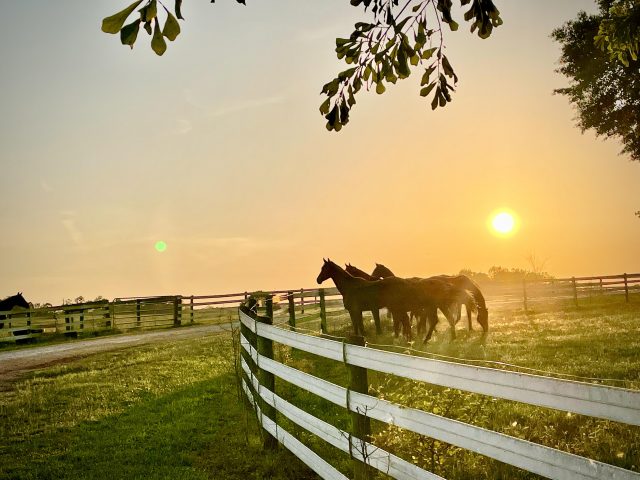
Don’t mind me trying to remember what that yellow ball is. Photo by author.
So, if the ride is tough and the horsemanship required to muddle through is even more challenging, I guarantee you’re learning. And the value in that might not be obvious at the time, but it’s there, I promise.
Go ride folks, and please soak up any sun you can find for me.
About Kentucky Performance Products, LLC:
Maintain your easy keeper’s health this spring with InsulinWise®. Available through your veterinarian, InsulinWise maintains normal insulin levels and metabolic function, supports a healthy body weight and fat distribution, and promotes the structural integrity of the laminae within the hoof.
Kentucky Performance Products creates scientifically proven supplements for your horse. Our supplements provide solutions to the everyday challenges facing your horse. The horse that matters to you matters to us®. Learn more about KPP at kppusa.com.

