



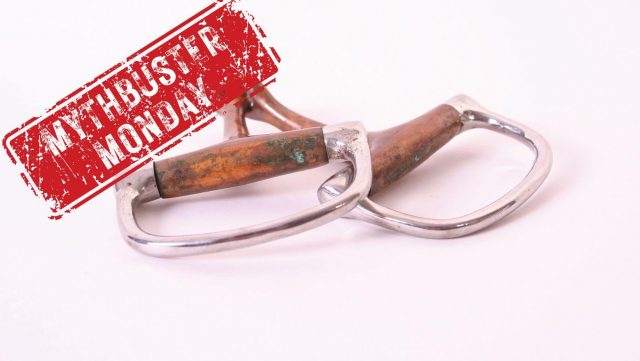
Mythbuster Monday: Snaffles are a Harsh Bit
On Mythbuster Monday, we tackle a variety of equestrian myths to either bust or confirm. Today’s discussion: Are snaffles a harsh bit?
It’s Mythbuster Monday, where Horse Nation dives into different equestrian myths and provides research-based evidence to either bust or confirm those myths.
Today’s Mythbuster Monday was inspired by an evening fire pit discussion while at a show.
It sparked enough curiosity that we decided to dig deeper, look at the science and physiology behind it, and separate myth from fact. So, here it is: Are snaffle bits a harsher type of bit? Read on to find out!
Myth: Snaffles are a harsh bit
Myth or Fact: Myth

Canva/CC
A snaffle bit is a type of bit that applies rein pressure primarily through the horse’s mouth, with the exact pressure and feel influenced by the bit’s design, fit, placement, and how the reins are used. Snaffles are commonly available with single-jointed, double-jointed, or mullen mouthpieces, and they can be made with different cheekpiece designs, such as loose rings, D-rings, or eggbutts. A snaffle is traditionally considered a non-leverage bit, meaning the reins attach directly to the bit rather than below or through a shank that creates mechanical leverage. When the rider takes contact, the mouthpiece can move and rotate within the horse’s mouth, distributing pressure across areas such as the tongue, bars, and lips. The horse’s individual anatomy, bit fit, rein tension, and rider’s hands all influence how that pressure is experienced. Proper sizing and adjustment are therefore essential to allow the horse to carry the bit comfortably and respond to rein cues without unnecessary pressure.
But, is it one of the more harsh bits?

Canva/CC
Clayton and Lee’s fluoroscopic study of the jointed snaffle bit provides an important look at what actually happens inside the horse’s mouth when a rider applies rein pressure. Rather than relying on illustrations or assumptions about how a jointed bit should behave, the researchers used fluoroscopy to observe the bit’s position and movement directly. Their observations showed that the bit is not fixed in one position within the horse’s mouth. Its position and movement change with rein application, and the horse’s tongue and other oral structures play an important role in how the bit is positioned and supported.
The study is particularly useful when discussing the commonly repeated description of a jointed snaffle simply “folding” in the horse’s mouth. The researchers observed the mouthpiece moving and changing its relationship with the tongue and palate as rein tension was applied, rather than demonstrating a simple mechanism in which the bit continuously folds in half and drives the center joint into the roof of the mouth. The findings demonstrate that bit action is considerably more dynamic than the commonly used “nutcracker” illustration suggests. This does not mean that a jointed snaffle cannot create pressure or become uncomfortable when improperly fitted or used with excessive rein tension; rather, it demonstrates why the action of a bit should be understood in terms of its actual movement, the horse’s anatomy, fit, and rein application rather than by its appearance alone.

Canva/CC
A 2018 study by Benoist and Cross examined how different horse bits behave when rein tension is applied, including both single-jointed and French-link snaffles. Rather than assuming that every jointed mouthpiece acts the same way, the researchers evaluated how the bits rotated in response to rein tension. Their findings demonstrated that the movement of a bit is influenced by its specific design and the direction in which force is applied. In other words, simply identifying a bit as “jointed” does not tell us exactly how that bit will move or where pressure will be applied.
This is important when considering the claim that a jointed snaffle is inherently harsh because it folds when the reins are engaged. The study demonstrates that bit action is more complex than simply having a joint in the middle of the mouthpiece. Different designs produced different patterns of rotation, meaning that the way a bit interacts with the horse’s mouth depends on more than the presence of a joint. Rein tension, the direction of the applied force, and the geometry of the individual bit all contribute to its action. Therefore, a jointed snaffle should not automatically be classified as harsh simply because it has a joint; its actual action must be considered in the context of its design, fit, and use.

Canva/CC
The 2022 peer-reviewed study by Anttila, Raekallio, and Valros, Oral Dimensions Related to Bit Size in Adult Horses and Ponies, provides important evidence that the relationship between a horse and its bit cannot be reduced to whether the mouthpiece is jointed or unjointed. The researchers examined the oral dimensions of horses and ponies in relation to bit size, highlighting the considerable anatomical variation between individual horses. Because a bit interacts with sensitive structures within the horse’s mouth, factors such as the size and shape of the horse’s oral cavity are important when determining how that bit fits and where pressure may be applied.
This research therefore supports a much more accurate way of evaluating snaffle bits: fit matters. Calling every jointed snaffle “harsh” ignores the individual anatomy of the horse, the dimensions and design of the bit, how it is adjusted, and how it is used. A bit that is appropriately sized and fitted to one horse may interact differently in another horse because their oral anatomy is different. The study does not establish that jointed snaffles are inherently mild, but it does reinforce that a bit’s potential for comfort or discomfort cannot be determined simply by looking at whether it has a joint. The better question is not “Is it jointed?” but “Does this particular bit fit this particular horse, and how is it being used?”

Canva/CC
Although a jointed snaffle can change position and distribute pressure within the horse’s mouth when rein tension is applied, the presence of a joint alone does not determine whether a bit is harsh or uncomfortable. The evidence demonstrates that bit action is influenced by several factors, including the design and dimensions of the bit, the direction and amount of rein tension, the fit and placement of the bit, and the individual anatomy of the horse. Collectively, the research demonstrates that describing all jointed snaffles as inherently harsh because they “fold” in the horse’s mouth oversimplifies the complex interaction between the bit and the horse. A properly evaluated bit should therefore be considered in the context of the individual horse, its anatomy, the fit of the bit, and how the bit is being used—not simply whether the mouthpiece contains a joint.
Do you have an equine myth you’d like us to tackle? If so, send it our way! Email your suggestions to [email protected]. Put Mythbuster Monday in your subject line.
