



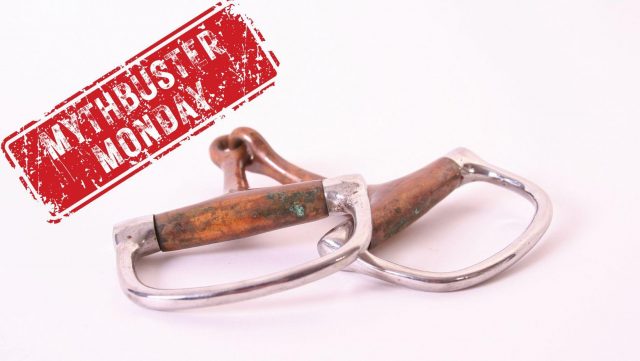
Mythbuster Monday: Horses Were Originally Started in Snaffle Bits Due to Their Teeth
On Mythbuster Monday, we tackle a variety of equestrian myths to either bust or confirm. Today’s discussion: Historically, horses were started in snaffle bits because they did no get their teeth floated until they were older.
It’s Mythbuster Monday, where Horse Nation dives into different equestrian myths and provides research-based evidence to either bust or confirm those myths. Today’s topic: Are horses started in snaffle bits because historically they’ve gotten their teeth done at an older age? Is there history that supports this? Why were (and are) snaffles used early in a horse’s training process? Read further to find out!
Myth: Horses are started in snaffle bits because historically horses didn’t get their teeth done until a later age
Myth or Fact: Myth

Canva/CC
The idea that young horses are started in snaffle bits because they haven’t had their teeth done yet is one of those horse-world misnomers that gets repeated often enough that people assume it’s true. In reality, the myth likely comes from a combination of older management practices, confusion about wolf teeth, and a misunderstanding of how snaffles and leverage bits actually work.
According to an article by Met Museum, the belief that horses are started in snaffle bits because historically they did not receive dental care at a young age is largely a myth. Snaffle bits are ancient designs that existed thousands of years before modern equine dentistry, meaning they were not developed as a solution for horses having untreated teeth. Instead, the snaffle became widely used because of its simple design, direct communication, and effectiveness in guiding horses.
Although a snaffle bit generally works on the bars of the mouth (the toothless area of the jaw) and the lips, its historical use was based on mechanics and practicality rather than the lack of dental care. Horses in the past did not have modern dentistry like today, but the timeline shows that snaffle bits were already in use long before those practices existed. The idea that horses were started in snaffles specifically because “they didn’t get their teeth done” is a modern assumption, not a historically supported reason for the bit’s use.

Canva/CC
PetMd’s article, “Horse Teeth Floating: What It Is and Why It’s Done,” explains that the idea that horses never had dental care until recently is an oversimplification. Although modern equine dentistry, including floating teeth with specialized tools to remove sharp enamel points, is a more recent practice, ancient horse owners were still aware of the importance of oral health. Historical veterinary writings from Greek and Roman traditions discussed horse care, including feeding, examining the mouth, and recognizing dental issues.
This challenges the myth that horses were started in snaffle bits simply because people did not take care of their teeth in the past. Ancient horsemen may not have had today’s advanced dental equipment, but they were not completely unaware of their horses’ mouths or health needs. The belief that “old horses never had their teeth done” ignores the fact that early civilizations understood basic equine care, and the use of snaffle bits was based more on their design and function than on a lack of dental knowledge.

Canva/CC
An article by Museum of the Horse states that the idea of a snaffle bit being inherently “gentle” or chosen historically because it is easier on a horse’s mouth is a misconception. Although a snaffle does not use leverage, its severity depends on multiple factors including mouthpiece design, thickness, joints, fit, and especially the rider’s hands and rein pressure. This means a snaffle can range from very mild to quite harsh depending on how it is used, rather than being automatically softer than other bit types.
This directly challenges the myth that snaffles are the default humane starting bit because they are less likely to cause discomfort, especially in historical contexts. The article emphasizes that even direct-pressure bits like snaffles require skilled, educated handling to avoid pain, and that severity is not determined by bit category alone. In some cases, a well-used curb bit may actually be milder than a poorly used snaffle, reinforcing that the myth oversimplifies both history and horsemanship.

Canva/CC
The literature supports the understanding that snaffle bits were adopted and used historically based on their mechanical design, practicality, and communication with the horse, rather than any connection to the timing of equine dental care or a lack of historical dentistry. The belief that horses are started in snaffles because earlier horses did not receive dental maintenance may persist because snaffles are often perceived as inherently “gentler,” which can incorrectly suggest a relationship to tooth sensitivity or dental limitations. In reality, historical evidence shows snaffle-style bits predate modern equine dentistry by thousands of years, and their use was not driven by dental absence or neglect.
Far from being a historically or anatomically justified explanation, the myth oversimplifies both equine dental history and bitting mechanics. Research and equine literature consistently emphasize that bit severity is determined by design factors and rider application rather than bit category alone, and that ancient horsemen were not entirely unaware of oral health or care considerations. As such, modern equine science and historical evidence both support the conclusion that snaffles were not chosen as a starting bit because horses lacked dental care, but because they provided a functional, direct method of communication that remains relevant in training today.
Do you have an equine myth you’d like us to tackle? If so, send it our way! Email your suggestions to [email protected]. Put Mythbuster Monday in your subject line.
