



Training in the Right Way: Training as Explaining, Not Correcting
The process of training a horse to do (or not to do) something is the process of explaining to the horse what you actually want him to do. Unfortunately this isn’t always as straightforward or as quick as you might like.
Dressage training is supposed to be the process of training ANY horse to be a better riding horse. The more the horse learns, in theory, the easier it is to communicate with and therefore complete more complex tasks with. Although competition dressage training often is more focused on training for the dressage test, that is not what the original intention (and original judging requirements) were for competitive dressage. Initially, it was designed to give riders and trainers a way to determine how their training measured up to the theoretical ideal of the training process. That said, it is critically important to understand the meanings and reasons for some of the terms we use to describe dressage training and what to look for when observing training and competition (and videos and photos), regardless of whether you intend to compete or just train your horse to be a better whatever you do with him. That, ultimately, is the main purpose of my articles. To provide education and knowledge for riders to understand and improve their eye and understanding of what dressage training is supposed to be. While there will always be some differences in practice and theory, good horse training is always recognizable to the educated eye. That said, it absolutely is necessary that we remember and understand that limited knowledge is limited judgment.
* * *
Sometimes (most of the time) the training process is not a matter of following the perfect timeline. Often (usually) it is a matter of starting in the middle, or peeling back some layers, to start over, and that starting over process isn’t beholden to any timeline you may have in your mind. Which is to say, that no matter where you start the process, the reality you need to embrace is that sometimes it takes longer, and requires a bit more creativity, to get through a problem than you would like.

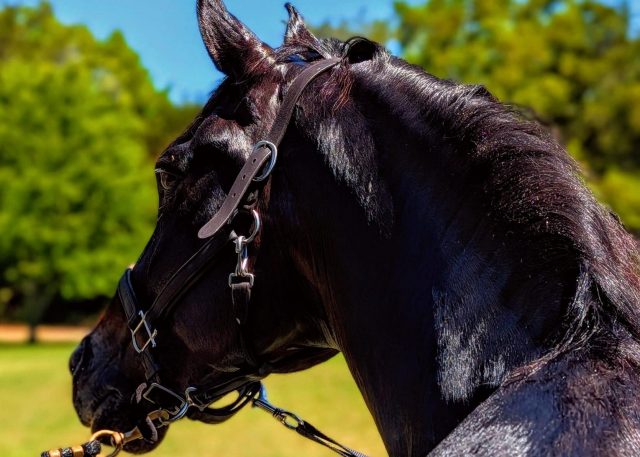
Training horses is the process of explaining to the horse what you actually want him to do. Photo (c) Morgane Schmidt.
Regardless of the scenario you find yourself in — starting out with a clean slate, such as a young horse with minimal training and no adversarial riding, or working with a horse that has been under saddle for years and has been ridden in such a way that he is fearful or resentful of the rider’s aids and/or presence on his back — the process of training a horse to do (or not to do) something is the process of explaining to the horse what you actually want him to do.
It’s remembering that explaining aspect that is so critical to the process. I find that many riders have been taught a more corrective style of training. When the horse performs an unwanted action, it simply gets punished for it. This cycle gets repeated in an attempt to get the horse to stop performing the unwanted action. In these cases, you often hear terminology like “set him on his a$$” or “teach him a lesson” because “he’s not listening” or “he always uses this as an excuse” or “he’s trying to get out of working.” Sharp aids are also often used and the entire process becomes adversarial. The result is usually that the horse continues to make the same mistake and continues to get “corrected” and very little changes for the better.
Yes. I know. “You can’t just let him get away with it” is often the argument I hear when I try to explain that there is a better way. Indeed, you cannot “let him get away with it.” But, in fact, better yet, don’t let it happen in the first place. The rider is always the only one responsible for creating the desired result. This is because the rider is always the only one who knows what the desired result is. The horse can only guess. Because he does not know what a half-pass is, or what level he is supposed to be competing at, or any number of other human constructed details we often try to apply to their thinking process.
It is the rider’s responsibility to explain to the horse what is ultimately being required of him. Often times this requires going much further back in the explanation process than most riders care to go, or admit, or even consider. The process of solving a training problem always lies in understanding what the underlying miscommunication, fear, or weakness the horse has that needs to be addressed to solve it.
Here is an example:
I have a student who is working on retraining a horse that grabs the bit and trots away (rapidly) as soon as the rider asks him to leave the halt. This horse is not young and has been through a few trainers, and the problem has waxed and waned throughout its riding life. In this process, a great deal of groundwork has been done. Saddle fitting. Tack changes. Rider changes. Time off. Vet care, etc, etc, etc. The result remains the same. As soon as the rider walked away from the mounting block, the horse performed the same way. The riders often just struggled to keep him from going so fast that he was not totally out of control. In this case, the horse consistently was anxious as soon as a rider asks him to walk away from the mounting block, and his experience was that the next thing that happens is that I get tense, grab the bit, and we play tug of war on the bit at varying speeds until the ride is over and I go back to the barn. He has done it so many times that he is an absolute expert at it. He knows better than the rider how to go fast and pull on the bit. And he has learned that is what you do when you go in the big sand box and someone sits on your back. He has years of proof of it.

Training horses is always a process that requires a great deal of patience and management of one’s own expectations. Photo (c) Morgane Schmidt
No one (not on purpose) has ever explained to him what they REALLY want him to do when they sit on him and ride him in the ring. All he knows is what he has repeated (pull on the bit and go fast). Fortunately for everyone involved, this horse is in fact happy to stand still. So, we developed a training plan that includes his preferred “gait,” the halt. We started the process of explaining to him that he does not need to do that by walking only as many steps as the rider can maintain control of the speed without futilely pulling back on his mouth as he rushes away, and then halting before he gets the urge to grab the bit and trot away. Every time he halts, he is rewarded and gets to stand with no pressure on the bit. Once he has clearly taken a breath and relaxes, he is asked to walk again. As you can imagine, this process requires a great deal of patience and management of one’s expectations. But, it allows the horse to learn a new pattern instead of repeating the old one endlessly (and this is paramount).
The rider had to take on the responsibility of changing the horse’s experience in the ring from repeating the old anxiety-driven unwanted behavior and has developed a new pattern based on understanding the expectations of him. The rider has given him confidence in his job and relaxation through predictable repetition. When the horse can perform walk-halt without anxiety and repeating the old pattern, the trot will get added back in by using the same method of only trotting the amount the horse can manage without grabbing the bit and leaving. The pattern will be walk-halt-walk-trot-walk-halt as often as need be to develop the understanding. How long is this going to take? I don’t know, but he is getting better.
Ultimately, the primary point is that in all training, the rider must give the horse a way of repeating what they actually want him to do, not the correction of the thing he did that they didn’t want him to do (they must explain it to him). Then the ride has to be crafted around maintaining control of this narrative until the horse has a clear understanding and confidence in what he is supposed to repeat. And then, at some point probably a little longer than you want, but shorter than you think, you’ll see the training progressing forward in an appreciable way.
Remember: Limited knowledge is limited judgment.

Gwyneth and Flair in competition at Grand Prix. (c) flatlandsfoto.
Gwyneth McPherson has over 35 years experience competing, training, and teaching dressage. She began her education in in the late 1970s, riding in her backyard on an 11 hh pony. Her first instructor introduced her to Lendon Gray (1980 and 1988 Olympian). who mentored Gwyneth for a decade during which she achieved her first National Championship in 1984, and her Team and Individual Young Rider Gold Medals in1987.
In 1990 Gwyneth began training with Carol Lavell (1992 Olympian) who further developed Gwyneth as an FEI rider and competitor. Gwyneth achieved a Team Bronze in 1991 and a Team Silver in 1992 in the North American Young Riders Championships, and trained her stallion G’Dur to do all the Grand Prix movements while riding with Carol.
In 2008, while Head Trainer at Pineland Farms, Gwyneth began training with Michael Poulin (Olympian 1992). Michael was trained by Franz Rochowansky (Chief Rider for the Spanish Riding School 1937-1955). Michael has shared much of Rochowansky’s knowledge and wisdom with Gwyneth, completing her education as a Grand Prix rider, trainer, and competitor.
Gwyneth’s teaching and training business, Forward Thinking Dressage,is based in Williston, FL. In addition to teaching riders and training, Gwyneth also loves sharing her knowledge of the sport and art of dressage as well as discussing relevant topics pertaining to the training itself and the current competitive landscape.

