



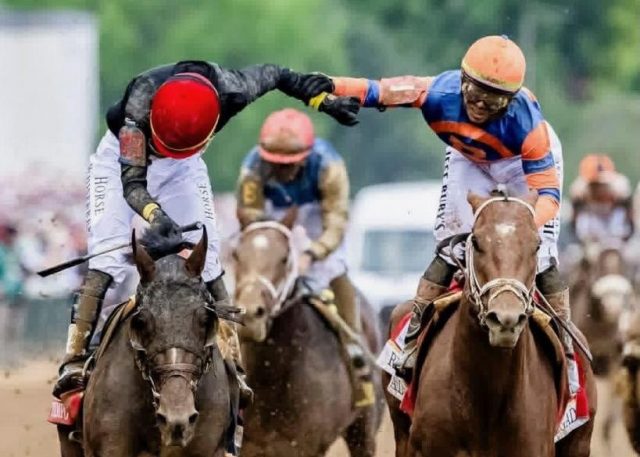
A Historic Finish: The Ortiz Brothers Go 1–2 in the Kentucky Derby
Two brothers, one finish line, one unforgettable derby!
The 2026 Kentucky Derby delivered no shortage of unforgettable moments, but among them, one storyline stood apart for its emotional depth and rare significance: two brothers finishing first and second in the most prestigious race in American horse racing. For José Ortiz and Irad Ortiz Jr., the race was not only a professional pinnacle, it was a deeply personal moment shaped by years of shared ambition, rivalry, and family.
The Ortiz brothers, both originally from Puerto Rico, have long been among the most accomplished jockeys in North America. Their careers have often run parallel, marked by consistent success at the highest levels of the sport. Yet, until this Derby, they had never shared such a defining stage in quite this way.
José Ortiz, the younger of the two, had built a career defined by persistence and steady progression. Prior to 2026, he had made multiple attempts at the Kentucky Derby, with his best finish being second place in 2018. Despite numerous victories in graded stakes races and a reputation as a tactically sharp rider, a Derby win had remained elusive. That changed in dramatic fashion.
His older brother, Irad Ortiz Jr., entered the 2026 Derby with an equally impressive résumé. Known for his aggressive riding style and consistency, Irad had already secured multiple Eclipse Awards and was widely regarded as one of the top jockeys in the world. Heading into the race, he was in a particularly strong position, riding one of the top contenders in the field.
José Ortiz rode Golden Tempo, a colt that few expected to win. Entering the race at approximately 23-1 odds, Golden Tempo was considered a longshot, overshadowed by more heavily favored competitors. Bred by Phipps Stable and St. Elias Stable, the colt carried strong bloodlines but had not yet proven himself dominant enough to command widespread confidence.
In contrast, Irad Ortiz Jr. was aboard Renegade, the morning-line favorite at around 4-1 odds. Trained by Todd Pletcher, Renegade had built an impressive record leading into the Derby, including strong finishes in key prep races. Expectations were high, and many analysts predicted he would be the horse to beat.
The race itself played out in a way that seemed almost scripted for drama. Renegade, breaking from the rail position, faced early challenges navigating traffic but remained within striking distance throughout much of the race. Irad Ortiz Jr. positioned him strategically, conserving energy while staying close enough to respond in the final stretch.
Golden Tempo, on the other hand, took a very different path. Shortly after the break, he settled at the back of the field, dead last. In a race as competitive and fast-paced as the Kentucky Derby, that position typically signals a difficult, if not impossible, path to victory. However, as the race progressed, the early leaders began to tire.
Approaching the final turn, José Ortiz began to ask more of Golden Tempo. What followed was a remarkable surge. Moving past horse after horse, Golden Tempo accelerated down the stretch, closing the gap with astonishing speed. In the final moments, he overtook Renegade, securing victory by a narrow margin.
It was a finish that highlighted not only the horse’s endurance and ability but also José Ortiz’s timing and composure, qualities that had been refined over years of experience.
The Kentucky Derby’s $5 million purse ensures that its financial rewards are as significant as its prestige. In 2026, the winning connections received approximately $3.1 million. Jockeys typically earn a percentage of those winnings, around 10% for first place and 5% for second.
This means José Ortiz likely earned in the range of $300,000 for his victory ride, while Irad Ortiz Jr. would have received a substantial payout as well, estimated at over $100,000 for his second-place finish. While these figures are notable, they pale in comparison to the long-term value of such performances. A Derby win or even a strong placing can significantly elevate a jockey’s career, leading to more high-profile mounts and increased opportunities.
What makes this moment particularly compelling is not simply the outcome, but the relationship between the two competitors. Horse racing, by its nature, is an individual sport when it comes to jockey performance. Each rider is tasked with making split-second decisions that can determine the outcome of a race. Yet, behind that individuality lies a shared foundation.
For the Ortiz brothers, that foundation is family. They grew up in the same environment, learned the same craft, and rose through the same ranks. Their careers have been intertwined for years, often competing against one another in races across the country. To meet at the finish line of the Kentucky Derby, one first, one second, adds a layer of meaning that extends beyond competition.
The emotional impact of the moment was evident not only in their reactions but also in those of their family. Reports described relatives watching the race with intense anticipation, fully aware of the significance of what was unfolding. The idea that two brothers could reach the pinnacle of their sport at the same time is rare in any field, but particularly so in one as competitive as thoroughbred racing.
In many ways, the 2026 Kentucky Derby represented more than a historic win for a trainer or a dramatic finish for a longshot horse. It told a story about shared ambition, perseverance, and the unpredictable nature of sport.
For José Ortiz, the victory marked the culmination of years of effort and near-misses, a long-awaited breakthrough on the sport’s biggest stage. For Irad Ortiz Jr., the runner-up finish, while undoubtedly bittersweet, reinforced his standing among the elite and added another chapter to an already distinguished career.
Together, their performance created a moment that will be remembered not just for its outcome, but for what it represents. In a race often defined by tradition and individual achievement, the sight of two brothers crossing the finish line first and second serves as a reminder that even in the most competitive arenas, there is room for connection, shared history, and pride.
It is this combination of excellence and emotion that makes their story endure, long after the roar of the crowd has faded and the race itself has been recorded in the history books.
