



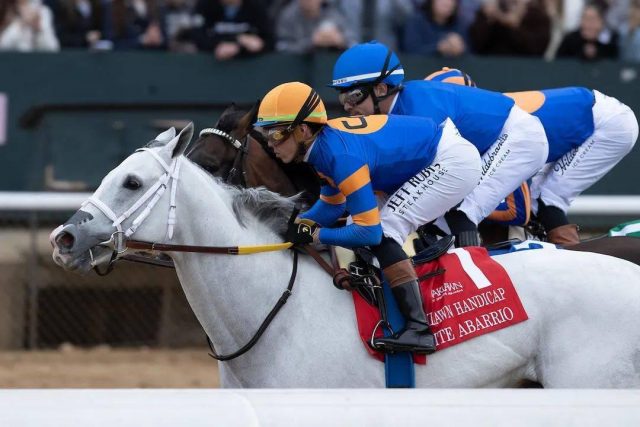
The White Abarrio Case and Racing’s Transparency Crisis
A late scratch, a multimillion-dollar lawsuit, and a sport forced to explain itself.
The controversy surrounding White Abarrio’s late scratch at the 2025 Breeders’ Cup has evolved into something far more consequential than a single race-day decision. What began as a disputed veterinary call has now become a legal battle, and a referendum on transparency in modern horse racing.
On November 1, 2025, in the moments before the Breeders’ Cup Dirt Mile at Del Mar, White Abarrio, one of the event’s most prominent entrants, was withdrawn during the post parade. The reason given was veterinary concern over potential lameness. Such decisions are not unprecedented; regulators are empowered to act in real time when a horse’s safety is in question, but the timing and context of this particular scratch immediately raised eyebrows.
White Abarrio had undergone extensive pre-race evaluation. In the days leading up to the Breeders’ Cup, he was subject to routine and advanced veterinary scrutiny, including imaging and repeated soundness checks. By all available accounts, he had been cleared to compete. Even on the morning of the race, there were no reported issues significant enough to trigger alarm. Yet minutes before post time, a final visual assessment led to his removal.
For the horse’s connections, the reversal was not just surprising, it was damaging. Beyond the immediate loss of a competitive opportunity, the scratch carried financial implications tied to purse money, wagering, and reputation. In April 2026, those frustrations crystallized into a lawsuit against Breeders’ Cup Limited, the California Horse Racing Board, and Del Mar, alleging negligence, breach of contract, and economic harm.
At the core of the complaint is a claim of inconsistency. The gait that reportedly concerned veterinarians on race day was not new. According to the plaintiffs, it had been observed throughout White Abarrio’s career and repeatedly deemed acceptable by regulatory vets, including during prior elite performances. The lawsuit also questions whether established protocols were properly followed, suggesting that a subjective, last-minute judgment overrode a week’s worth of objective data.
Still, the case is not as simple as right versus wrong. Veterinary authority in horse racing is intentionally broad, and for good reason. The sport has faced increasing scrutiny over equine safety, and regulators are expected to err on the side of caution. A veterinarian’s obligation is not to the betting public or even to the connections, it is to the welfare of the horse. When something appears off, even subtly, action is expected.
That reality complicates the narrative. A lawsuit cannot retroactively invalidate what a veterinarian believed they saw in the moment. Nor does the horse’s subsequent ability to race necessarily prove that the original concern was unfounded. Veterinary assessments are often precautionary, based on risk rather than confirmed injury.
What the lawsuit does do, however, is expose a persistent weakness in the sport: the lack of transparency surrounding these decisions.
Horse racing operates within a layered regulatory structure, combining private event management with state oversight and independent veterinary teams. There are rules governing pre-race exams and scratch deadlines, but there is also significant discretionary power built into the system. That discretion is essential for safety, but when exercised without clear communication, it can appear arbitrary.
In the case of White Abarrio, the official explanation, “veterinary reasons,” offered little insight into what changed between morning clearance and post parade removal. For bettors, owners, and even casual fans, that lack of detail creates uncertainty. In a sport deeply intertwined with wagering, uncertainty quickly erodes trust.
The comparison to other major sports is difficult to ignore. In the National Football League, when officials make a controversial call, they are required to explain it publicly and immediately. The explanation may not eliminate disagreement, but it provides clarity. It shows the rule being applied and the reasoning behind the decision.
Horse racing offers no such mechanism. Decisions are often communicated after the fact, in minimal terms, and without the kind of real-time accountability that modern audiences expect. The result is a communication gap that leaves stakeholders guessing.
That gap is where the White Abarrio lawsuit finds its broader significance. It is not merely a challenge to a single veterinary decision; it is a challenge to a system that prioritizes authority over explanation.
Introducing more transparency would not be without challenges. Veterinary evaluations are nuanced, and translating them into clear, immediate public statements is no simple task. There are also legal considerations, particularly when decisions could later be scrutinized in court. Yet other industries with high stakes and complex judgment calls have found ways to balance authority with openness.
Horse racing may now be at a point where it must do the same.
The sport has made significant strides in recent years to improve safety protocols and restore public confidence. But safety alone is not enough. Confidence depends not just on the quality of decisions, but on the visibility of the process behind them.
White Abarrio’s scratch, and the legal battle that followed, has made one thing clear: when decisions of this magnitude are made in silence, the silence itself becomes part of the controversy. If racing hopes to maintain credibility in an increasingly scrutinized environment, it may need to rethink not just how decisions are made, but how they are communicated. In the absence of explanation, even the right call can feel like the wrong one.
