



Training in the Right Way: Equitation vs Training
Let’s look at why simply “riding better” doesn’t result in a trained horse.
Dressage training is supposed to be the process of training ANY horse to be a better riding horse. The more the horse learns, in theory, the easier it is to communicate with and therefore complete more complex tasks with. Although competition dressage training often is more focused on training for the dressage test, that is not what the original intention (and original judging requirements) were for competitive dressage. Initially, it was designed to give riders and trainers a way to determine how their training measured up to the theoretical ideal of the training process. That said, it is critically important to understand the meanings and reasons for some of the terms we use to describe dressage training and what to look for when observing training and competition (and videos and photos), regardless of whether you intend to compete or just train your horse to be a better whatever you do with him. That, ultimately, is the main purpose of my articles. To provide education and knowledge for riders to understand and improve their eye and understanding of what dressage training is supposed to be. While there will always be some differences in practice and theory, good horse training is always recognizable to the educated eye. That said, it absolutely is necessary that we remember and understand that limited knowledge is limited judgment.
* * *
Riding and training are inextricably linked, but they are not synonymous. Let me explain.
I think most people understand that there is a difference between a horse trainer and a riding instructor. Not that a person cannot be both, but they are two different skill sets.
That being said, I don’t think most riders understand that there is a vast difference between learning equitation and training the horse. Equitation is how you sit on the horse and understanding and controlling how your balance and movement affects the horse. Training is the process of teaching the horse how to respond to the aids the rider gives and the resulting strengthening, suppling, and balancing effects that this education creates in the horse (or, more simply put, it’s teaching the horse how to be a better riding horse).
Although the rider’s equitation must be developed enough to effectively give the aids to the horse to train it, it’s necessary to understand that equitation alone does not train the horse. While every rider must learn equitation in order to stay in balance, follow the motion of the horse, and have an independent seat so they can give independent aids, simply practicing this equitation will not better train the horse. It is not possible to ride well or train a horse without these key elements, but the rider will need to go beyond them to further the horse’s education.
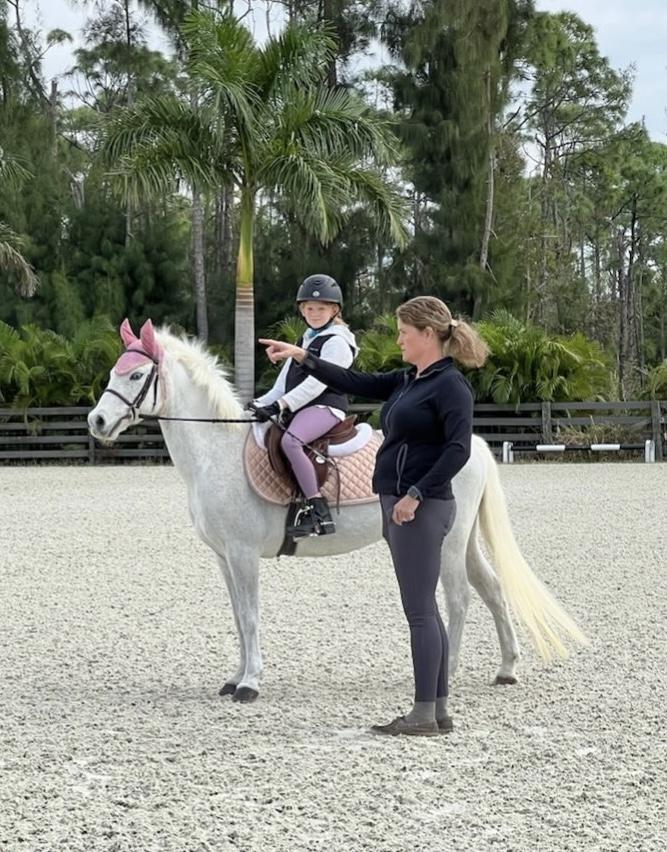
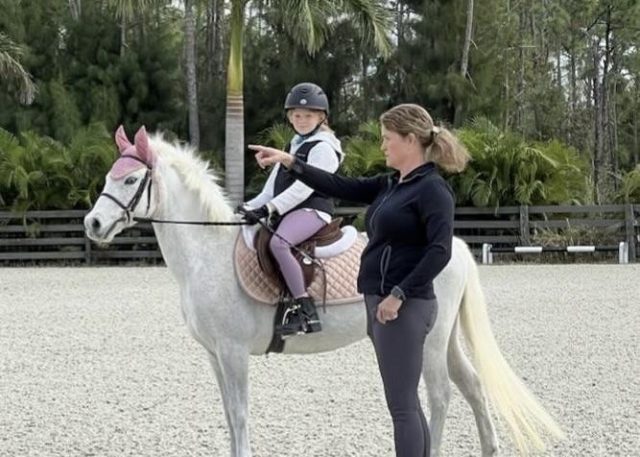
Learning equitation is the process of learning how to make your seat and aids independent by learning how to balance on make purposeful movements while the horse is in motion. Photo (c) Gwyneth McPherson
Why is this an important concept? Because I routinely see riders who are under the notion that simply riding better (focusing on their equitation), will train the horse (and then they are disappointed when this is not the case). While skillful riding makes training easier, they are not one in the same. For example, obsessing over whether or not you weighted to left seat bone correctly will not in itself teach your horse how to do a flying change.
Let’s look at each independently and consider how they intersect.
Equitation is the development of the rider’s seat, balance, and aids. The development of an independent seat and independent aids is critical to learning to ride. The meaning of “independent” in reference to the seat and the aids is referring to the rider’s ability to absorb the movement of the horse and give aids with the hands, legs, and seat that are not effected by each other, the motion of the horse, or the rider trying to hold on to the horse in order to not get bounced off.
The simplest example is learning sitting trot. Initially, the rider is unable to absorb the motion of the trot and tightens the muscles in their arms, legs, and torso in order to hold on to the horse while getting jostled by the trot rhythm. With practice and good instruction, the rider starts to be able to straighten up, lengthen their torso and legs, sit down in the saddle, and follow the motion of the trot (develop and independent seat) rather than fighting the motion and holding on.
As this process develops, the rider goes from not being able to steer and keep from falling off to being able to sit quietly, in balance with the horse and its motion, and move the arms and legs independently from each other while the seat follows the motion of the horse (independent aids). Equitation is not a one and done process. Instead, it evolves over time based on the horses that the rider rides and the level of complexity of the exercises.
When a rider masters the basics, there is further diversification after the original learning phase. A showjumper rider will have to learn specific skills related to jumping a big course at speed and what each type of fence requires for balance while an upper-level dressage rider will have to learn specific skills related to riding exercises like piaffe, passage, and one tempis (for example).
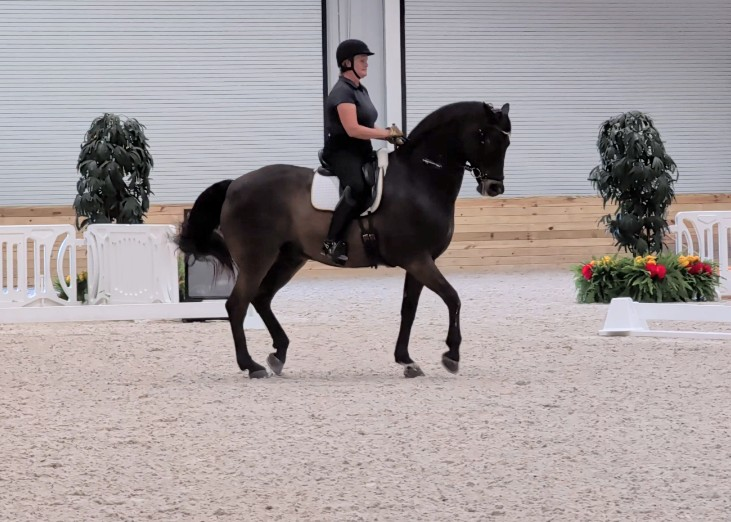
Equitation changes and needs to be improved over the rider’s career and is modified for each horse and the complexity of the exercises being performed. Photo (c) Morgane Schmidt.
As a rider progresses and develops their skillset in these areas, it makes logical sense that their horse’s performance would also improve due to the rider’s better timing, balance, and more skillful aids. But this still isn’t the same as training.
Training a horse is the systematic approach to using consistency of expectations and repetition of aids and exercises to produce in the horse an understanding and physiological ability to perform specific skills. Not all these skills are always taught from the saddle, but when they are, it is dependent on the framework of the rider’s high-quality equitation.
It is also dependent on the rider using their independent seat and aids to develop reproducible responses from the horse to those aids. Read that sentence again. Training is the development of reproducible responses. This means the horse becomes physically and psychologically educated to give essentially the same results to the same aids each time they are given. The end-product of this is “self-carriage.” For the sake of space this process has been vastly over-simplified, but that’s it in a nutshell.
Once again, the reason I am making this distinction is that I often work with riders who have been well-educated in equitation and have been led to believe that “if I just ride right (in balance with independent aids), my horse will do it right (be trained).” Often these riders are trying to solve their training problems by just riding better.
They think that if they just sit better, or if their horse was just more comfortable under them, they would solve the problem. There is truth to this belief, the horse must have excellent riding to perform excellently, but the important and not so subtle difference from training is the lack of reproducible results.
While just riding better (perfecting balance or the horse’s comfort under the rider) will potentially make things better initially, the problem is that it may solve a balance issue in the moment, but it does not educate the horse to be strong enough or confident in what he is expected to perform. Improving one’s equitation can definitely have an effect on the horse’s understanding and balance in an exercise or way of going, but only if the horse already KNOWS how to perform the exercise or way of going. It does not teach him what he is supposed to do.
Instead, using your equitation to give excellent aids to create exercises and perform actions that build the horse’s strength, suppleness, and balance are what give him confidence in what is expected of him. This is training the horse. So, remember, while adjusting your balance and trying to ride in a perfect riding position has its place in learning to be an excellent rider and trainer, it isn’t the entirety of it, and it does not inherently train the horse.
Remember: Limited knowledge is limited judgment.

Gwyneth and Flair in competition at Grand Prix. (c) flatlandsfoto.
Gwyneth McPherson has over 35 years experience competing, training, and teaching dressage. She began her education in in the late 1970s, riding in her backyard on an 11 hh pony. Her first instructor introduced her to Lendon Gray (1980 and 1988 Olympian). who mentored Gwyneth for a decade during which she achieved her first National Championship in 1984, and her Team and Individual Young Rider Gold Medals in1987.
In 1990 Gwyneth began training with Carol Lavell (1992 Olympian) who further developed Gwyneth as an FEI rider and competitor. Gwyneth achieved a Team Bronze in 1991 and a Team Silver in 1992 in the North American Young Riders Championships, and trained her stallion G’Dur to do all the Grand Prix movements while riding with Carol.
In 2008, while Head Trainer at Pineland Farms, Gwyneth began training with Michael Poulin (Olympian 1992). Michael was trained by Franz Rochowansky (Chief Rider for the Spanish Riding School 1937-1955). Michael has shared much of Rochowansky’s knowledge and wisdom with Gwyneth, completing her education as a Grand Prix rider, trainer, and competitor.
Gwyneth’s teaching and training business, Forward Thinking Dressage,is based in Williston, FL. In addition to teaching riders and training, Gwyneth also loves sharing her knowledge of the sport and art of dressage as well as discussing relevant topics pertaining to the training itself and the current competitive landscape.

