



Eight Years, Two Titles, One Decision: UC Davis Equestrian’s Fight Isn’t Over
A mid-season announcement, a federal lawsuit, and growing fears that the loss of one Division I program could trigger a ripple effect across collegiate equestrian.
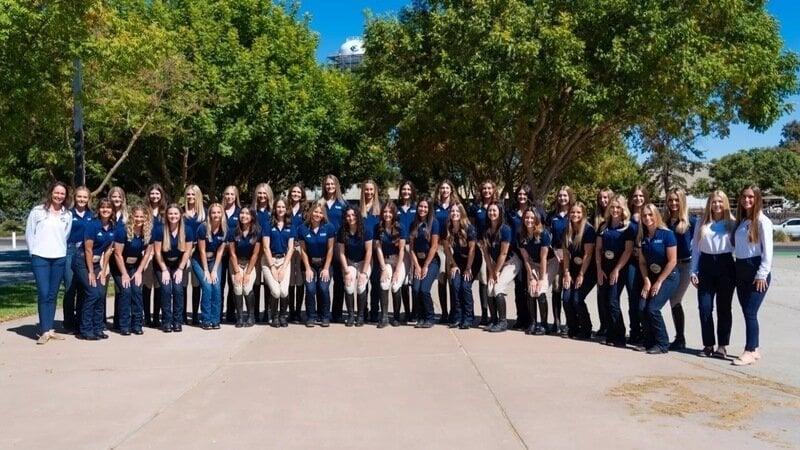
Photo from UC Davis Equestrian
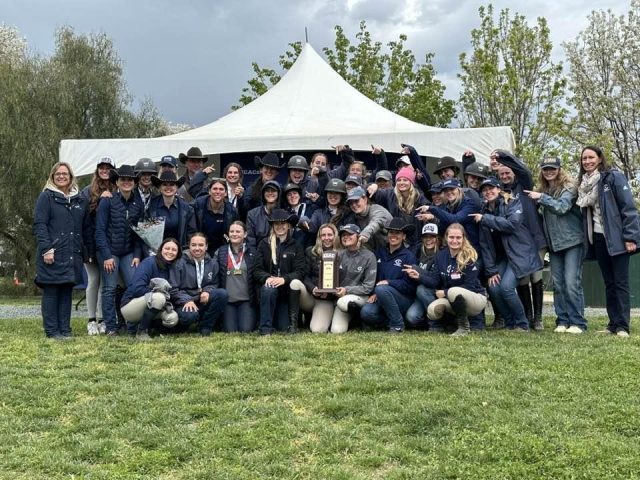
For eight years, the women of the UC Davis Equestrian Team have ridden under the banner of NCAA Division I athletics. They won back-to-back conference championships in 2023 and 2024. They’ve competed at the NCEA national championships. They’ve represented an agricultural university whose mascot — Gunrock — is a horse.
Now, they’re being told it’s over.
On January 9, University of California, Davis leadership announced the varsity equestrian program would be downgraded to club status after the 2025–2026 academic year. In its place, the university will elevate women’s STUNT — an acrobatic sport derived from cheerleading — to NCAA Division I status.
The 33 women currently on the roster were informed mid-season. Their final regular season meet as a DI program is scheduled for March 7.
And now, the fight has moved to federal court.
A Federal Lawsuit and Allegations of Fraud
One month after the announcement, four student-athletes — listed anonymously as “Jane Does 1-4” — filed a federal lawsuit against UC Davis, Chancellor Gary May, Athletic Director Rocko DeLuca, and others.
According to attorney William Janicki, the complaint centers on allegations of fraud. The suit claims the university knew earlier that it intended to eliminate the team but continued recruiting athletes under the representation that they were joining a Division I program.
Two of the plaintiffs joined this past fall. Two were recruited for the upcoming 2026 season.
Several allegations outlined in the suit raise difficult questions:
- Coaching contracts were reportedly restructured to end in June rather than August, aligning with the end of the 2025–2026 season.
- November recruits were allegedly asked to sign only “verbal commitments” rather than National Letters of Intent.
- The announcement came after admissions and transfer deadlines had passed.
If true, that timing matters. In football or basketball, entering the transfer portal opens dozens of doors. In equestrian? There are only 14 Division I programs nationwide. On the West Coast, just two — Davis and Fresno State Equestrian. Now, potentially one.
That’s not a portal. That’s a bottleneck.
The lawsuit seeks punitive damages for emotional distress and asks the court to reinstate the team for at least four years so current athletes and recruits can complete their Division I careers.
The University’s Position
UC Davis leadership maintains that the decision followed “extensive external and internal analysis” focused on competitive alignment, financial sustainability, Title IX obligations, participation metrics, and the evolving landscape of Division I athletics.
The university has stated:
- Equestrian will remain varsity through the 2025–2026 academic year.
- Current athletic scholarships will be honored through degree completion.
- Student-athletes will continue receiving academic and medical support during the varsity sponsorship period.
- Coaches’ contracts will be honored through their current terms.
- Club status will allow interested students to continue competing in a self-funded format.
On paper, it sounds orderly.
On the ground, parents describe athletes cycling through shock, anger, grief, and determination, all while continuing to compete for the school they love.
“This Is Bigger Than Anyone Imagined”
An organized effort under the banner “Keep Davis Riding” has gathered more than 12,000 petition signatures. Parents even offered to self-fund the team if the university would allow it to remain Division I.
They were not taken up on the offer.
Supporters argue the issue goes beyond budget lines. They question transparency. They question data. They question why an agricultural institution would cut a women’s equestrian program while elevating another women’s sport.
And they are saying something else — something that should make every collegiate equestrian program pay attention:
If one falls quietly, others will follow.
Why This Matters to All Collegiate Equestrian Programs
Let’s step back.
NCAA equestrian is already a fragile ecosystem. Only 14 Division I schools sponsor it. It requires land, horses, specialized facilities, veterinary care, trained staff, and long-term investment. You can’t lock horses in a ball cage and revisit them next semester. They require daily management and infrastructure.
That reality makes equestrian uniquely vulnerable.
When athletic departments face financial recalibration or Title IX balancing acts, equestrian is often scrutinized first — not because it lacks value, but because it’s complex and expensive.
The irony? These programs produce veterinarians, researchers, trainers, equine business owners, and industry leaders. They are pipelines. They are workforce development engines for a multi-billion-dollar equine industry.
When a Division I equestrian team disappears, the ripple effect doesn’t stop at campus gates.
- Fewer scholarship opportunities for women.
- Fewer West Coast options for elite riders.
- Greater geographic concentration in the Southeast and Texas.
- Reduced visibility and legitimacy for collegiate equestrian nationwide.
And here’s the uncomfortable truth: if a respected agricultural powerhouse like UC Davis can demote a successful DI equestrian program, no program should feel immune.
Former captain Kendall Lance put it plainly: “If Davis is willing to do this, possibly other teams are too.”
She’s not wrong to worry.
Club Is Not the Same as DI
The distinction matters.
Club sports typically are self-funded. They lack athletic scholarships. They don’t compete at the NCAA championship level. The recruiting pipeline changes. The competitive structure changes. The career trajectory shifts.
For athletes who have spent their entire riding careers chasing NCAA recruitment, the difference is not symbolic. It’s structural.
Parents describe their daughters feeling “empty.” Alumni say the Division I designation provided professional credibility in the equine industry. The team even serves as “Maggie the Aggie,” representing the university at football games — a literal embodiment of the school’s equestrian heritage.
This isn’t just about competition. It’s identity.
The Domino Effect
Equestrian programs sit at a crossroads of athletics, agriculture, and women’s opportunity. They are also easy targets in an era of shifting NCAA economics.
Name, Image, and Likeness pressures. Conference realignments. Escalating football budgets. Third-party reviews. Institutional “competitive alignment.”
When administrators look at spreadsheets, equestrian can appear expendable.
But when you zoom out to the equine industry — which supports hundreds of thousands of jobs and billions in economic impact — collegiate equestrian becomes something else entirely: infrastructure.
That’s why this lawsuit is bigger than UC Davis.
It’s a test case.
It tests transparency in athletic governance.
It tests the durability of women’s equestrian programs under NCAA recalibration.
It tests whether schools will treat equestrian as a long-term investment or a discretionary line item.
What Happens Next?
The federal case will unfold in the coming months. UC Davis will sponsor the team through the 2025–2026 academic year. The athletes will continue competing — with grit, by all accounts.
Their March 7 meet against UT Martin may feel different now.
And across the country, athletic departments and equestrian coaches are watching closely.
Because if one Division I equestrian domino falls without resistance, others may tip more easily.
The question isn’t just whether UC Davis reinstates its program.
The question is whether collegiate equestrian as a whole decides to fight for its place at the Division I table — loudly, strategically, and together.
This isn’t just Davis’s ride anymore.
It’s everyone’s.
