



Training in the Right Way: Don’t Perpetuate Your Training Problems by Repeating Your Training Problems…
…or, in other words, sometimes you have to stop participating in the problem to eliminate the problem.
Dressage training is supposed to be the process of training ANY horse to be a better riding horse. The more the horse learns, in theory, the easier it is to communicate with and therefore complete more complex tasks with. Although competition dressage training often is more focused on training for the dressage test, that is not what the original intention (and original judging requirements) were for competitive dressage. Initially, it was designed to give riders and trainers a way to determine how their training measured up to the theoretical ideal of the training process. That said, it is critically important to understand the meanings and reasons for some of the terms we use to describe dressage training and what to look for when observing training and competition (and videos and photos), regardless of whether you intend to compete or just train your horse to be a better whatever you do with him. That, ultimately, is the main purpose of my articles. To provide education and knowledge for riders to understand and improve their eye and understanding of what dressage training is supposed to be. While there will always be some differences in practice and theory, good horse training is always recognizable to the educated eye. That said, it absolutely is necessary that we remember and understand that limited knowledge is limited judgment.
* * *
It doesn’t matter if you are starting a young horse, or retraining an older horse, there is one extremely important, very basic premise that you must organize all of your other decisions around. Do not allow the horse to repeat a behavior or action that you do not want to be in its repertoire.
This applies to the little things like trying to look outside the arena while you are schooling an extended walk, to the more irksome ones like bolting back to the barn, and everything in between. Most of the time unwanted behaviors get perpetuated because a rider does not know what to do to stop or prevent it. Sometimes the behavior is scary and has intimidated the rider into accepting it and other times, the rider never realized the behavior was a problem…until it was. Regardless of the innocence or danger of the behavior, the first step to getting rid of it is to not repeat it.
Much of the time riders are taught, or have somehow come to the understanding, that they must repeatedly put the horse in the same situation over and over and “correct” the behavior (think late flying changes). The problem is, however, that no matter how many times you ride a late flying change and then try to correct or punish the late change, you will still have a late change (and eventually you also have an angry or fearful horse right after that late change. Which is not particularly enjoyable or useful). Because that is what you have been practicing over and over and over and over and over….
If you take nothing else from this article, remember this: training horses is simply whatever the horse repeats the most, over time.
So, whether your horse rears and takes you back to the barn, or it pulls so hard on the reins in the canter that you cannot control the stride length or speed, the solution is always to either avoid the problem or prevent it. In truth, all behavior corrections involve both devices. In other words, the trainer’s job is to avoid letting the horse repeat the behavior and then create exercises or training techniques that prevent it from starting.
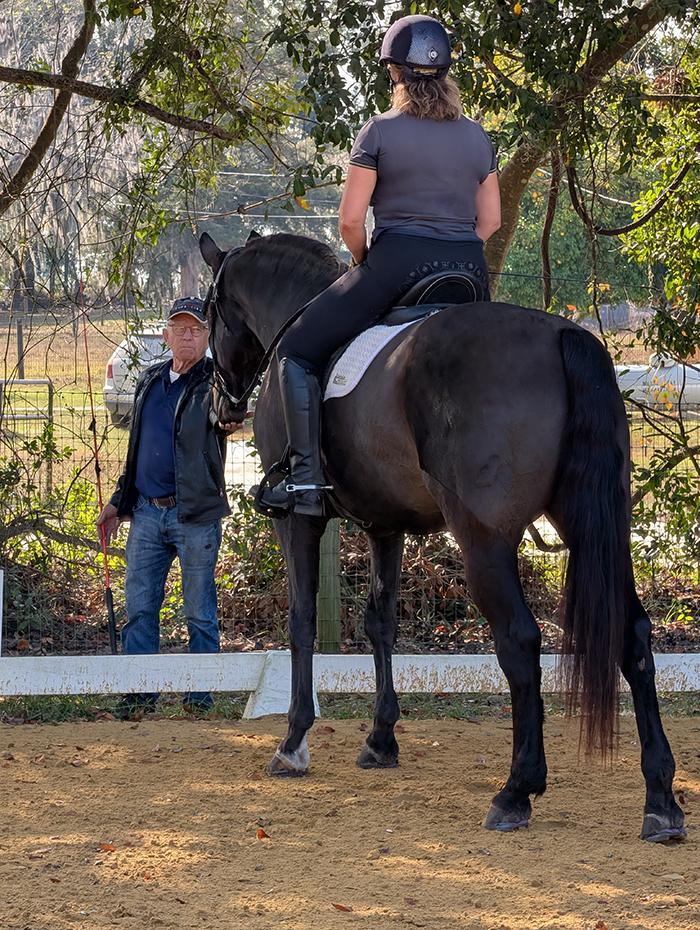
Knowledgeable help is vital when the techniques and exercises you know are not enough to solve the problem. Photo (c) Morgane Schmidt.
The challenge here is that the person training the horse has to have knowledge of the training techniques and exercises that can produce both of these results. Also, if the behavior is dangerous, then it must be dealt with in educated and experienced hands. Even though I have been training horses for over 45 years, I still will hand some problems off to someone who specializes in dealing with the really dangerous stuff. Often, I might know what needs to be done, but I can recognize that I do not have enough experience making that correction to not only stay safe but also be successful. This applies to the “easy stuff” too. If you do not know how to avoid the problem you have with your horse, and do not know what exercises or techniques will prevent it, then you need to get help from someone who does.
Let’s use the late flying change as an example. If your horse has a clean flying change to right, but is late EVERY TIME to the left, your first step is to STOP doing late changes to the left. This might mean doing absolutely NO changes to left.
Yeah, absolutely NO ONE likes hearing that when I say it. But if you do not ride the left change late over and over, at least you and your horse are no longer practicing late left changes. This is the avoidance part. Then, you must have some understanding of why the change is late. Is it a suppleness issue? A balance/collection problem? This is highly specific to the horse in question and there is no one specific answer that fits all situations. And, sometimes it is the way the rider is riding that creates the problem.
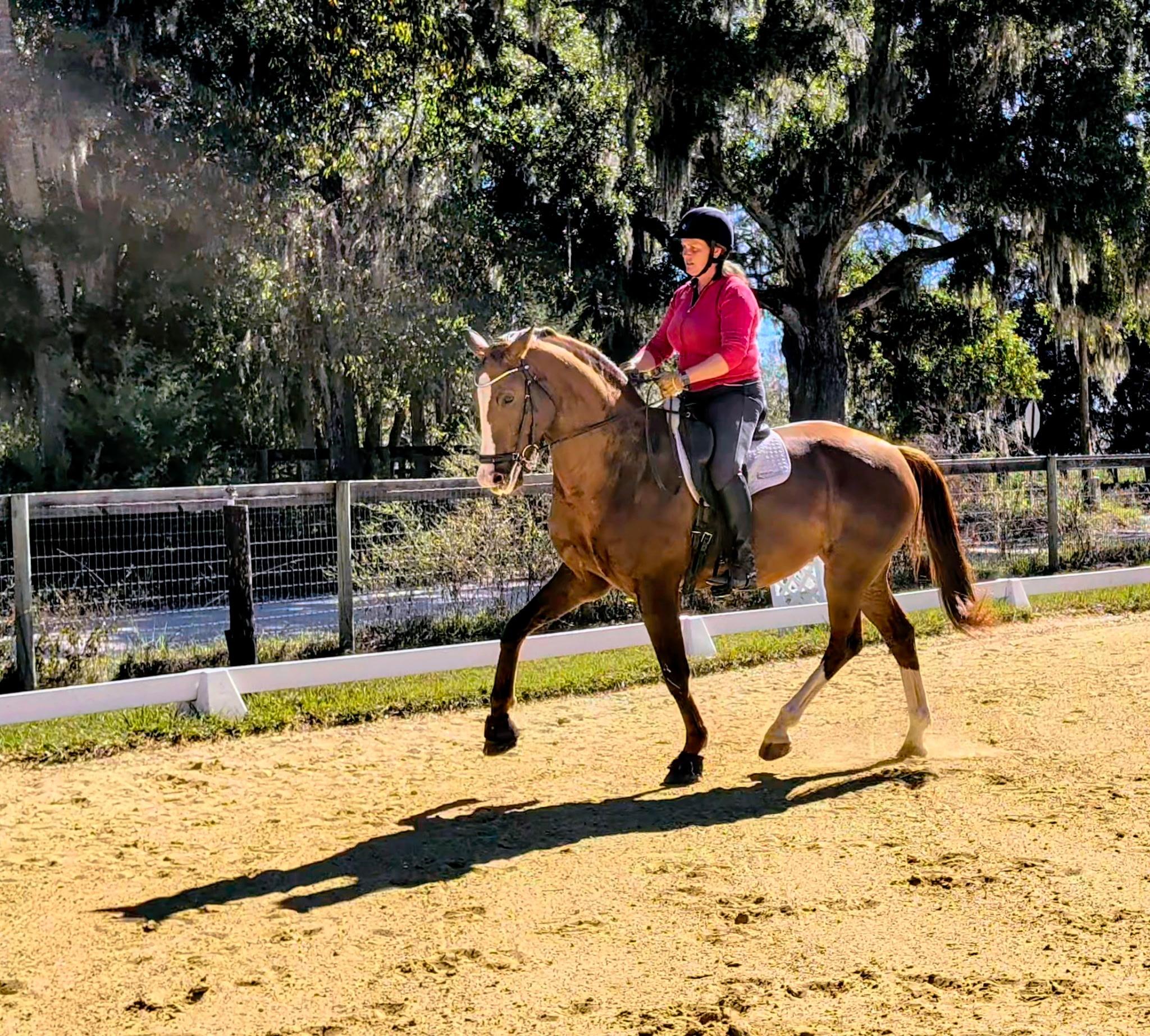
Training horses is simply what we allow the horse to repeat over time. Photo (c) Morgane Schmidt
BUT an example would be to return to the simple change (canter-walk-canter) instead of the left flying change (it helps the horse re-learn the half-halt for the collection required for the change). But also, over the next days, weeks, or months you might need to add some exercises that increase the effect of the outside leg aids such as counter-canter, haunches-in, and simple changes while still avoiding the left flying change. The canter quality (the suppleness, the impulsion, the contact and the development of collection) will improve with this approach. When these qualities are better established, usually the late change problem is solved and the rider can more often than not create a clean change.
Once again, training horses is always a matter of whatever the horse is allowed to repeat over time. The first step to solving a training problem is to avoid repetition of the problem. The second step is to use training techniques and exercises that develop the solution. Most often, most riders get trapped in a repetitive problem because they do not have the means to stop or avoid the issue, and/or do not have the experience or knowledge of the exercises and techniques that create the solution. This is where having knowledgeable help is absolutely vital. All riders benefit from having good eyes on the ground, but it is especially important to seek out those with the appropriate knowledge to help you develop not only your horse, but your own training skills as well.
Remember: limited knowledge is limited judgment.

Gwyneth and Flair in competition at Grand Prix. (c) flatlandsfoto.
Gwyneth McPherson has over 35 years experience competing, training, and teaching dressage. She began her education in in the late 1970s, riding in her backyard on an 11 hh pony. Her first instructor introduced her to Lendon Gray (1980 and 1988 Olympian). who mentored Gwyneth for a decade during which she achieved her first National Championship in 1984, and her Team and Individual Young Rider Gold Medals in1987.
In 1990 Gwyneth began training with Carol Lavell (1992 Olympian) who further developed Gwyneth as an FEI rider and competitor. Gwyneth achieved a Team Bronze in 1991 and a Team Silver in 1992 in the North American Young Riders Championships, and trained her stallion G’Dur to do all the Grand Prix movements while riding with Carol.
In 2008, while Head Trainer at Pineland Farms, Gwyneth began training with Michael Poulin (Olympian 1992). Michael was trained by Franz Rochowansky (Chief Rider for the Spanish Riding School 1937-1955). Michael has shared much of Rochowansky’s knowledge and wisdom with Gwyneth, completing her education as a Grand Prix rider, trainer, and competitor.
Gwyneth’s teaching and training business, Forward Thinking Dressage,is based in Williston, FL. In addition to teaching riders and training, Gwyneth also loves sharing her knowledge of the sport and art of dressage as well as discussing relevant topics pertaining to the training itself and the current competitive landscape.

