



Training in the Right Way: Your Horse’s ‘Bad Days’ May Be a Training Opportunity
In my experience, most riders think of these days as bad or a day that was lost in the training process, but the reality is that these are often the days when the largest training gains can be made.
Dressage training is supposed to be the process of training ANY horse to be a better riding horse. The more the horse learns, in theory, the easier it is to communicate with and therefore complete more complex tasks with. Although competition dressage training often is more focused on training for the dressage test, that is not what the original intention (and original judging requirements) were for competitive dressage. Initially, it was designed to give riders and trainers a way to determine how their training measured up to the theoretical ideal of the training process. That said, it is critically important to understand the meanings and reasons for some of the terms we use to describe dressage training and what to look for when observing training and competition (and videos and photos), regardless of whether you intend to compete or just train your horse to be a better whatever you do with him. That, ultimately, is the main purpose of my articles. To provide education and knowledge for riders to understand and improve their eye and understanding of what dressage training is supposed to be. While there will always be some differences in practice and theory, good horse training is always recognizable to the educated eye. That said, it absolutely is necessary that we remember and understand that limited knowledge is limited judgment.
* * *
If you ride and train horses, you have absolutely noted that progress does not occur as a simple meteoric upward trajectory. Improvement comes in small increments, and there are many opportunities for unanticipated time off due to illness, lameness, weather, and various other disruptions. Even if you somehow sidestep any training disruptions that might occur, you will notice that your horse does not just continuously get better each day. And — even with excellent training — there is a day here and there that feels like a setback or maybe even a complete departure from the path of progress. In my experience, most riders think of these days as “bad” or a day that was “lost” in the training process, sometimes then permitting themselves to ride with less quality (and when I say less quality, I mean poorly). The reality is though, that these are often the days when the largest training gains can be made (assuming you don’t do that whole riding poorly bit).
I overheard a top rider once say that “the measure of a good rider is not how well they ride when things are going well, but how well they ride when things are going badly.” So many times, riders lose the most useful training opportunities by allowing themselves to devolve into poor riding just because their horse is having a bad day. When, in fact, your horse’s bad day is usually one of your very best training opportunities. In other words, HOW you handle the problem is far more important than the problem itself.
To quote a very wise and erudite man, “The problem is not the problem. The problem is your attitude about the problem” ~ Jack Sparrow
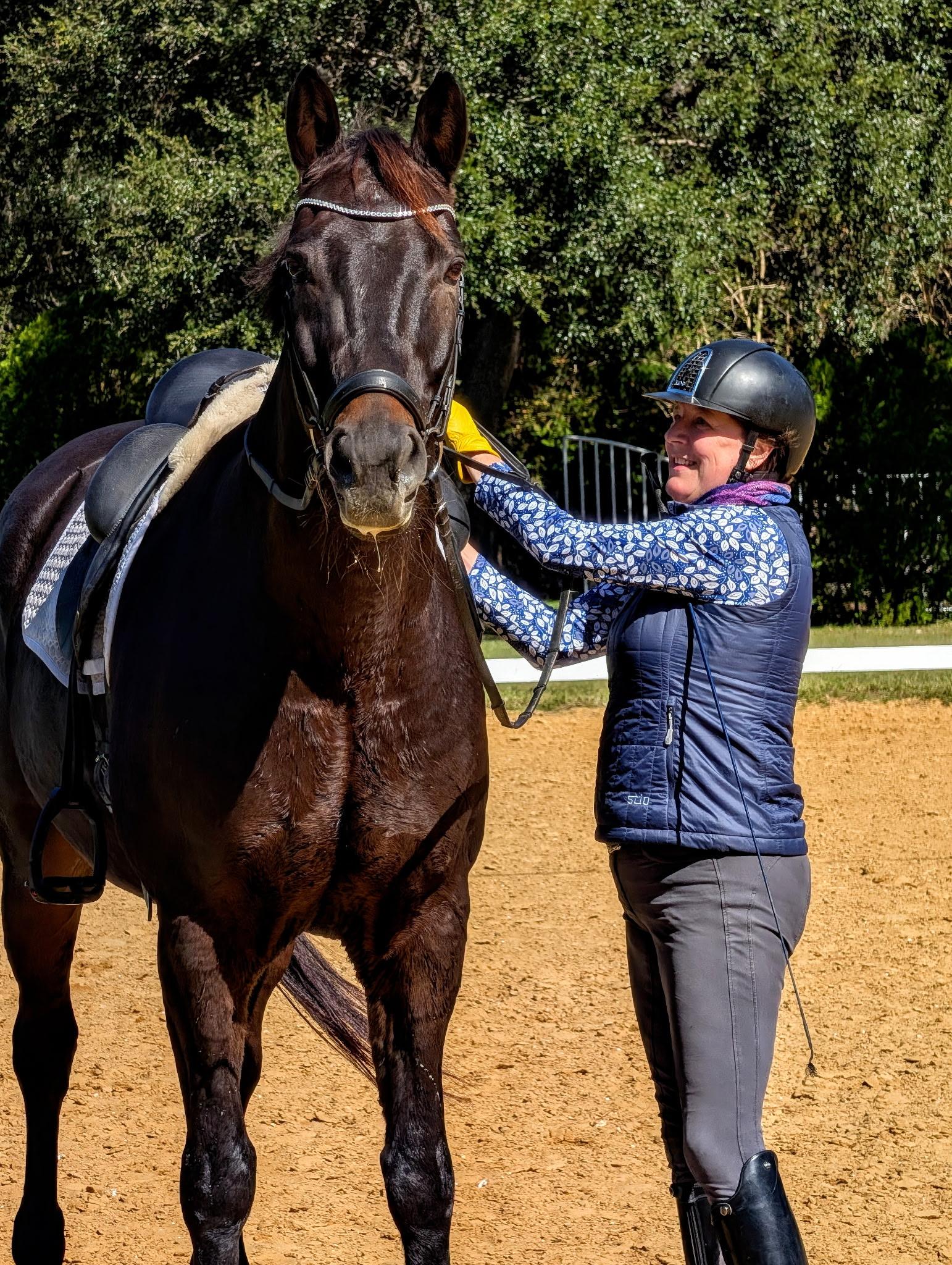
Your attitude about the problem, or what you do with the problem, is of greater importance than the actual training problem, itself. Photo (c) Morgane Schmidt
So, why do riders end up in the situation of riding worse when their horse is not going well? Most often because they get frustrated, and people get frustrated when they do not have a tool to solve their problem. Fortunately for us, there is a problem-solving body of knowledge that has been developed over 2000 years that helps us make decisions and use exercises to train our horses. It is called Dressage (training). But of course, as with all tools, if you do not have the knowledge of which tools to use and how to use them, they will not work for you. So, frustration rises out of not having the training tool at hand to fix the problem and most commonly occurs because:
- The rider has not been taught the solution.
- The solution that the rider has been taught isn’t working, and they do not have another solution.
- The rider has been successful in the past using strength or a stronger piece of equipment, and the horse has become numb or resilient against that increase in strength.
- The rider may know the solution but is not patient enough to let it work.
One of the biggest barriers to making a bad day into a positive training experience is the unwillingness to change the plan for the training for the day. Most often this starts out with a statement like “We are going to work on flying changes today” (thinking that “we” had some really good changes yesterday, so “we” will continue to work on improving them). However, today, the second half of “we” (the horse) has no concept of flying changes, dressage, or progress, and they came out of the stall feeling a little wound up because the wind has shifted, and the changes were a little stressful yesterday, and their rider feels a little excited or charged with energy that they cannot comprehend the source of.
Somewhere in the canter warm up the horse starts to pull a little more than yesterday. It’s harder to make him supple. Everything is a little too fast and then the first change, and the first change is late. So, we try again and this one is also late, and the horse snatches the reins and goes too fast afterward. And then the next attempt is the same, only worse, and now the rider thinks “I had to chuck him in the mouth and forcibly and abruptly halt because HE can’t get away with that.” And now everyone is tense. The horse is more focused on his internal feeling than the rider and the rider is getting rougher because “he needs to be taught a lesson.” This is, by the way, is how most flying changes become a problem. But that’s a different article….
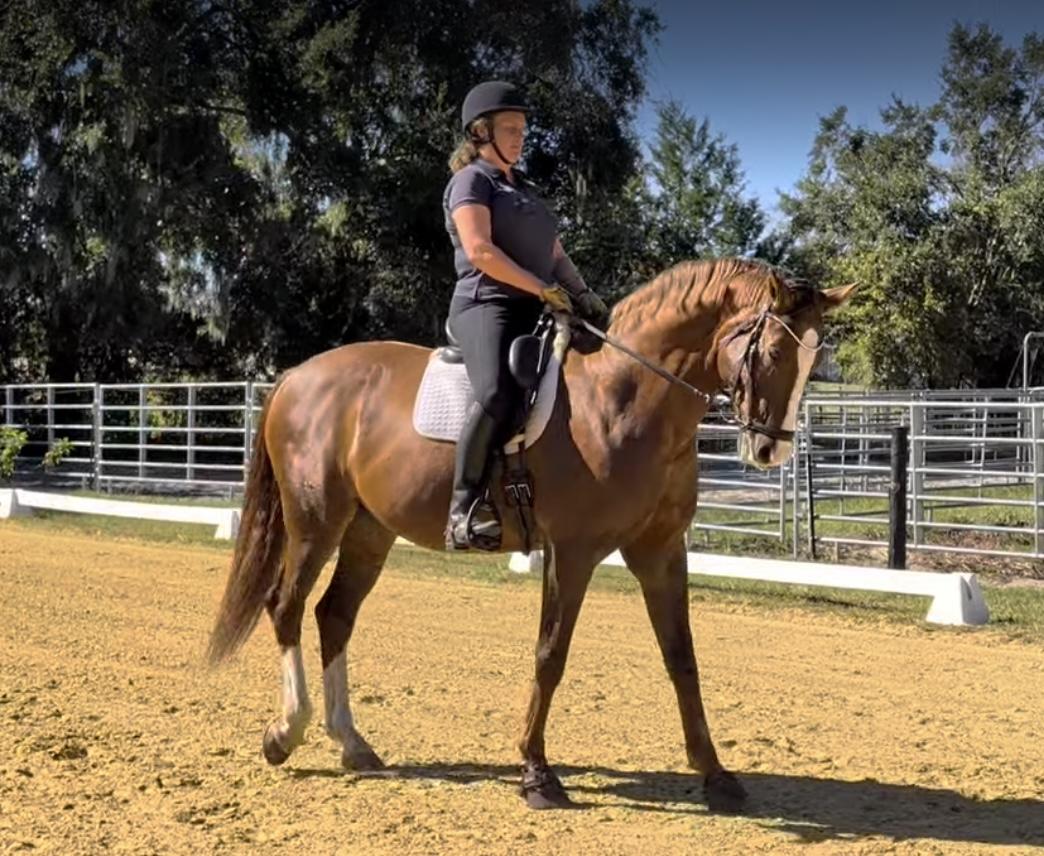
Rhythm, suppleness and contact, the base of the Training Scale, is the foundation of all riding. Photo (c) Morgane Schmidt
If we remind ourselves that:
- The training scale shows us that rhythm, suppleness, and contact have to be consistent and adequate for the level of the horse’s training.
- That there are specific exercises that create these qualities (and we remember that those exercises are the answer to recreating rhythm, suppleness and contact whenever we lose them in the training process.
- That we cannot produce a new, unfamiliar, or harder exercise without these qualities (and probably some others like impulsion, straightness and collection)
Then we know that just repeating the exercise that didn’t work without returning to these exercises will end in failure.
The moral of this story is that sometimes you make the changes (or anything else) better by not specifically practicing them, but going back to the exercises that got us to the point of being ready to start the changes (or whatever the problem is today). And even if you do not get the horse back to the point of being able to ride the changes TODAY, you have set him up to be BETTER TOMORROW.
Yes—what you do today will set the horse up for what he will do tomorrow for better or worse. And you must remember that he does not have the knowledge and understanding of the process that you have, so you have to re-explain it as many times as necessary. Just because you did everything right on a bad day does not mean you will elastically snap back to where you want to be the following day either, it just means that you didn’t let it get worse, and that you continued to build a platform for progress to continue from. Sometimes the worst bad days are actually the best training opportunities if you handle them really, really well.
Ultimately, if you are following the principles of classical training, you can solve your training problems. If you do not have the knowledge to solve your problem, you need to find someone who does, and don’t let your frustration rule your training decisions. And when your horse is having a bad day, it’s far more productive to know what exercises to work on to bring back your horse’s understanding of what he is supposed to be doing, rather than just trying to do the same thing over and over, expecting it to get better and becoming frustrated and permitting yourself to ride poorly because your horse is not going well.
Remember: limited knowledge is limited judgment.

Gwyneth and Flair in competition at Grand Prix. (c) flatlandsfoto.
Gwyneth McPherson has over 35 years experience competing, training, and teaching dressage. She began her education in in the late 1970s, riding in her backyard on an 11 hh pony. Her first instructor introduced her to Lendon Gray (1980 and 1988 Olympian). who mentored Gwyneth for a decade during which she achieved her first National Championship in 1984, and her Team and Individual Young Rider Gold Medals in1987.
In 1990 Gwyneth began training with Carol Lavell (1992 Olympian) who further developed Gwyneth as an FEI rider and competitor. Gwyneth achieved a Team Bronze in 1991 and a Team Silver in 1992 in the North American Young Riders Championships, and trained her stallion G’Dur to do all the Grand Prix movements while riding with Carol.
In 2008, while Head Trainer at Pineland Farms, Gwyneth began training with Michael Poulin (Olympian 1992). Michael was trained by Franz Rochowansky (Chief Rider for the Spanish Riding School 1937-1955). Michael has shared much of Rochowansky’s knowledge and wisdom with Gwyneth, completing her education as a Grand Prix rider, trainer, and competitor.
Gwyneth’s teaching and training business, Forward Thinking Dressage,is based in Williston, FL. In addition to teaching riders and training, Gwyneth also loves sharing her knowledge of the sport and art of dressage as well as discussing relevant topics pertaining to the training itself and the current competitive landscape.

