



Training in the Right Way: Repetition in Training
Although training a horse always involves repetition, it has to be done in the right way at the right time for it to actually further the training.
Dressage training is supposed to be the process of training ANY horse to be a better riding horse. The more the horse learns, in theory, the easier it is to communicate with and therefore complete more complex tasks with. Although competition dressage training often is more focused on training for the dressage test, that is not what the original intention (and original judging requirements) were for competitive dressage. Initially, it was designed to give riders and trainers a way to determine how their training measured up to the theoretical ideal of the training process. That said, it is critically important to understand the meanings and reasons for some of the terms we use to describe dressage training and what to look for when observing training and competition (and videos and photos), regardless of whether you intend to compete or just train your horse to be a better whatever you do with him. That, ultimately, is the main purpose of my articles. To provide education and knowledge for riders to understand and improve their eye and understanding of what dressage training is supposed to be. While there will always be some differences in practice and theory, good horse training is always recognizable to the educated eye. That said, it absolutely is necessary that we remember and understand that limited knowledge is limited judgment.
* * *
When I’m teaching, I find that most riders are very (and not necessarily inappropriately) focused on doing the exercise “right.” They also want to repeat the exercise as many times as possible, even if the horse has already performed it fairly well for his level of understanding. This isn’t as productive as one might think.
Although training a horse always involves repetition, it has to be done in the right way at the right time. Whether the rider is working on improving a gait or a transition, developing collection, or starting a new exercise, it is necessary to use repetition in order for the horse to develop the balance, suppleness, and recognition of the aids to perform the desired movement or way of going. That being said, many riders do not understand that just trying to repeat the exercise as it is expected to be performed in the test is not the same as training the horse. The process of training horses to do anything in dressage involves more than just knowing what the end result is supposed to be; you have to recognize that there are steps in between and how much repetition is helpful and at what point it becomes destructive. It is also necessary to know what aspects of the exercise must absolutely not be done incorrectly and what the horse can be allowed to do “not quite right” during the learning process.
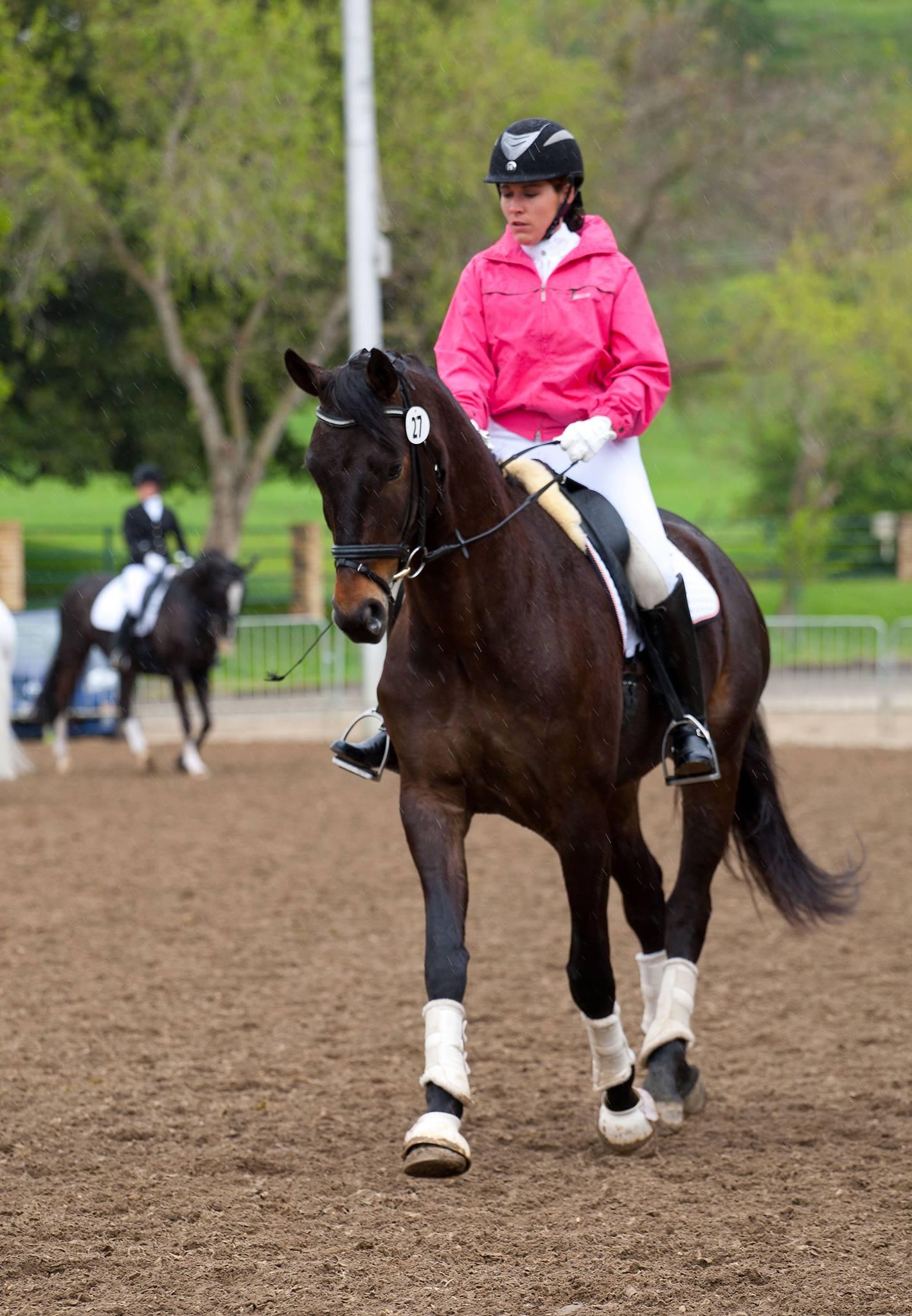
Horses of all ages need repetition to learn what is expected of them. Knowing how to make the exercise more understandable is the key to making the repetitions more productive. Photo (c) Michele Ting.
To begin though, let’s discuss repetition. Repeating an exercise over days, weeks, months, and years –while making small adjustments and performing supporting exercises before and after each attempt — is necessary for the horse to learn what is expected of him. Riding the same exercise over and over in a ride, with very little variation in the aids and results, and in the absence of supporting exercises before and after the attempts will do two things:
- Make the horse really good at doing the exercise the way he repeats it (so, if the flying change is late every time, its going to be late every time).
- Potentially make the horse dislike or be afraid of the exercise (if the aids keep increasing and pressuring the horse and he has no supporting exercises to understand the exercise, he will become afraid or upset by the increase in the aids).
Repetition only makes the horse better at an exercise if the exercise is only repeated a couple times in the ride with exercises before and after that improve the quality of the exercise. RIDERS will often need to repeat an exercise multiple times when THEY are learning it, but this does not help the horse learn it.
What do I mean by supporting exercises? A supporting exercise is something the horse is already familiar with that has a focus on one or more of the qualities desired in the new exercise that you are teaching the horse. An example would be riding an impulsion building exercise (a lengthening, medium, or extended exercise) in the gait you are using to teach the new exercise. Or you might ride a transition or do a suppling exercise between attempts at the new exercise. Using the flying change as an example, the horse may benefit from counter canter, canter-walk-canter transitions, medium canter and canter half-pass between attempts at a flying change. All these exercises have different effects on the horse’s way of going and can help develop those effects before and during the flying change attempt.
To build on that, in order for a horse to learn an exercise, transition, or a change in balance (collection) he will need to be rewarded for the aspects of the exercise he does correctly, and limited in what he is allowed to do wrong. In other words, there needs to be some understanding by the rider that the horse cannot just simply perform the exercise perfectly because the rider gave the right aids. Also, the horse may have to perform aspects of the exercise in a less than optimum way in order to develop some of the critical aspects of the exercise.
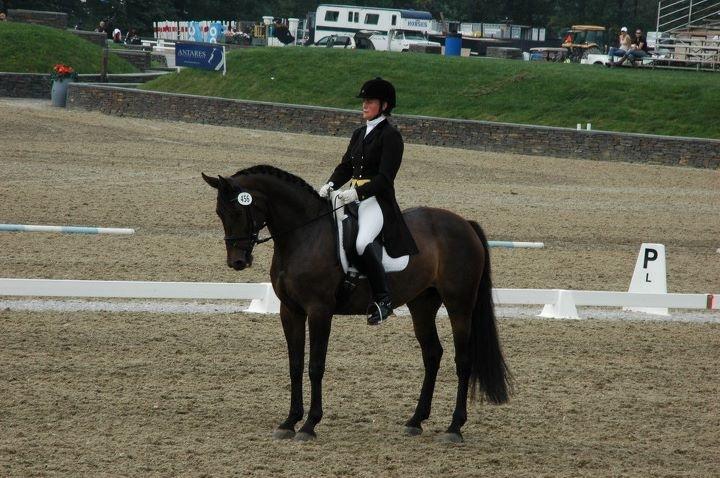
The end result of the exercise being performed well in the dressage test is the product of careful repetition and modification of the exercise over days, weeks, months and years. Photo (c) Gwyneth McPherson
A simple example would be developing something like half-pass. The requirements that must not be allowed to be done poorly are that the horse needs to stay on the bit, on the aids, and go sideways on a diagonal line from the rider’s outside leg. The horse must move laterally equally with both the front an hind legs. But in the initial TEACHING of the half- pass that horse may have less than optimal bend, may be slightly not parallel to the wall, may need to do a transition from the gait he is learning the half-pass in to a gait that he is better balanced in the half-pass in, and he may be allowed a longer (easier) angle for the diagonal line he is on. These are all technically “wrong” in terms of the finished result that shows the proof of the training in the test. But in the LEARNING of the exercise, he may need to have lenience in some of the requirements. Over days and weeks the expectations slowly and methodically become more demanding that the horse performs a version of the exercise that more closely resembles the one desired in the test.
As I have stated often, it is absolutely necessary to have a trustworthy, knowledgeable trainer to help you. They can often see what you may not be able to feel in the moment, and they can tell you what exercises will help improve your horse’s understanding of what is required of him before and during the new exercise attempt. Repeating the exercise is always necessary, but the critical part to that thought process is to only repeat it in a well-prepared, well-thought out way and only a couple times a ride. Use your supporting exercises and always have a sense of what requirements the horse must absolutely produce in the learning of the exercise and what aspects may be done less than perfectly while he learns the most important aspects.
Remember: limited knowledge is limited judgment.

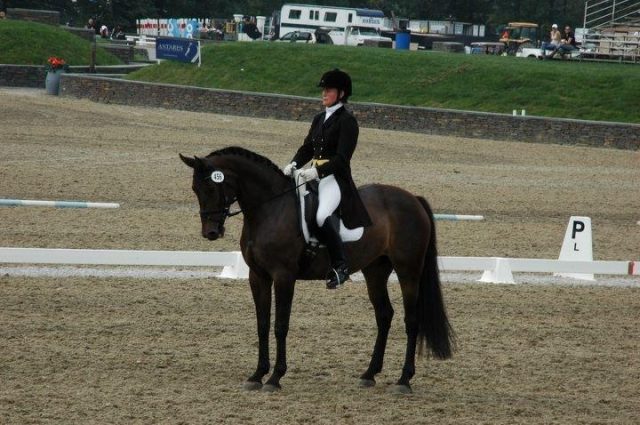
Gwyneth and Flair in competition at Grand Prix. (c) flatlandsfoto.
Gwyneth McPherson has over 35 years experience competing, training, and teaching dressage. She began her education in in the late 1970s, riding in her backyard on an 11 hh pony. Her first instructor introduced her to Lendon Gray (1980 and 1988 Olympian). who mentored Gwyneth for a decade during which she achieved her first National Championship in 1984, and her Team and Individual Young Rider Gold Medals in1987.
In 1990 Gwyneth began training with Carol Lavell (1992 Olympian) who further developed Gwyneth as an FEI rider and competitor. Gwyneth achieved a Team Bronze in 1991 and a Team Silver in 1992 in the North American Young Riders Championships, and trained her stallion G’Dur to do all the Grand Prix movements while riding with Carol.
In 2008, while Head Trainer at Pineland Farms, Gwyneth began training with Michael Poulin (Olympian 1992). Michael was trained by Franz Rochowansky (Chief Rider for the Spanish Riding School 1937-1955). Michael has shared much of Rochowansky’s knowledge and wisdom with Gwyneth, completing her education as a Grand Prix rider, trainer, and competitor.
Gwyneth’s teaching and training business, Forward Thinking Dressage,is based in Williston, FL. In addition to teaching riders and training, Gwyneth also loves sharing her knowledge of the sport and art of dressage as well as discussing relevant topics pertaining to the training itself and the current competitive landscape.

