



Training in the Right Way: Mythbusters Edition
In riding and training, there are some commonly held beliefs that while they may seem plausible, are actually incorrect. In this week’s article, I thought I’d tackle a few of the most common ones I routinely encounter.
Dressage training is supposed to be the process of training ANY horse to be a better riding horse. The more the horse learns, in theory, the easier it is to communicate with and therefore complete more complex tasks with. Although competition dressage training often is more focused on training for the dressage test, that is not what the original intention (and original judging requirements) were for competitive dressage. Initially, it was designed to give riders and trainers a way to determine how their training measured up to the theoretical ideal of the training process. That said, it is critically important to understand the meanings and reasons for some of the terms we use to describe dressage training and what to look for when observing training and competition (and videos and photos), regardless of whether you intend to compete or just train your horse to be a better whatever you do with him. That, ultimately, is the main purpose of my articles. To provide education and knowledge for riders to understand and improve their eye and understanding of what dressage training is supposed to be. While there will always be some differences in practice and theory, good horse training is always recognizable to the educated eye. That said, it absolutely is necessary that we remember and understand that limited knowledge is limited judgment.
* * *
When I first start working with riders of all levels, I often ask them to talk to me about what they are working on with their horse and to give me some background on their previous riding experience. Often there are some commonly misunderstood, or incorrectly held, beliefs that consistently come up in these discussions. Given the prevalence of these ‘myths,’ I thought it might be useful to discuss, and ultimately dispel, some of them. While this is not an exhaustive list, these are some of the most commonly perpetuated misunderstandings that I have heard many riders tell me, and why they are not true.
Myth: If the exercise, or transition, was “bad,” you have to repeat it to make it better.
While it is often necessary to repeat an exercise more than once in a ride to help the horse understand it better (or in a lesson, in order to help the rider understand it better), doing a “good” or “better” transition (or exercise) after a poor one does not erase the first one. And, sometimes, there is no point in doing it over. Often, a rider will ride a transition without being fully aware and engaged in the process and they think that doing it over again will correct the first transition. It does not. Both transitions exist equally in the horse’s experience of the lesson.
Training is more like a score card. Of the five canter-walk transitions I schooled today, the first two were not as good as the next three. Each transition was ridden with an equal amount of attention and care, and my horse slowly improved throughout the process. Now I have had more good transitions than failed ones, and I am going to stop training this exercise today. The horse’s experience of doing the transition well is greater than the lesser quality ones.
Myth: Bending the neck makes the horse better balanced.
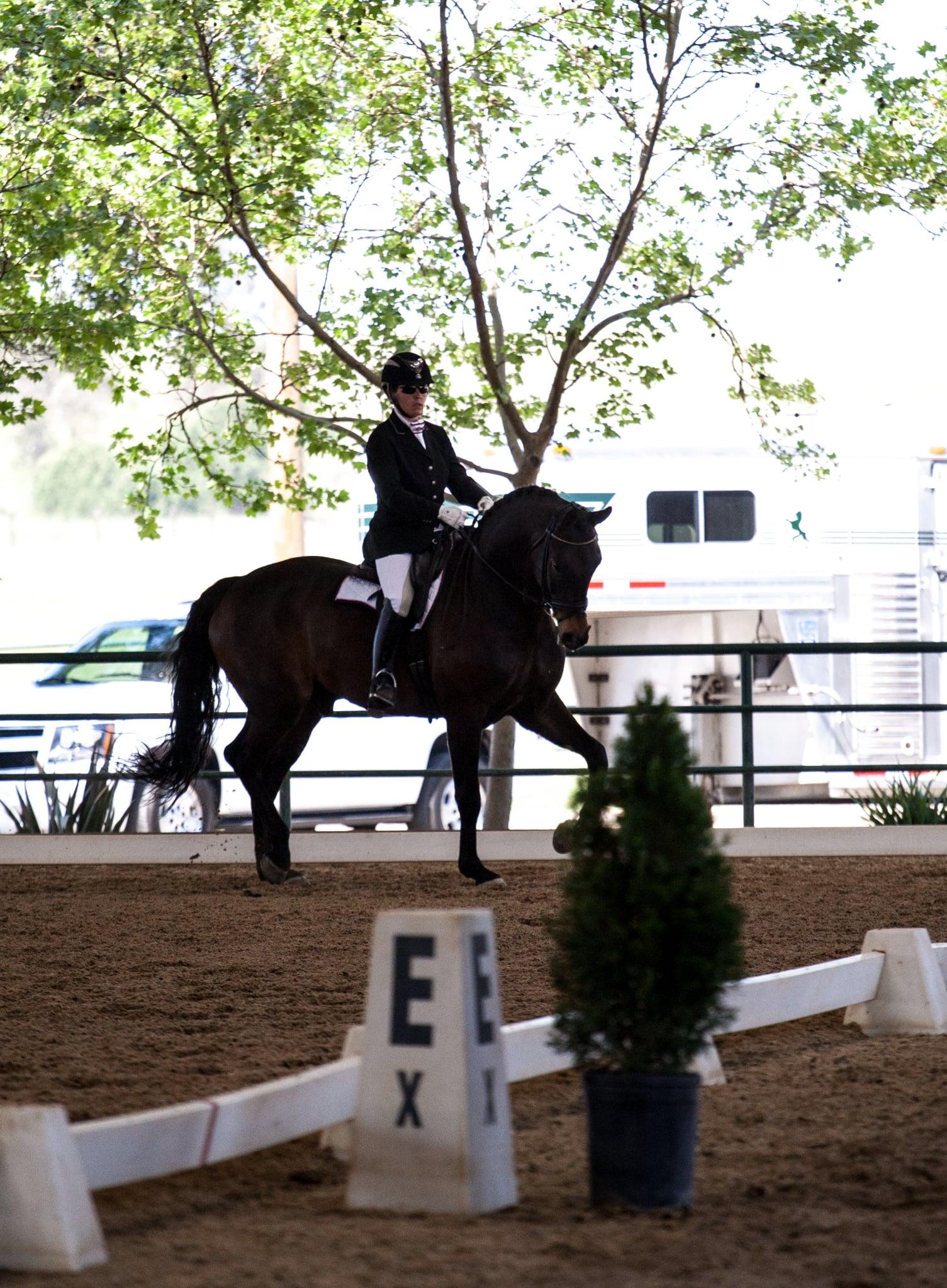
The amount of bend that is “correct” depends on what exercise is being performed. Photo (c) Morgane Schmidt.
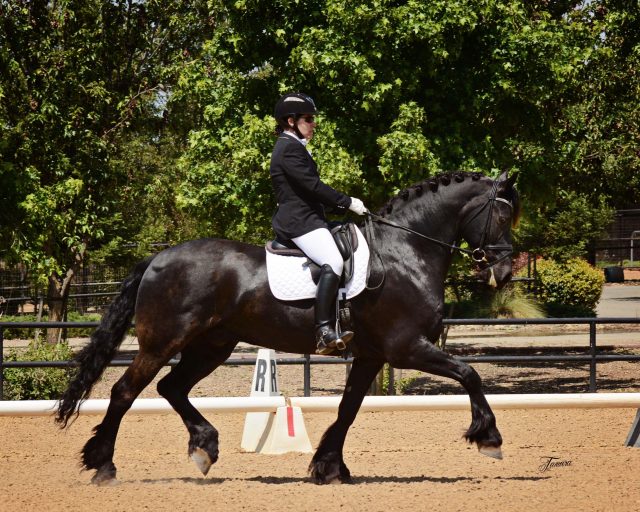
This is a big one, so those of you in the back, listen up: bending the neck of the horse does not make the horse better balanced. That being said, the correct amount of bend throughout the horse’s body, for the exercise he is being asked to perform, helps him be able to use his body in a more organized way to keep his balance during the exercise. While too little bend (and/or the absence of suppleness) can be detrimental to the horse’s balance, so can too much bend, incorrect aids for the bend, and too much strength used to create the bend. Each exercise, corner, and straight line require a specific amount of bend or ability to bend in order for the horse to become balanced in each movement. For example, the amount of bend required for a 20-meter circle is just enough bend to allow the horse to bring his inside hind leg forward to the rider’s seat and a little bit toward his midline. This helps him find his balance on the circle. More bend will destroy the balance as much as not bending enough can.
Myth: Horses need to be able to bend their neck extremely in both directions to be supple.
There is no dressage test, ever, that requires a horse to bend his neck beyond the point of his shoulder on either side (I know, I know. I was *shocked* too). And, the greatest degree of bend needed in the dressage test occurs at Grand Prix, and still the horse does not need more bend than that. The horse should be able to bend his neck equally well in both directions to perform the movements he is required to perform. He does not need to be able to look at your kneecap while you are sitting on him.
Myth: My Training Level horse needs to be more collected.
There is no collection at Training Level. There is no collection at Training Level because there are no impulsion building exercises at Training Level. There also are no collecting exercises and only very basic, rudimentary suppling exercises. The Training Level horse does not have the balance, strength, suppleness, coordination or education to produce collection. The Training Level horse is only supposed to be supple enough, and on the aids enough, to be able to maintain his balance under a rider well enough to not be more on the forehand than his natural balance. Collection is developed slowly and incrementally throughout the horse’s training life.
Myth: Once the horse has repeated the exercise enough, he knows what it is and should be able to do it a) on his own once the aid is given b) the other direction equally well automatically.
A horse will never “know” how to do shoulder-in (or any other exercise). What we want him to know is that the rider will use the bit, seat/back, and legs to transmit feelings in his mouth and on his skin that mean to move his body in certain ways and that by making these motions he is a) rewarded b) able to produce the movement with confidence and c) the rider is there to help him make the movements.
And just by what I have written, I have attributed more human thinking and awareness than a horse actually has the ability to produce. The horse can learn self-carriage which can be confused with knowing because the horse is so well-educated in his job, he can anticipate what is coming next based on the rider’s aids and the exercise looks and feels easy.
Myth: Horses plan ahead and decide to be “naughty” before they are brought out to be ridden.
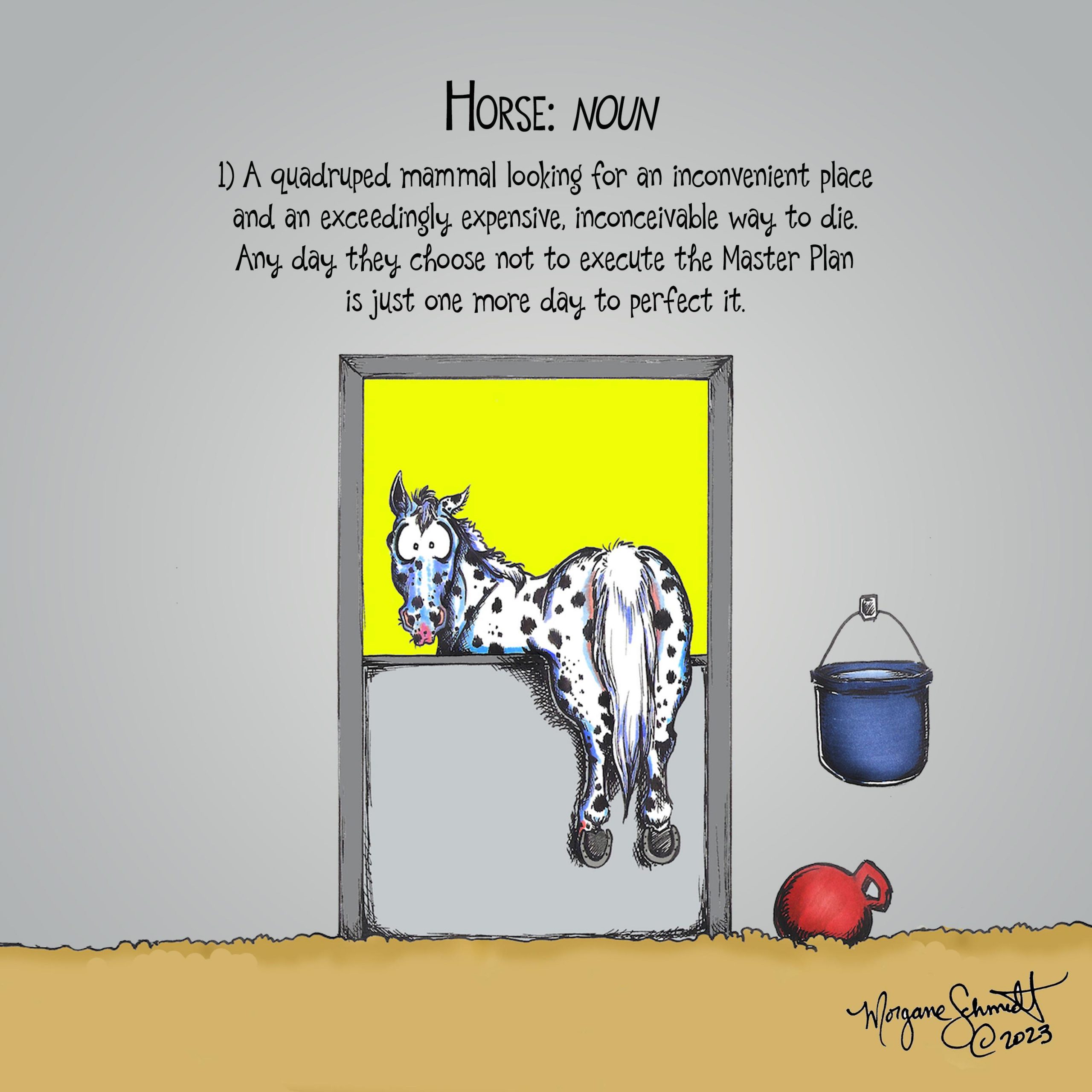
As often as it may seem that your horse may plot embarrassment and frustration overnight, mostly he is just eating hay and minding his own business. Image (c) Morgane Schmidt.
Horses cannot plan ahead. They do not have the brain structures that the human brain has that allow us to think abstract thoughts, imagine the future, lie and make up stories. They have a tremendous ability to recognize and react to exterior stimuli. They absolutely can recall how to do or respond to things that they have been exposed to before. They can recognize people and other animals that they know and remember them even if they haven’t seen them in a long time. But they lack the ability to plan ahead and plot the next way to frustrate or embarrass you. There are multiple factors in why horses behave differently on different occasions, and there’s not enough time or space to cover that in one article.
Myth: There is an aid for collection.
There is no “collecting aid.” The horse develops the ability to collect over months and years of muscle building and balance exercises. The rider creates more collection by using collecting exercises and half-halts in the rhythm of the gait they are working in. The more educated the horse is, the smaller and more refined these aids become. Eventually the appearance of effortlessness develops. It’s not effortless. For anyone. It just looks like it is.
Myth: The rider can use their seat to make the horse go more forward.
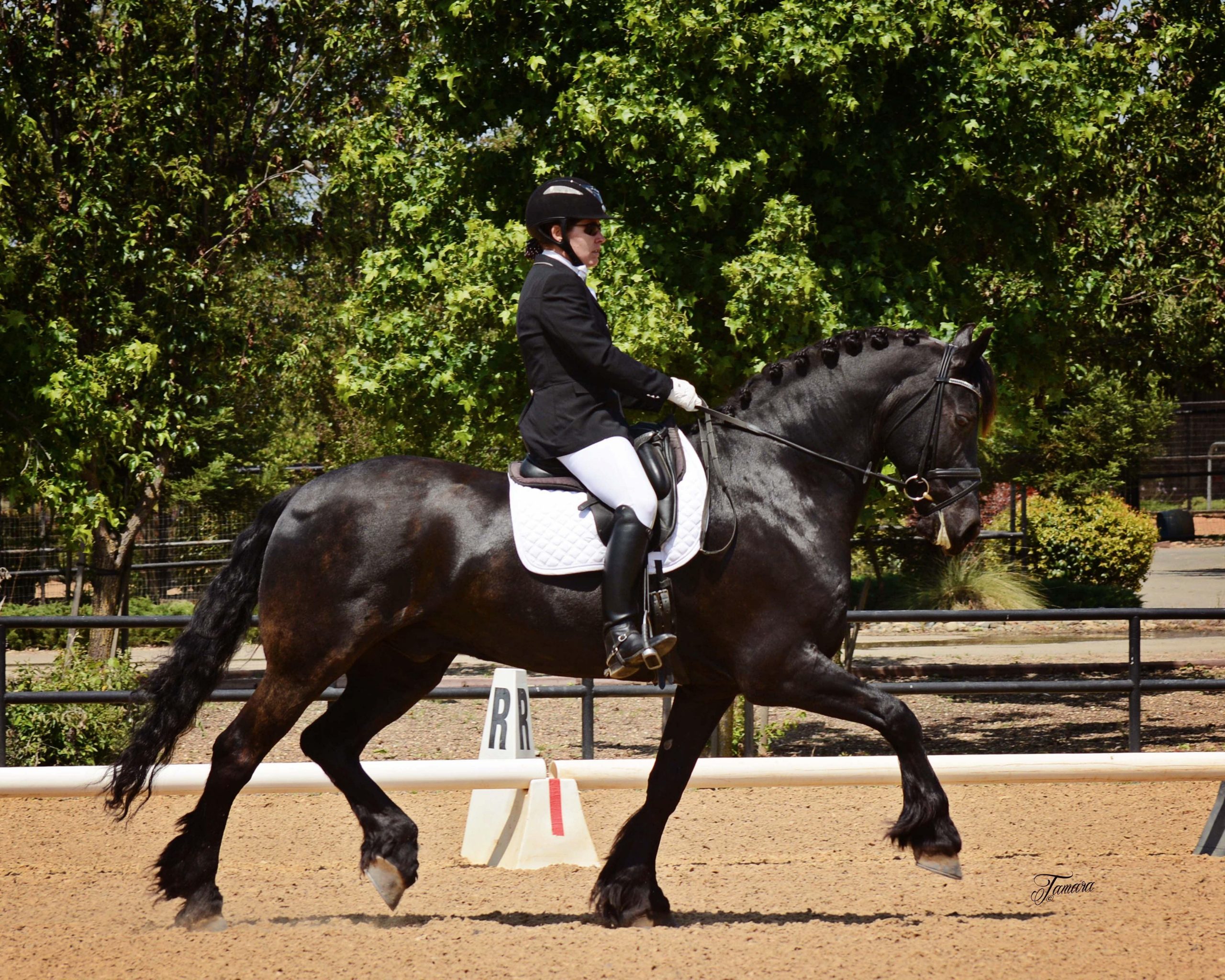
The seat and back of the rider is the foundation of good riding and well-delivered meaningful aids. The seat, however, cannot make a horse go forward without any other aids involved. Gerrit Fan Bonnie View. Photo (c) Tamara with the Camera.
The seat and back of the rider are absolutely integral to correctly producing aids that help the horse understand what he is supposed to do. And if the rider does not have a well-developed seat, they will not be able to improve the horse’s balance and produce suppleness and collection. The seat of the rider, however, CANNOT make the horse go forward. If you need proof, sit on your horse. Take your legs away from the horse’s side. Do not use your hands, reins or whip, and make the horse go solely from your buttocks. I guarantee, unless your horse has a habit of just leaving on his own, it won’t work.
While many of these myths are probably originally rooted in a truth about training horses, each one is an example of how training can get derailed by the rider’s misunderstanding of how or why and exercise is to be performed a certain way. Often these misunderstandings start with a “some is good so more must be better” thought process. Other times it comes from the lack of understanding the Training Scale or the fact that training is a process that spans years. And, very often, these myths get perpetuated by simple repetition. Regardless of the source, a good teacher will help you steer clear of these mistakes.
Remember: limited knowledge is limited judgment.

Gwyneth and Flair in competition at Grand Prix. (c) flatlandsfoto.
Gwyneth McPherson has over 35 years experience competing, training, and teaching dressage. She began her education in in the late 1970s, riding in her backyard on an 11 hh pony. Her first instructor introduced her to Lendon Gray (1980 and 1988 Olympian). who mentored Gwyneth for a decade during which she achieved her first National Championship in 1984, and her Team and Individual Young Rider Gold Medals in1987.
In 1990 Gwyneth began training with Carol Lavell (1992 Olympian) who further developed Gwyneth as an FEI rider and competitor. Gwyneth achieved a Team Bronze in 1991 and a Team Silver in 1992 in the North American Young Riders Championships, and trained her stallion G’Dur to do all the Grand Prix movements while riding with Carol.
In 2008, while Head Trainer at Pineland Farms, Gwyneth began training with Michael Poulin (Olympian 1992). Michael was trained by Franz Rochowansky (Chief Rider for the Spanish Riding School 1937-1955). Michael has shared much of Rochowansky’s knowledge and wisdom with Gwyneth, completing her education as a Grand Prix rider, trainer, and competitor.
Gwyneth’s teaching and training business, Forward Thinking Dressage,is based in Williston, FL. In addition to teaching riders and training, Gwyneth also loves sharing her knowledge of the sport and art of dressage as well as discussing relevant topics pertaining to the training itself and the current competitive landscape.

