Training in the Right Way: Dressage Reading List

Often, students ask me for a reading list and I am always overwhelmed with trying to choose my favorites. In this article, I am going to try to finally do that.  

Dressage training is supposed to be the process of training ANY horse to be a better riding horse. The more the horse learns, in theory, the easier it is to communicate with and therefore complete more complex tasks with. Although competition dressage training often is more focused on training for the dressage test, that is not what the original intention (and original judging requirements) were for competitive dressage. Initially, it was designed to give riders and trainers a way to determine how their training measured up to the theoretical ideal of the training process. That said, it is critically important to understand the meanings and reasons for some of the terms we use to describe dressage training and what to look for when observing training and competition (and videos and photos), regardless of whether you intend to compete or just train your horse to be a better whatever you do with him. That, ultimately, is the main purpose of my articles. To provide education and knowledge for riders to understand and improve their eye and understanding of what dressage training is supposed to be. While there will always be some differences in practice and theory, good horse training is always recognizable to the educated eye. That said, it absolutely is necessary that we remember and understand that limited knowledge is limited judgment.

* * *
If you know me as an instructor and as a person, you know that I love history, I love dressage, and I love to read. Because of these qualities, I have amassed a fairly well-stocked library about horses, riding, and dressage. My favorite books range from modern day masters that I have had the good fortune of riding with –- or getting the opportunity to discuss the theory of training and/or breeding with — to historical reprints of books by the dressage masters of antiquity. Often, students ask me for a reading list, and I am always overwhelmed with trying to choose my favorites. In this article, I am going to try to finally do that.  

It is extremely important to point out that there is no book or video that will replace riding  and working with an excellent instructor. It is not possible to learn riding from a book. It is also important to recognize that just because someone wrote a book does not mean they are a good source of information. You should always do your research about the author. Reading can help develop your understanding of riding theory and history, and it can introduce and clarify concepts that are hard to learn in the saddle, but it cannot teach you the physical skills and feelings you need to develop to be an excellent rider.  

For starters, I have to plug Black Beauty, by Anna Sewell, published in 1877. If you do anything with horses, you need to read it. Make sure you read one of the original editions. It is known for being written in the voice of a horse and is meant to bring attention to how horses were treated and used by humans. It was integral to the development of the idea of animal welfare and it brought awareness to potential cruelty and neglect in Victorian England. I got my first copy of Black Beauty at a flea market in my home state of Maine. I read that edition eight times before high school, and I have read it at least that many times since. It’s the sort of book that grounds you. 

Now for the official list. We will start with some solid, easy-to-read books with simple illustrations. These books are great foundations for your dressage journey. 

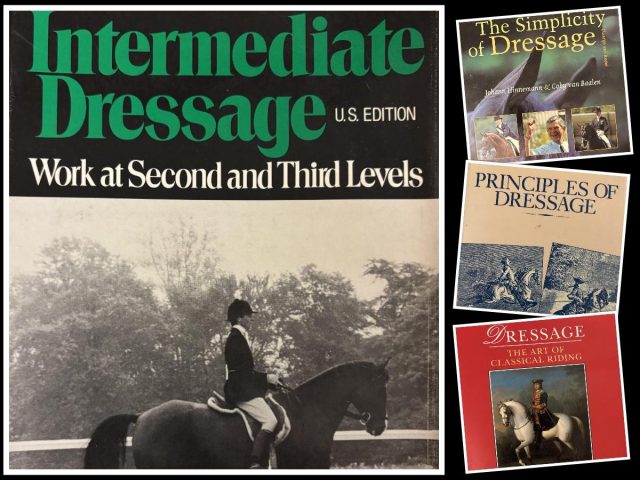
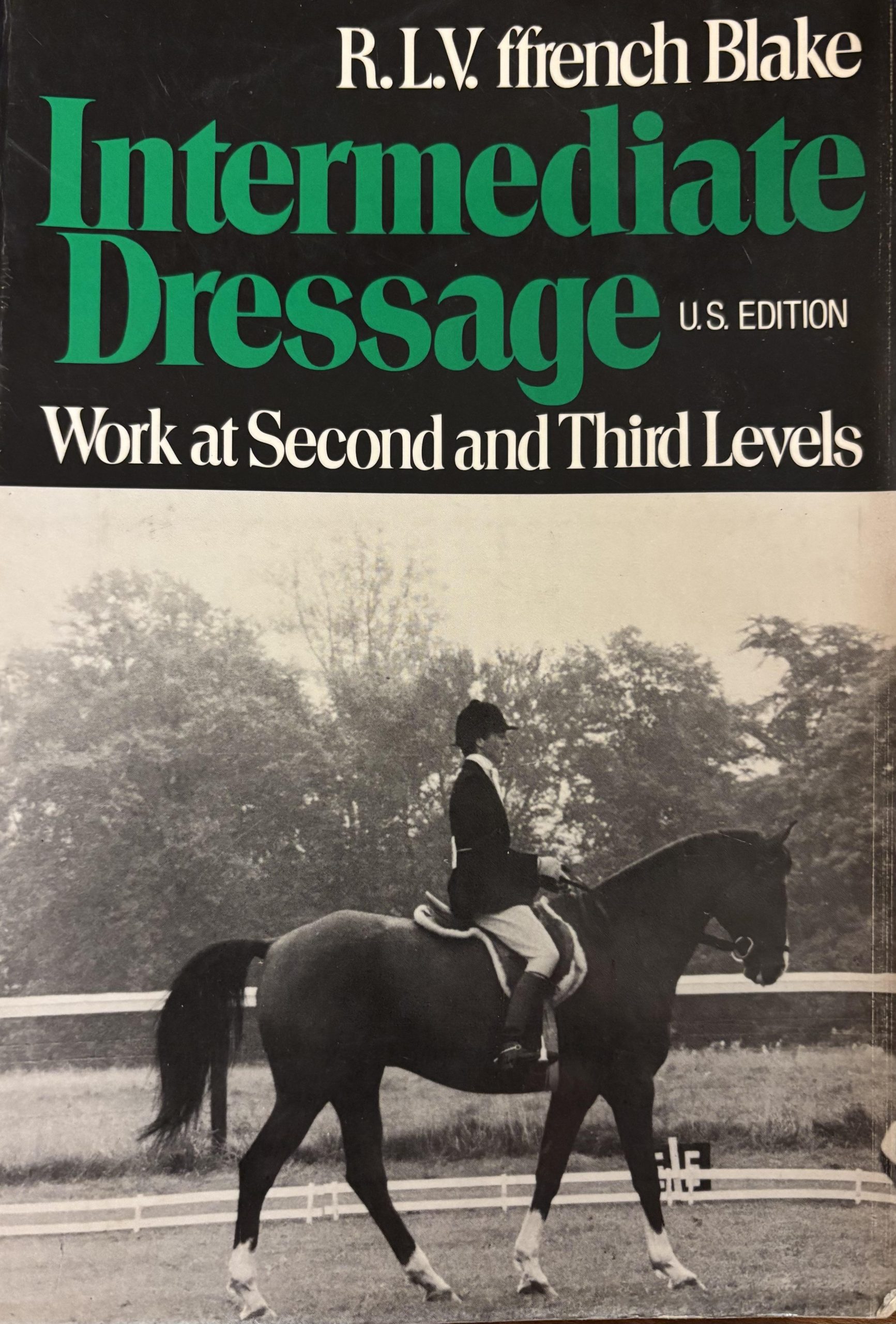
This was my first book on dressage and remains one of my favorites for lower level riders to learn from. Photo (c) Gwyneth McPherson

  • Intermediate Dressage by R. L. V. ffrench Blake. Published in 1977 by Houghton Mifflin. This was my first dressage book. I got it for my birthday when I was eight or nine years old. The best thing about this book is the simplicity with which it describes and illustrates dressage. It is excellent for young readers and anyone starting to build their foundation of knowledge. 
  • Dressage Riding, by Richard Watjen was my second dressage book. It was originally published in 1958 in German. The English edition that I have was published by J.A. Allen in 1979. It is also simple, easy to read, and an excellent resource for new riders and young readers. It is a little more technical than the previous book, but it is not overwhelming. As a side note, The Seventh Edition of this book has a Foreword written by Franz Rochowansky, one of the great influences in the history of my dressage education. I love reading his words about the author and dressage training. 
  • The Noble Horse by Monique and Hans Dossenbach, published in 1987 by Portland House, is an excellent picture book with a medium dive into history of horses from evolution through World War II, their partnership with man, horse sport, breeding, conformation and color. My first “real horse” crush was Christine Stuckelberger’s Granat. He has a fold out in the middle of the dressage section. The photos are depictions of dressage movements. They are easy to understand and very correct. This is an excellent book for both young readers and adults. 

Modern Day Dressage based training books. These books are a more complex look at training and exercises for riders and horses. They are not overwhelming for the beginner, but suitable for the more advanced rider.  

Written by a former Commander of the Spanish Riding School in Vienna, this book focuses on the responsibility of the rider in training. Photo (c) Gwyneth McPherson

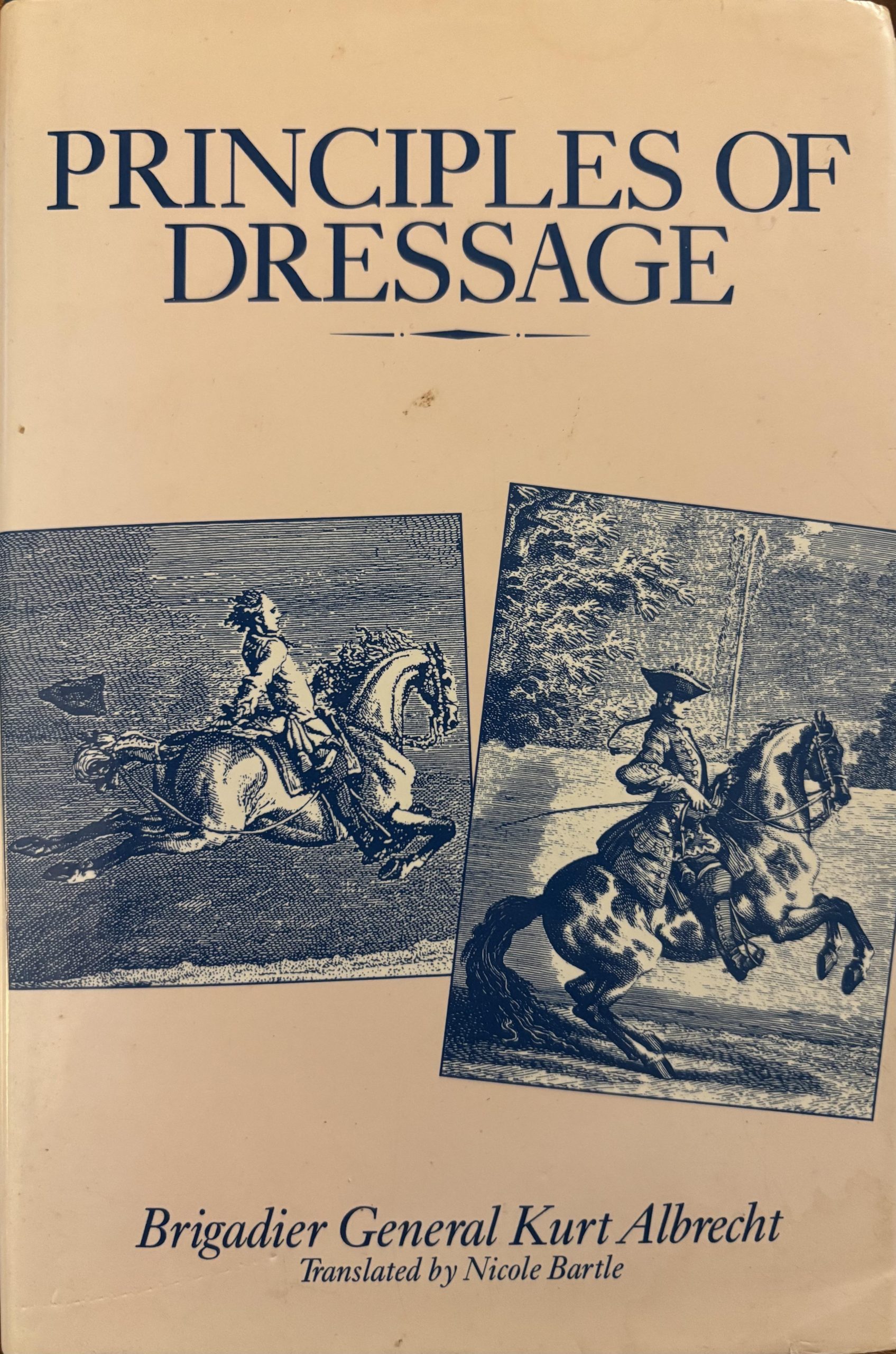
  • Principles of Dressage by Brigadier General Kurt Albrecht Former Commander of the Spanish Riding School in Vienna, first published in 1981. J. A. Allen published the edition I have in 1993. This is also a short and easy book to read. It focuses on the rider’s aids and position and responsibility to the horse. I love the voice of this book as well as the content, and antique illustrations of dressage training.  
  • Ahlerich The Making of a World Champion by (1984 Olympic Gold Medalist) Reiner Klimke. Half Halt Press published it in the US in 1986. I love this book because it combines the ups and downs of training a horse to be an Olympian, with training philosophy and it is not a long or hard read.  
  • Dressage with Kyra, by (six-time Olympian) Kyra Kyrkland. Trafalgar Square published it in English in 1998. This book explains and illustrates dressage exercises and training in a straightforward easy to comprehend way. It is an excellent resource for riders who are just starting to be serious about dressage and riders who are already well on their way. 
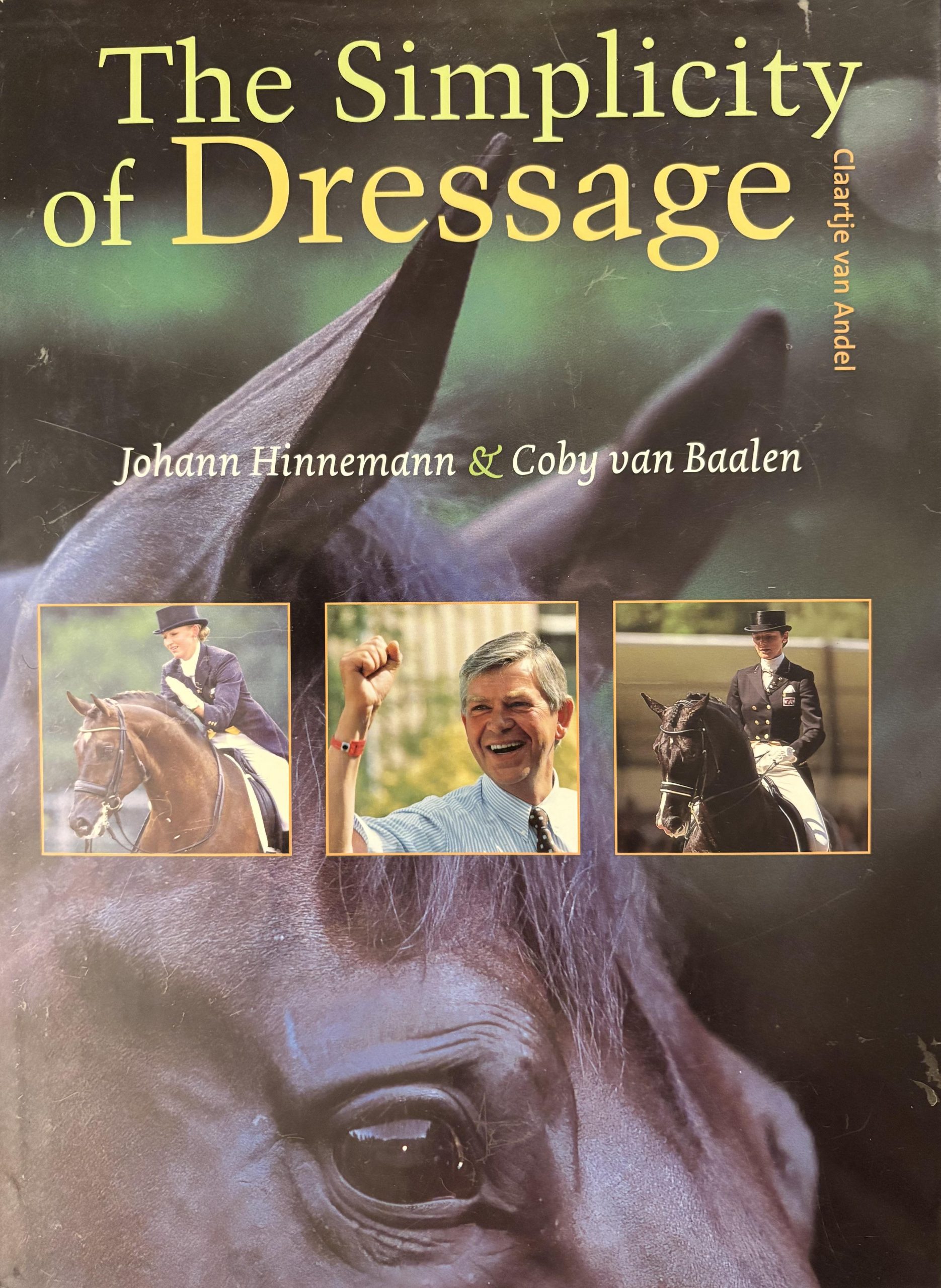
  • The Simplicity of Dressage, by Johann Hinnemann & Coby van Baalen, published by Trafalgar Square in 2003. This book talks about the training process of both horse and rider based in the historic combination of Johann Hinnemann and Olympian Coby van Baalen’s training relationship. It discusses the exercises and aids in a direct and simple way against the backdrop of training a multitude of horses for international competition.  

This book looks through the lens of training multiple horses and riders for international competition. The exercises and theory are illustrated with diagrams and photos from training and competition. Photo (c) Gwyneth McPherson

Some “deep dive” historical reading. All of these books are for the reader who want to really dive into dressage theory and history. They’re excellent for developing a greater understanding of how and why dressage is what it is. They do not shed a lot of light on how to ride but give the reader a more detailed background on the purpose and process of training. 

  • Bilder und Fakten zur Entwicklung der Ausbildung von Reiter und Pferde im Dressur und Springreitin ( Pictures and Facts to Develop the Education of the Rider and Horse in Dressage and Jumper Riding ) by Angelika Fromming, published in 2011 by FNverlag. The downside of this book is that it is in German. I am not fluent in German, but I can read some of it and translate the rest using my phone. Even with this impediment, I find this book to be fascinating. The training and historical information in this book is unrivaled by anything else I have read. Angelika Fromming is a retired FEI judge, Grand Prix competitor and trainer and has a vast knowledge of the history of training and riding. 
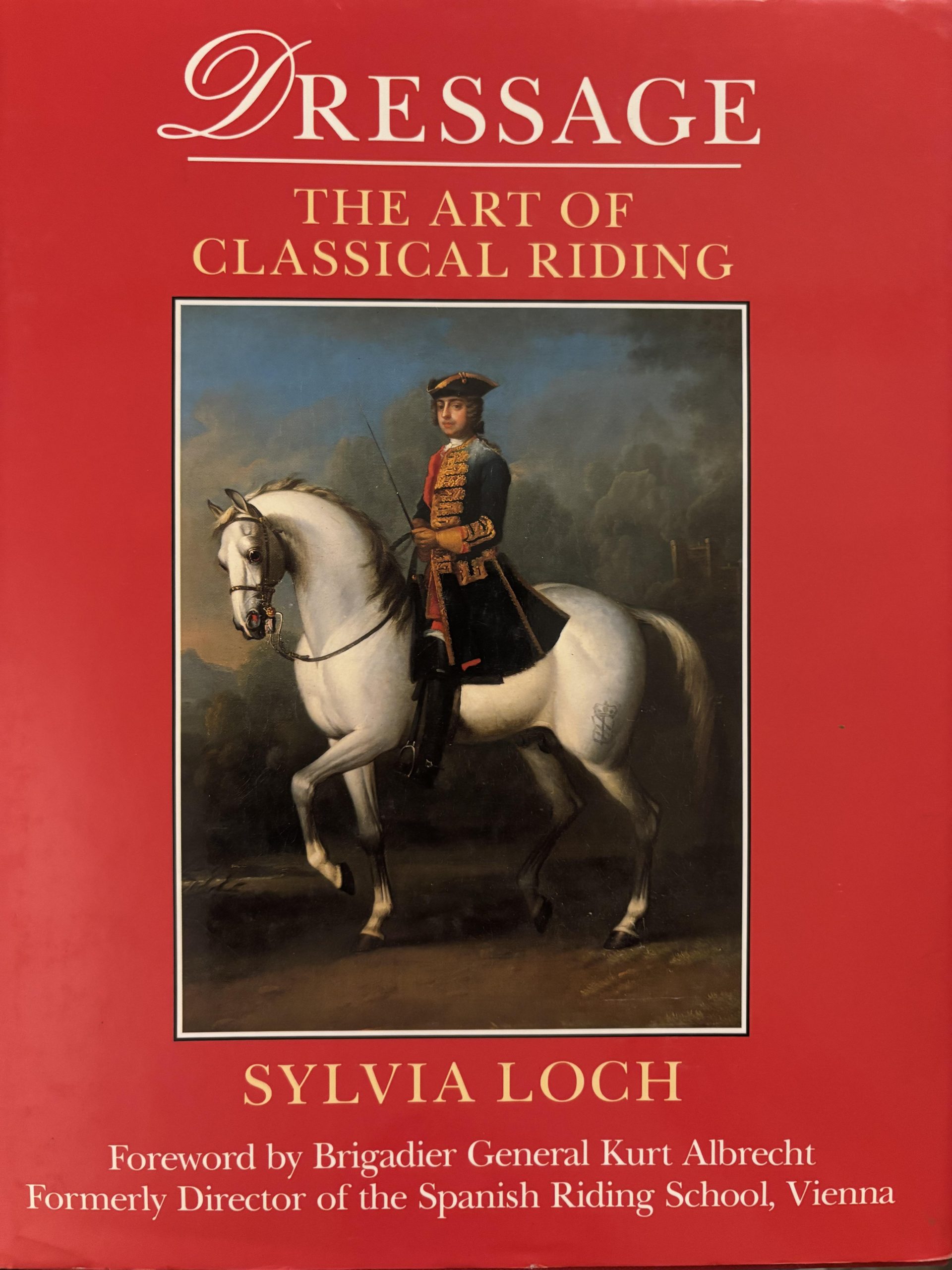
  • Dressage the Art of Classical Riding, by Sylvia Loch. Published by Trafalgar Square in 1990. Sylvia Loch is known as an expert on classical training, lecturing on the subject internationally. The combination of antique works of art and her knowledge of riding history is similar to what you find in Angelika Fromming’s book.  

A deep dive into the history of classical dressage with a wonderful quote from Francois Robichon de la Gueriniere at the beginning of the book. Photo (c) Gwyneth McPherson

Inside both of the previously mentioned books, you will find references to the following three authors. There are other important authors from antiquity, but William Cavendish, Antoine de Pluvinel, and Francois Robichon de la Gueriniere are excellent authors to read if you want to go deeper in to their theory and understanding of training than you will find in Loch’s and Fromming’s books.  

  • A General System of Horsemanship, by William Cavendish, Duke of Newcastle. First published in 1743. Trafalgar Square published my edition in 2000. Its worth looking at just for the illustrations. William Cavendish was an English duke who devoted himself to dressage riding and training. His book catalogues the horses he owned and rode, their care and his beliefs and systems of training them. 
  • The School of Horsemanship, by Francois Robichon de la Gueriniere. First published in French in 1733, my copy is a translation by Tracy Boucher, published by J.A. Allen in 1994. De la Gueriniere’s teachings are foundational for the basis of the teachings of The Spanish Riding School in Vienna, Austria and the School of Cavalry in Saumur, France. De la Gueriniere is credited with putting forth the idea of humane and educated training based on de Pluvinel’s teaching. This book is also full of amazing illustrations of dressage as it was in the 18th century. 
  • The Maneige Royal, by Antoine de Pluvinel, first published in 1626. My copy is an English translation from French, published by J. A. Allen in 1969. De Pluvinel was the riding instructor and trainer for Louis XIII of France. De Pluvinel developed his theory based Xenephon’s belief in harmony and kindness philosophies on training horses. 

Riding and training horses is not a new endeavor. Humans have partnered with horses for purposes of war, travel, farming, and companionship throughout written history. While we have different ways of using horses in modern times, the need to train them has not changed. If we intend to ride and compete it behooves us to learn what those who have come before us can teach us. While I have many more books and authors on my bookshelves, and they all contain valuable information, this is my core reading list that I would suggest to any serious student of dressage start with.  

Remember: limited knowledge is limited judgment.


Gwyneth and Flair in competition at Grand Prix. (c) flatlandsfoto.

Gwyneth McPherson has over 35 years experience competing, training, and teaching dressage.  She began her education in in the late 1970s, riding in her backyard on an 11 hh pony. Her first instructor introduced her to Lendon Gray (1980 and 1988 Olympian). who mentored Gwyneth for a decade during which she achieved her first National Championship in 1984, and her Team and Individual Young Rider Gold Medals in1987.

In 1990 Gwyneth began training with Carol Lavell (1992 Olympian) who further developed Gwyneth as an FEI rider and competitor. Gwyneth achieved a Team Bronze in 1991 and a Team Silver in 1992 in the North American Young Riders Championships, and trained her stallion G’Dur to do all the Grand Prix movements while riding with Carol.

In 2008, while Head Trainer at Pineland Farms, Gwyneth began training with Michael Poulin (Olympian 1992). Michael was trained by Franz Rochowansky (Chief Rider for the Spanish Riding School 1937-1955). Michael has shared much of Rochowansky’s knowledge and wisdom with Gwyneth, completing her education as a Grand Prix rider, trainer, and competitor.

Gwyneth’s teaching and training business, Forward Thinking Dressage,is based in Williston, FL. In addition to teaching riders and training, Gwyneth also loves sharing her knowledge of the sport and art of dressage as well as discussing relevant topics pertaining to the training itself and the current competitive landscape.