



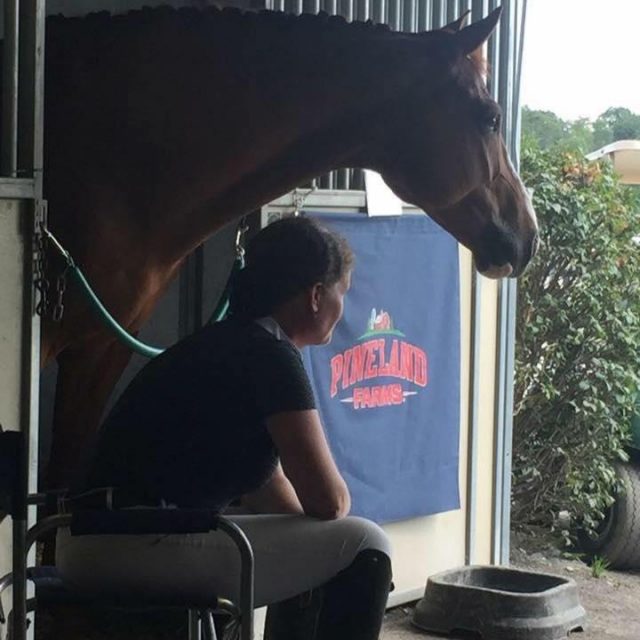
Training in the Right Way: Habits and Sports Psychology
Because your internal environment is as important to your growth as a rider as your development of your exterior athletic abilities.
Dressage training is supposed to be the process of training ANY horse to be a better riding horse. The more the horse learns, in theory, the easier it is to communicate with and therefore complete more complex tasks with. Although competition dressage training often is more focused on training for the dressage test, that is not what the original intention (and original judging requirements) were for competitive dressage. Initially, it was designed to give riders and trainers a way to determine how their training measured up to the theoretical ideal of the training process. That said, it is critically important to understand the meanings and reasons for some of the terms we use to describe dressage training and what to look for when observing training and competition (and videos and photos), regardless of whether you intend to compete or just train your horse to be a better whatever you do with him. That, ultimately, is the main purpose of my articles. To provide education and knowledge for riders to understand and improve their eye and understanding of what dressage training is supposed to be. While there will always be some differences in practice and theory, good horse training is always recognizable to the educated eye. That said, it absolutely is necessary that we remember and understand that limited knowledge is limited judgment.
* * *
Well, here we are at the end of the year, and it is time to make some New Year’s resolutions. Or, more to the point, it’s the habit changing time of year.
I always choose something to work on each year and take it very seriously, making myself adhere to the new habit. Because of that, I’m very careful to try to choose things that I know I can actually focus on. Most of them are ways of thinking habits, though some have physical components as well. One reason I tend to focus on my mental tendencies is that I have learned a lot over the years from professional athletic trainers and sports psychologists that your internal environment is as important as your development of your exterior athletic abilities.
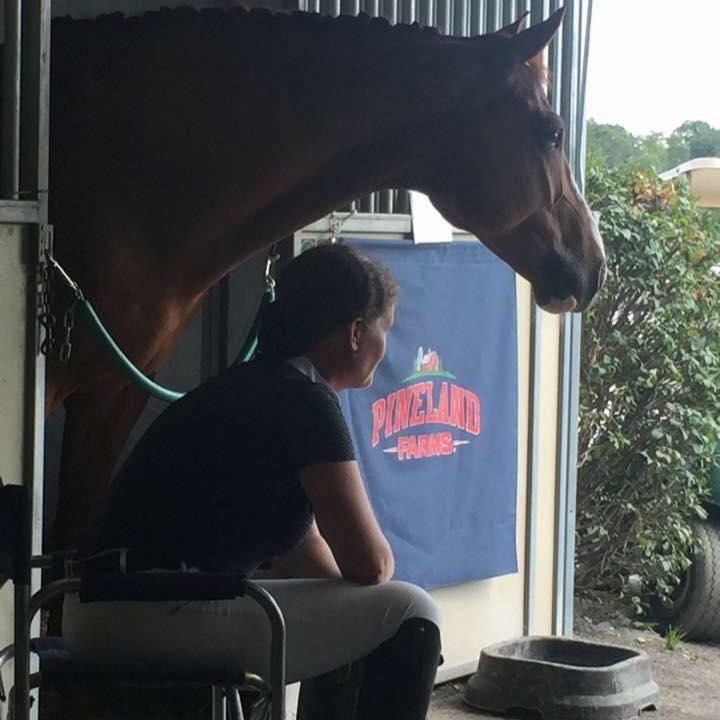
Imagining your dressage test going well, with the aids and adjustments that prevent problems from occurring trains your brain to manage the problems under pressure. Photo (c) Gwyneth McPherson
If you are riding and training horses, you are an athlete. Some of us are more athletic than others, but the physical talent required for riding allows for a range of physical fitness depending on whether you are riding “for fun” or seriously competing and training at the upper levels. Most people are familiar with the required physical strength and suppleness a rider needs to be excellent, but the psychological aspect of riding generally gets less attention. You do not need to be a serious competitor to benefit from using sports psychology. I am not a sports psychologist (and I do not pretend to be), but I have learned a few very helpful thought techniques that I use pretty much every day when I’m riding, and I often share them with my students.
- Using positive words creates a positive attitude – this absolutely is the most important, number one method to follow in riding and training (arguably also in life, but I won’t go into that right now). Using positive or at least neutral words in both your self talk (internal) and when speaking to others does change how you act and react. This topic could fill a book. Essentially, the idea is that the human brain believes what it thinks. So, if it is constantly thinking “I can’t” and “I will never,” it believes it, and it works to make it true. So, using phrases like “I will never be a Grand Prix rider” or “I can’t get my left flying change” are devastating to a rider’s progress. While we can accept the reality that it takes a tremendous amount of time, effort, and luck to become a competitive Grand Prix rider, stating that it will “never” happen ends the process. Saying “I can’t get my left flying change” implies it is an unresolvable problem. It is necessary to acknowledge the obstacles in front of you and systematically dismantle them to get to your stated goal. Stating “never” takes away all your power to dismantle the tough goals. Likewise, talking about your riding problems or your horse negatively also damages your path to improvement. Instead, say things like “In order to get to Grand Prix, I need to _______________” or “I need to make the left flying change more like my right flying change.” These statements are charged with an action that can be taken and are not endpoints that are immovable. You do need to know what steps to take to solve these problems but starting with a positive statement is the first step. Yes, we all get frustrated, and yes, sometimes the obstacles are very large and hard to move, and you may not be able to see how to move them. But negative talk makes them more immovable because our brain is trained to look at the problem as the end point, with no actionable possibilities.
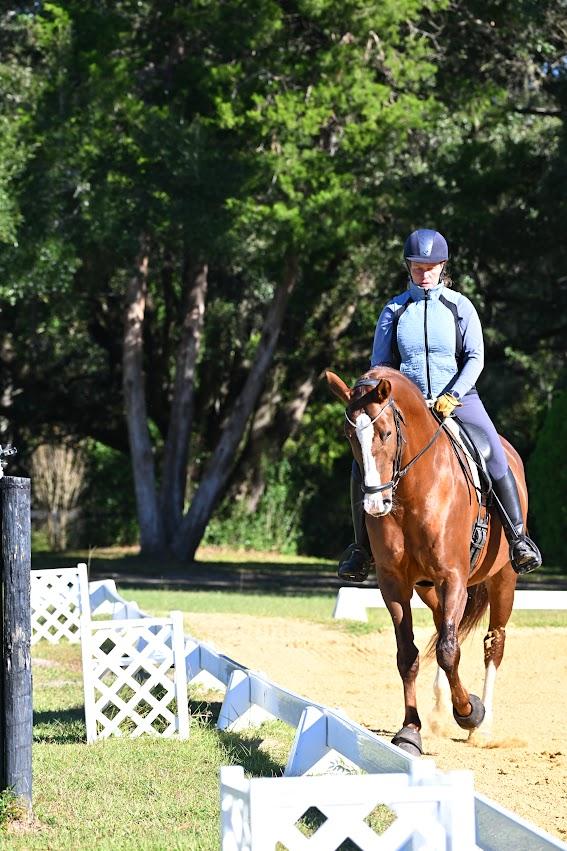
Changing your riding habits requires making the corrections in the saddle over and over. Using negative words like “I can’t” and “I’ll never” train your brain to believe that is true. Photo (c) Jennifer Dillon.
- Using imagery – We have all done it. We imagine just how badly something can go wrong. And then it does. While using imagery is not magic and will not fix something just because you imagined it would, paired with action it is an extremely powerful psychological tool. So, instead of imagining how your horse “never” comes back from the extended canter in your dressage test and drags you around the corner at Mach 5, develop the training techniques that help solve that problem, and while you are memorizing your dressage test, you memorize the general feeling and sequence of how you manage the downward transition at the end of the extended canter successfully. And, most importantly, memorize the feeling of it working. This trains your brain to follow the sequence that has been working and it will think those thoughts under pressure and makes you feel more empowered to solve the problem if it should arise. Your brain will believe what you think.
- Repetition of a correction – I am not talking about horses right now, I am talking about riders. If you have a habit in your riding that is impeding your progress, you must correct it. Correcting a problem like sticking your elbows out to the side, instead of having your upper arm hang straight down requires repetitive correction. This applies to head up, heels down, and everything in between. There is a strong argument for doing strengthening exercises, stretching exercises, and other balance and coordination activities off the horse to help with this, but the most important aspect to correcting a problem like this is how you think about it.
If you think that some people can just ride better than you, or that they just never had this problem, and you add to that “I can’t” or “I’ll never,” then you are stuck in a negative cycle. First of all, any absolutely excellent rider worked hard to get that way, and don’t take away their accomplishment by just assuming it was easy for them. Secondly, ditch the “I can’t’ and “I’ll never” self-talk.
Finally, understand that fixing a problem in your riding requires repeating the correction numerous times for weeks/months/years, not minutes or days. Notice I said “repeating the correction” and I did not say “hold it endlessly until you do it right.” Your brain needs to repeat tucking your elbows back where they belong every time they want to stray away from your sides.This is not the same as sitting still and flapping your elbows out and in like you’re doing the chicken dance. It means in the practice of riding, doing all the other things that you have to do while riding and training, you remind yourself to tuck your elbows back where they belong. And do it over and over and over….
Some studies report that it takes 10,000 repetitions of an action like this to create a new habit. Whether the number is accurate or not, your brain learns by doing the action (tuck the elbows back in) within the specific activity (riding the canter).
If you flap your arms up and down, the up part is as memorable to your brain as the down part. That’s why you don’t want to use the chicken dance arm flap to fix it. That last part is very important. Be sure you are repeating the correct correction, not just something else that you will have to correct later, like clamping your elbows so hard to your sides that they don’t move enough and create the wrong contact on the horse’s mouth.
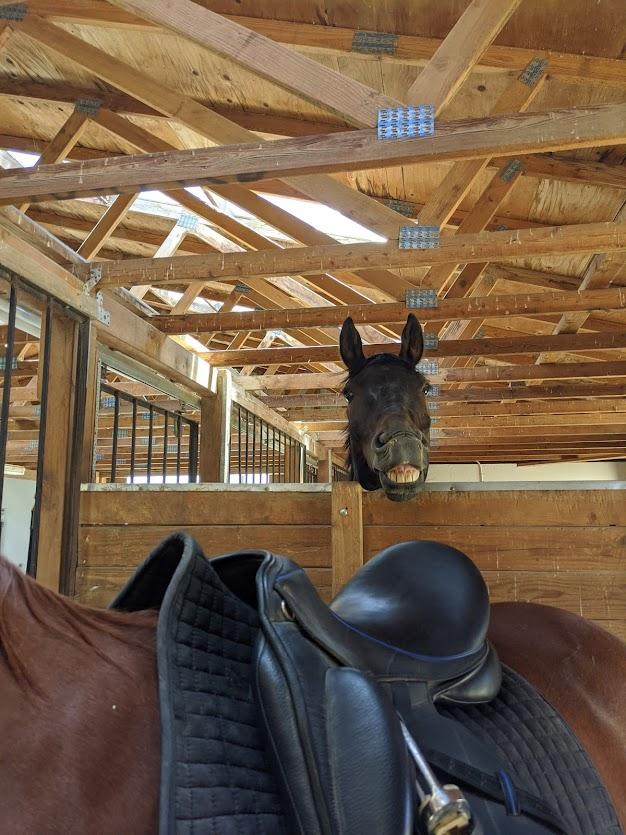
Success in riding is a process of dismantling the obstacles in your way. Working on your internal environment is as important as developing your physical skills. Photo (c) Morgane Schmidt
As with all riding and training challenges, you must have a good teacher who can help you solve the problems. They need to be educated in the techniques of riding and training that get you to your goals. That said, you are responsible for managing your internal training environment and adjusting your thoughts to actions and solutions. Working with a professional athletic trainer or sports psychologist can definitely help, but doing your own internal work will make a huge difference.
Remember: limited knowledge is limited judgment.

Gwyneth and Flair in competition at Grand Prix. (c) flatlandsfoto.
Gwyneth McPherson has over 35 years experience competing, training, and teaching dressage. She began her education in in the late 1970s, riding in her backyard on an 11 hh pony. Her first instructor introduced her to Lendon Gray (1980 and 1988 Olympian). who mentored Gwyneth for a decade during which she achieved her first National Championship in 1984, and her Team and Individual Young Rider Gold Medals in1987.
In 1990 Gwyneth began training with Carol Lavell (1992 Olympian) who further developed Gwyneth as an FEI rider and competitor. Gwyneth achieved a Team Bronze in 1991 and a Team Silver in 1992 in the North American Young Riders Championships, and trained her stallion G’Dur to do all the Grand Prix movements while riding with Carol.
In 2008, while Head Trainer at Pineland Farms, Gwyneth began training with Michael Poulin (Olympian 1992). Michael was trained by Franz Rochowansky (Chief Rider for the Spanish Riding School 1937-1955). Michael has shared much of Rochowansky’s knowledge and wisdom with Gwyneth, completing her education as a Grand Prix rider, trainer, and competitor.
Gwyneth’s teaching and training business, Forward Thinking Dressage,is based in Williston, FL. In addition to teaching riders and training, Gwyneth also loves sharing her knowledge of the sport and art of dressage as well as discussing relevant topics pertaining to the training itself and the current competitive landscape.

