



Thoroughbred Logic, Presented by Kentucky Performance Products: A Little Christmas Celebration & Wine
On Christmas Eve, a once-discarded Thoroughbred steps out of quarantine and into the barn, proof that even in a long, hard year, second chances can still find their way home.
Welcome to the next installment of Thoroughbred Logic. In this weekly series, Anthropologist and trainer Aubrey Graham, of Kivu Sport Horses, offers insight and training experience when it comes to working with Thoroughbreds (although much will apply to all breeds). This week ride along as Aubrey shares her logic on giving some Thoroughbreds in-need a second chance.
It has been a very long month, folks. Hell, like for most of us, it has been a long year. I’m tired. It is cold. But there are some good — big — things brewing under that first layer of northern snow.
A horse who had gone from track to kill pen-auction pipeline within a week of retiring from the track gets a legit shot at another career and a second chance at what is possible once retired from the track.

Wine Responsibly, as photographed by Finger Lakes Finest Volunteers at Finger Lakes Track backside in mid-November.
The biblical references are totally incidental, but today — Christmas Eve — Wine Responsibly gets to leave his straw-bedded shed and return to find he indeed has a room at the inn (the main barn). I don’t think I have ever been so excited to take a horse on a quarter mile walk before. And I’m pretty sure he’s going to be one excited kite.
Access to the main barn signals an end of the purgatory that is quarantine. It means he can have friends, far more human attention, better turnout, and get started under saddle. In stead of staring at the chaos, he’ll be allowed to take part. And then, once we assess his knees and soundness, he’ll be in the lineup to find a new home (and hopefully start the training trek towards the Thoroughbred Makeover) this year. I’ll take that Christmas present.
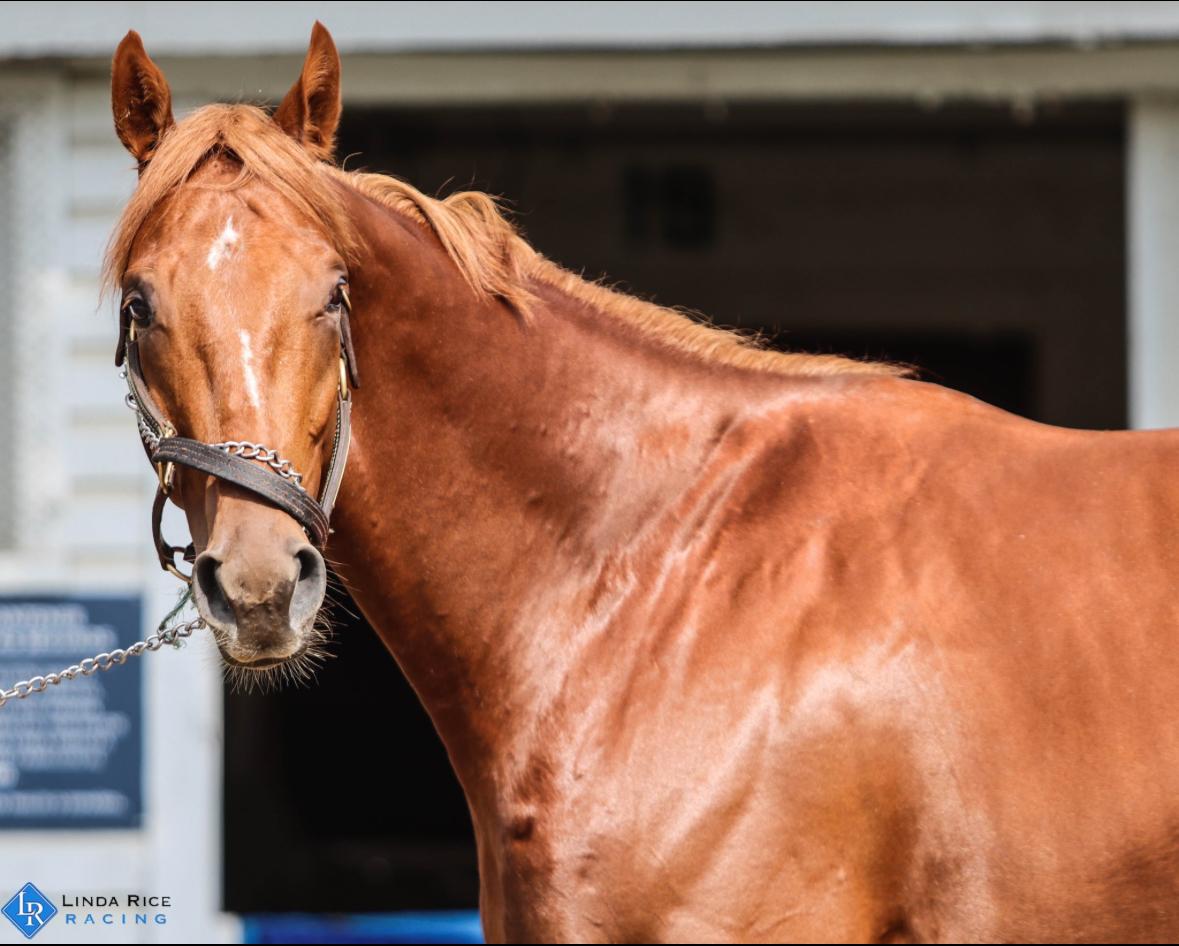
Wine Responsibly when he was running for Linda Rice (and had a forelock!) in 2024. Photo by Linda Rice Racing.
Wine has a wild backstory, but it is not one that is terrifically unique. Here’s what I know:
This petite – 15.3? (once he gets back in the main barn, I’ll put a stick on him and find out for real) four-year-old redhead absolutely is a Curlin. His sire — Vinno Rosso (Curlin) — passed along the broad, flat forehead, independent personality, the athletic build, and somewhat flat-kneed gait. As a two-year-old, he was listed at $70,000 for the Ocala Breeder’s Sale (Spring) in 2023 and RNA-ed (reserve not attained), so remained with his connections. He ran 16 times, bringing in a respectable $87,229 for his connections.
His career started off with some bigger races under Broman and Broman then Linda Rice Racing — he ran at Saratoga (a top class track for top class horses), and was entered in a number of Black Type Stakes Races (good races for fast horses) where he had respectable finishes, but didn’t hit the board until they dropped him to lower tier races.
It looks like something may have happened at the end of his two-year-old year. He ran well enough at his last two-year-old race, just per the notes, “had no rally.” But he had a nine-month gap between races — running again with the same connections at Saratoga in August of 2024. Nine months is usually enough to heal up a tendon or ligament strain and bring them back to training responsibly. Considering his knees and the interesting distention of his extensor tendon sheaths, this might be where an issue originated. Or it could be unrelated — all I’m doing is piecing together threads based on a race record.
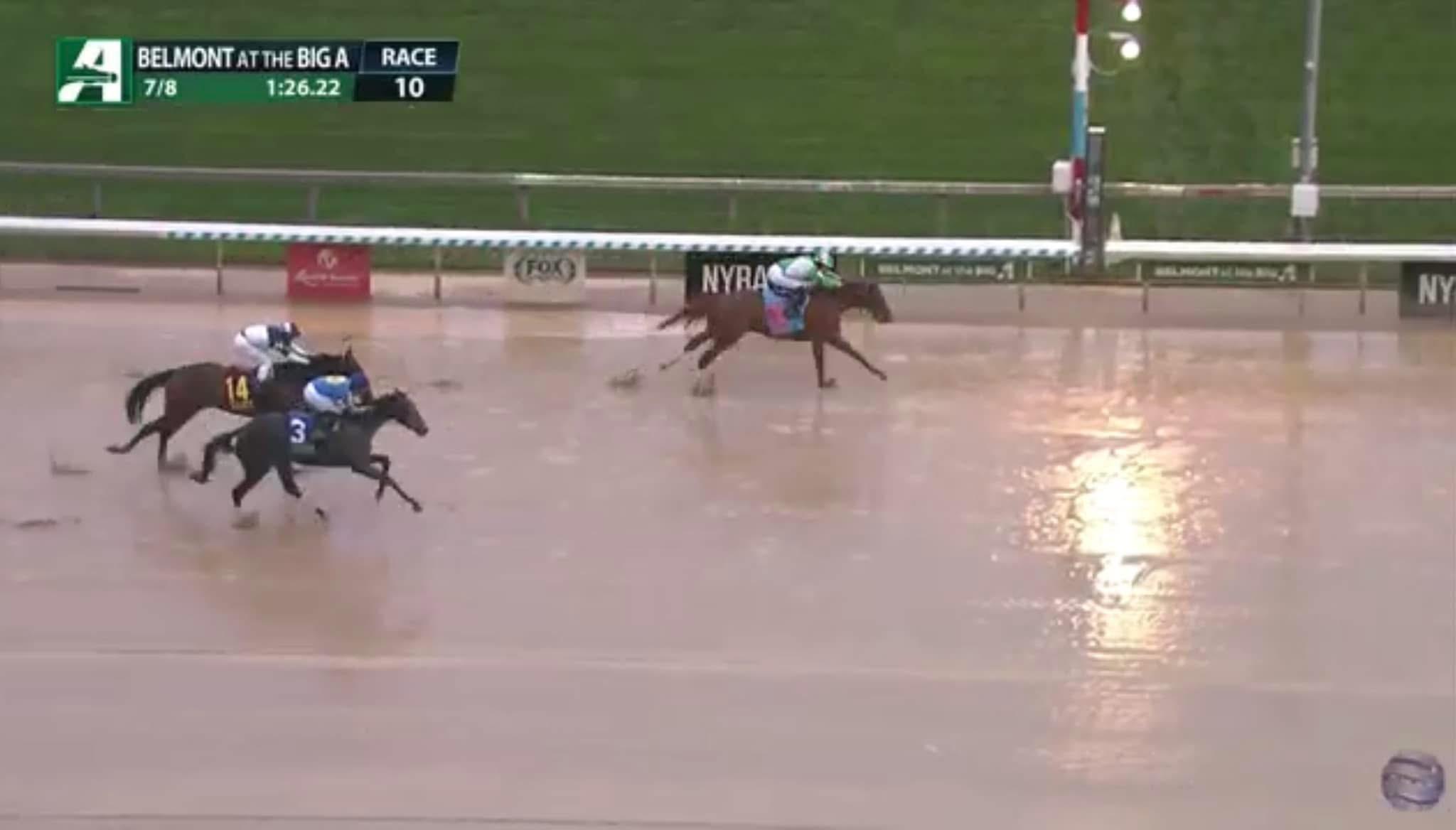
Wine taking the lead to the wire during one of this two career wins. Photo from Linda Rice Racing.
From there he ran on a few different tracks with different owners and trainers. An important part is that under his last owners, Henry Ortis and Chetram Bhigroog, he was run once to twice a month at Finger Lakes for the last three months of the meet. What this tells me is that the little red horse was deemed sound enough to run consistently. He wasn’t on the vet’s list or sidelined for other reasons. He put in the work and crossed his last finish line on November 10th, 2025.
The track was to close two weeks later, and the frenzy to find homes for horses before winter commenced (see more on that here). Wine’s performance and concern about his knee/s made it clear he was ready for a new career. Volunteers at Finger Lakes Finest Thoroughbreds (who help to get the horses safely from the backside to new careers) photographed him and grabbed jog video on the weekend of the 16th. His price on the track was set at $1000. The ad chatted about how snuggly he was and what a good brain he had (typical of the Curlin offspring). It also mention that Ortis had said he had “knees” with no further details (a situation that irked volunteers and they worked to remedy so to make sure he was able to find an appropriate second career).
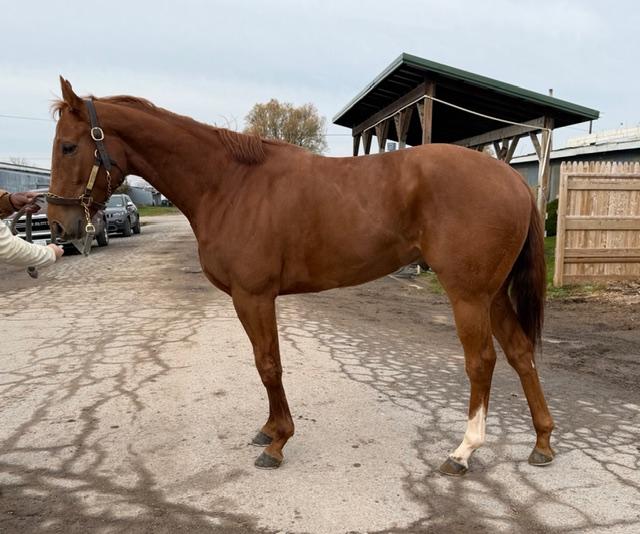
Wine Responsibly at the end of his race career at Finger Lakes. Photo courtesy of FInger Lakes Finest Thoroughbreds.
Not too long after, he was sold to a woman who said all the right things. She explained to Ortis that the horse had a “forever home” with her and her daughter who would train him up for “trail riding.” Money exchanged hands, the little horse hopped on a rig, and within a week he was in the pipeline to slaughter.
So what went off the rails? Who the hell knows. The woman who purchased him makes all sorts of assertions — that he ran through her fence (repeatedly?). She later made it clear that she and her daughter were out horsed, had no Thoroughbred experience, and that clearly this was not going to make a trail horse for her kid. She asserts that she called rescues in hopes of finding him a spot. There’s no evidence that that happened. Neither Finger Lakes Finest nor Ortis nor any rescue we’re aware of were contacted.
Within a week of retirement, Wine was traded for some random mare at a holding facility that sells directly to auctions, knowing that some will go to slaughter. In NY, there’s a law on the books that prevents horse traders from selling directly to known kill buyers. But the location Wine found himself is known for the being the start of that pipeline. In NY, “kill pens” are a not exactly that — traders can’t sell directly to buyers “who ship,” but are allowed to sell to auctions like New Holland and so on where horses will often be hauled across international borders to be processed. Nice loophole, NY.

Wine at the holding pen in NY. Photo by Teddy Adams.
A few notes here — this part of the story sounds dramatic. It is, but probably not for the reasons some might be thinking. Wine was not bailed at kill-buyer rates (generally in the three figure rates). He’s a healthy, young Thoroughbred. Instead, he was at risk of the auction pipeline. That pipeline does have an exist which sure, ships to slaughter. But more often than not, these horses are hauled from feed lot and auction to the next one, moving hands, being purposely bid up, and resold for more money at the next one. Life in the auction pipeline is something I need to do more research on, but it is not a life I’d wish on any horse. Movement, instability, neglect and illness commonly follow its wake.
The “fun” part of this story is that the bad guy is not really the bad guy. When Wine landed in the dealer’s pen in the hills of NY, Teddy Adams did something he didn’t have to do. He called his connection at the track and let them know he had a young, fresh OTTB in his pen. It didn’t take long to rally help, compile donations, and raise his bail (yes, Teddy made a few hundred on this). Former track trainer and owner, Henry Ortis was devastated, but didn’t have the funds to pull Wine — there was no where to put him even if he got him back. So the small army of TB folks in NY got the ball rolling. They had his bail ready to send, and then when he needed somewhere to go, right in the middle of the EHM/V outbreak, his options that had been there thinned and stalled.
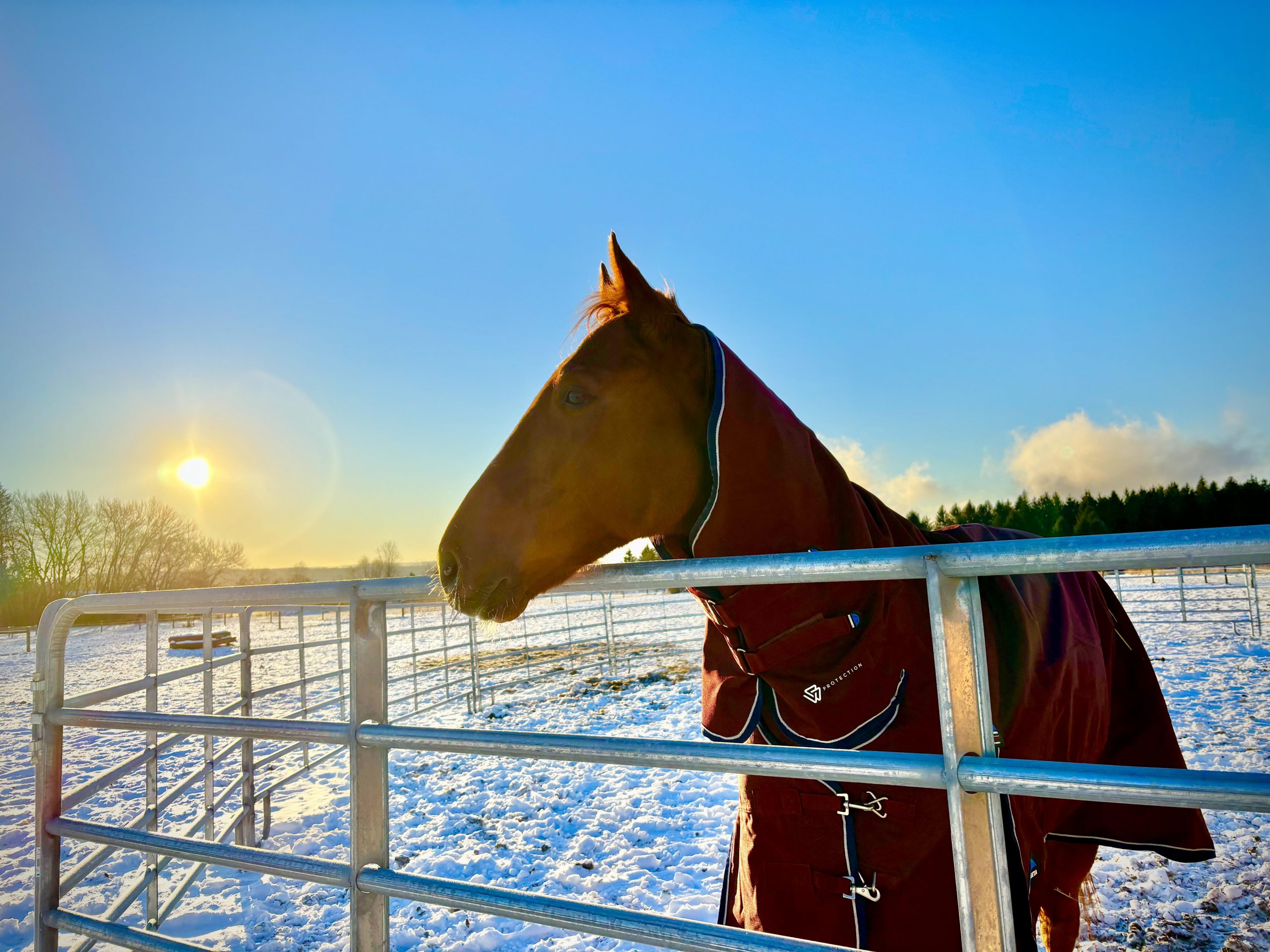
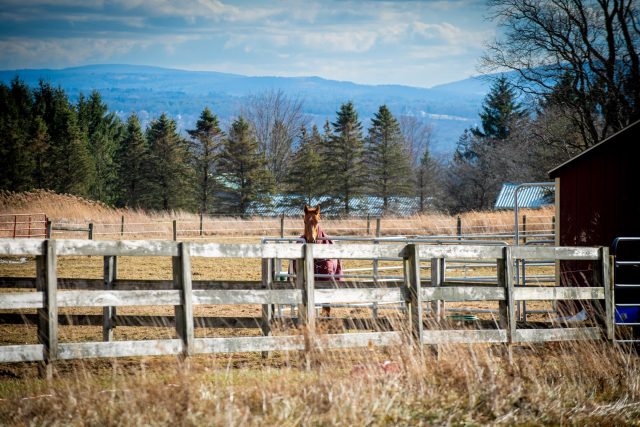
Wine taking it all in from his new digs in Stall 13 quarantine. Photo by author.
And this is where we come in. I had followed the story, but it had looked like Wine was all set — good to go — more necessary to just send a donation along to those who were going to take him on. On Sunday evening, Nov. 30th, my partner stepped away from the dinner table for a few minutes. I checked my phone. By the time he came back, I looked up and was like, “Well, I just made both of our lives a bit more complicated.” “What did you buy?” (He knows me too well). And so I explained that the non-profit I run, Stall 13 Thoroughbreds would be taking Wine. The only catch is that he’d need to quarantine.
We don’t have a quarantine set up (well, at least we didn’t a month ago).
The how the hell were we going to pull that off was the big question. But when you have a horse person who is good at chaos and logistics and a retired army leader, you get sh*t done.
I don’t usually quarantine my horses. I’m a big fan of letting horses be horses and getting them out with their herds ASAP. They’re happier, healthier, and easier to manage when they have friends. But more importantly, my horses come in from tracks or reputable farms where they are UTD on vaccinations and not passed around with who-knows-what diseases. Since Wine spent a week hanging out on a round bale with a variety of equines of all walks of life, and all points along the care to neglect spectrum, he could carry the dreaded S word (strangles), any form of equine corona virus, or EHV.

Wine in the quarantine set up. Photo by author.
The money donated during the scramble to save Wine paid his bail and I covered his shipping to get him down to us and into the Stall 13 program that Wednesday. So Sunday night, we realized that by sunup on Wednesday (with the first real snowstorm slated for all day Tuesday) we had to have a space to safely quarantine Wine.
Cool. Basically T-24 hours. On it. Challenge set, and enter the community, stage left. Folks donated blankets, grooming gear, grain, and my awesome feed store rearranged schedules to ensure we had a round-pen dropped off Monday before dark. Taylor grabbed the drills and spare plywood and set to work transforming an old run-in into a deluxe, straw-bedded refuge from the cold. Lily, my working student, didn’t ask — she amended her schedule, hauled buckets of water, moved, and stood up panels with me until we had something safe that Wine could walk into.
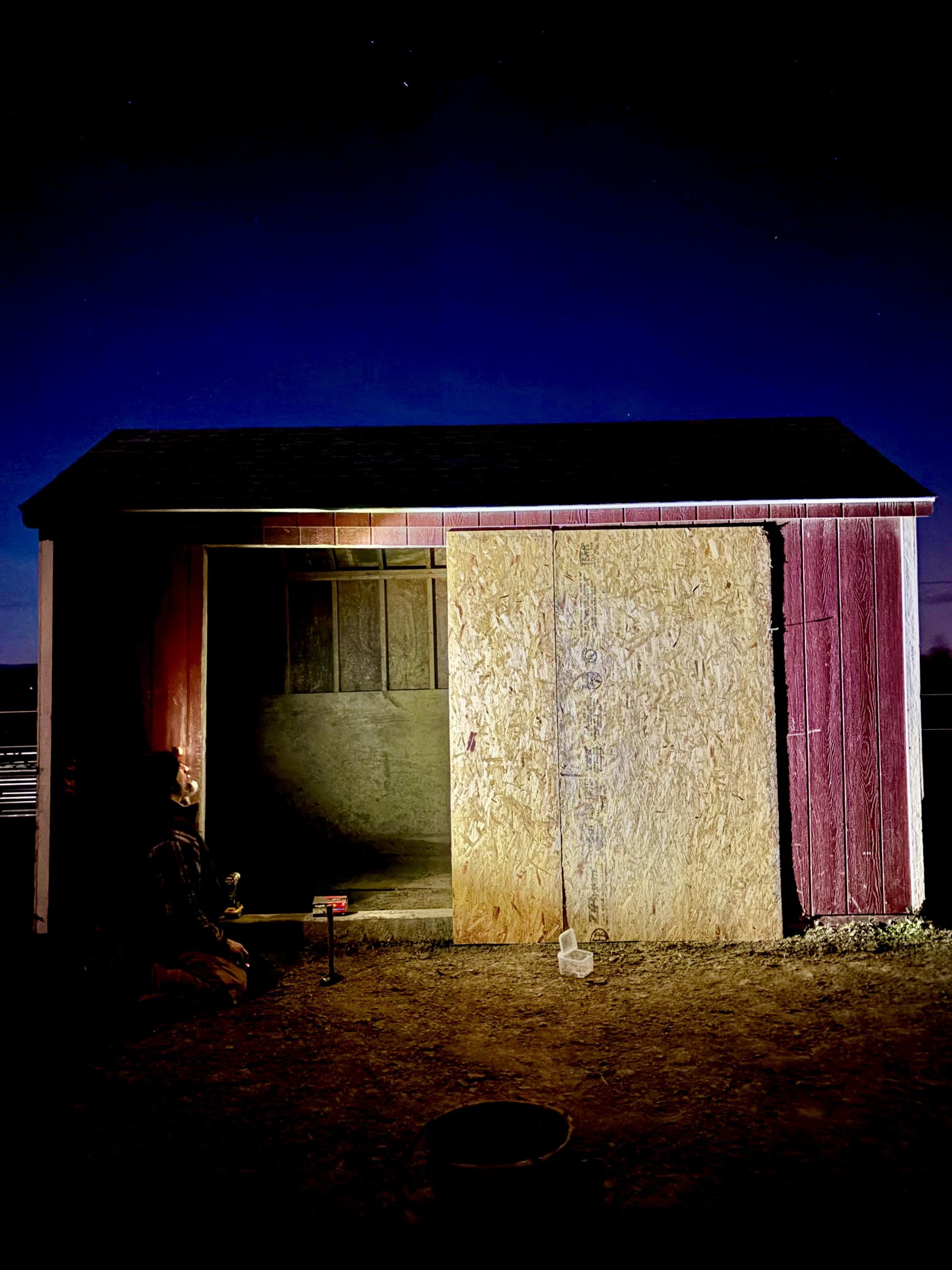
Getting it done. Photo by author.
So that Wednesday, December 3rd, Wine danced through fresh snow from the transport into his small, safe liminal space, about a quarter mile from the barn and 300-meters from the house. He weathered the cold well (that shed is WARM) and we worked out the kinks in how we run the process. And for those three weeks, I donned different clothes, gloves, hats, boots, and hauled his feed out twice a day, came back in scrubbed, changed clothes and went to work in the usual barn. It was a slog, sure. But the best part was watching Wine go from dull-eyed to quick-witted, fresh and funny.
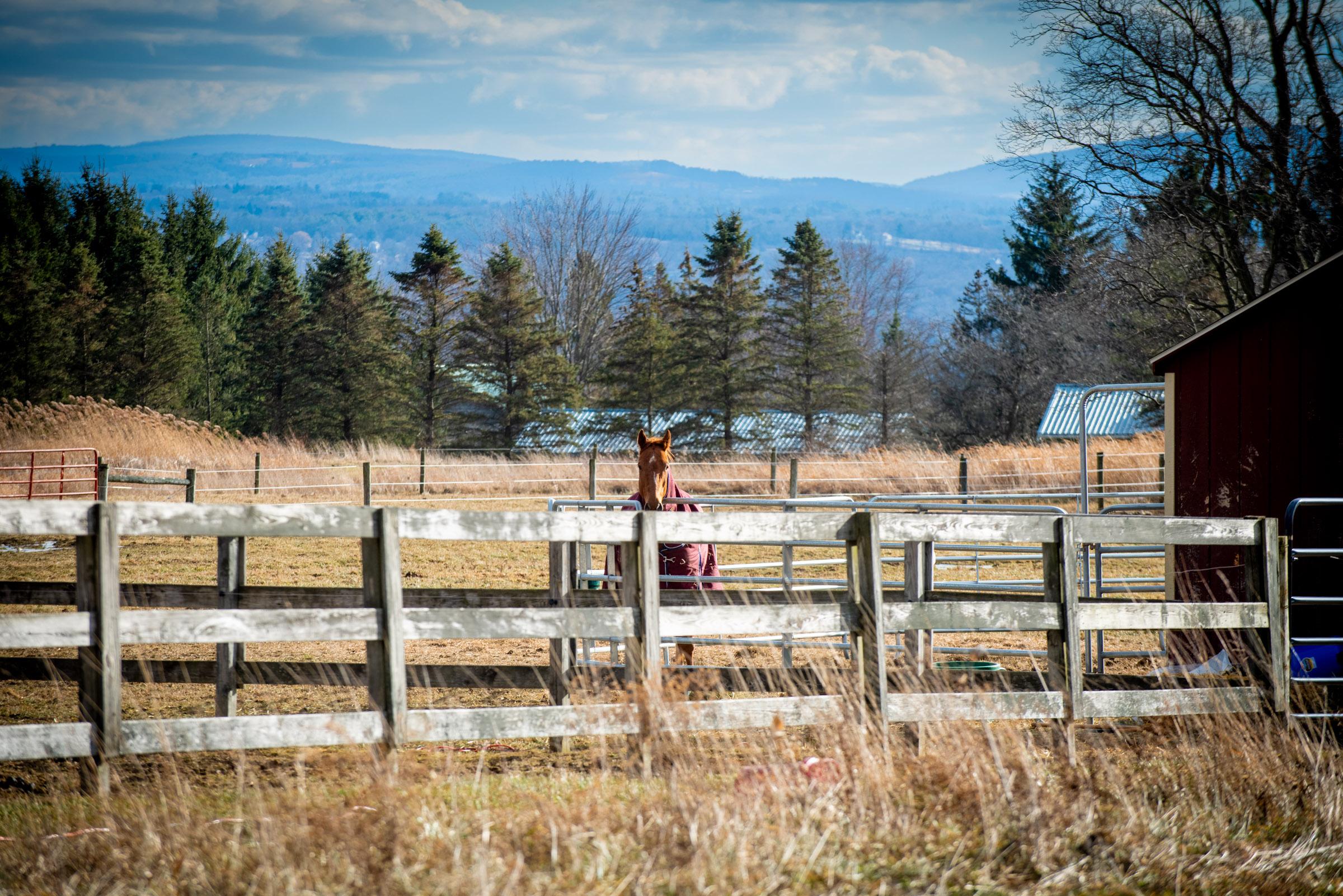
Wine at a social distance. Photo by Kristen Drew.
The last three nights I have hiked out with his grain, called him, and he has answered with a nicker, squeal, and some sizable bucks and kicks around the pen. He’s pretty damn ready to be done with this. I think he’s quite going to like his Christmas present.
And so today, when Wine enters the barn, another horse, Datesfreedom gets a second chance (again). Dates is another Finger Lakes horse who ran til the end of the meet and was purchased by a seemingly responsible family. Within weeks, he found him self in a similar situation — traded for pennies on the dollar into an auction pipeline. With the help of the same wonderful network of track connections, Finger Lakes Finest voluneteers, and Stall 13 supporters, we paid his bail, and set up his shipping. On Tuesday we’ll begin again as a new kid will walk the same path from trailer to quarantine in order to get another shot at this whole retirement thing.
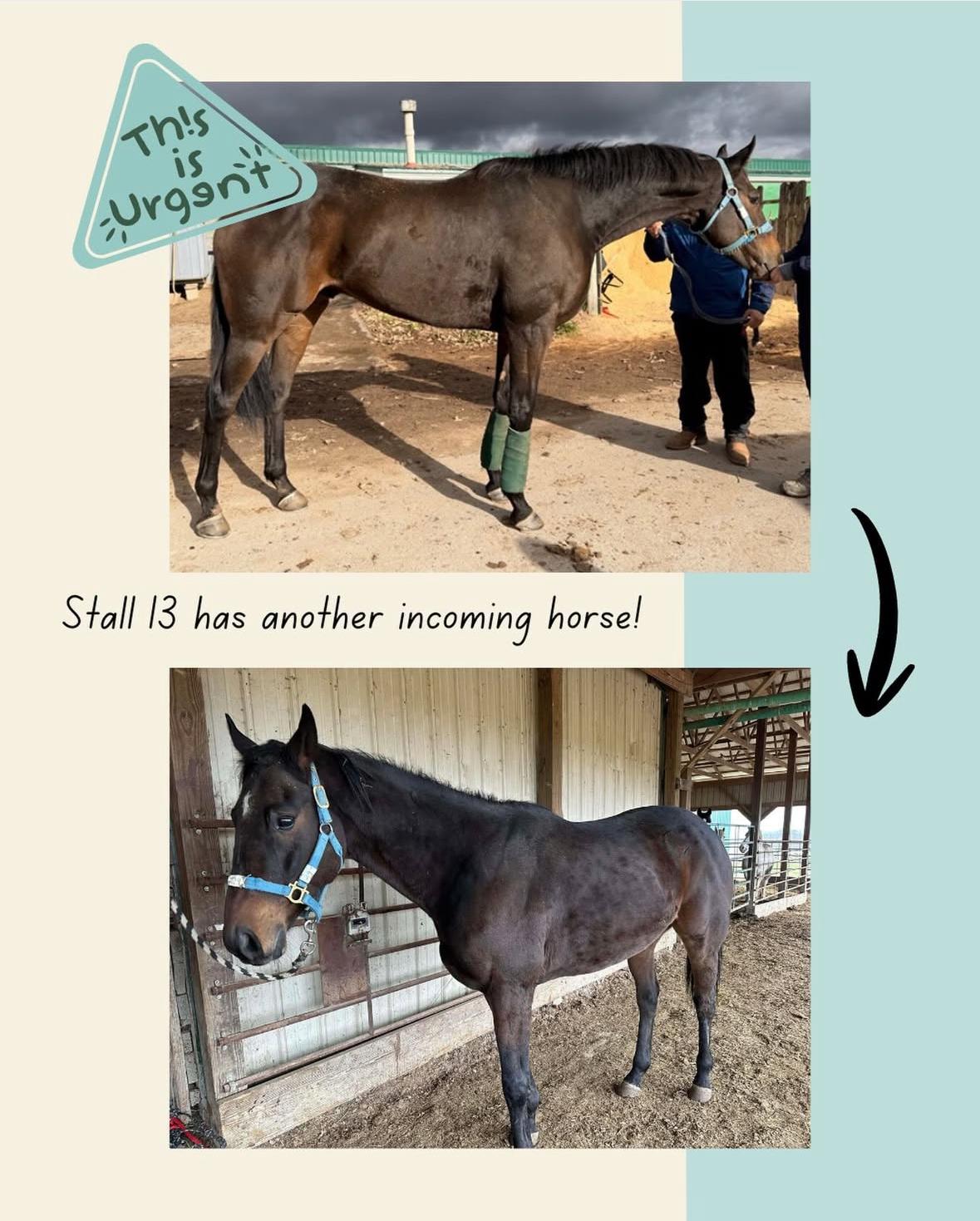
Datesfreedom has a similar story to Wine’s. His auction pipeline (photo below; track sale photo above) ended in Kentucky and he’ll be home soon. Graphic by Amanda Woomer for Stall 13.
In the meantime, Merry Christmas/Happy Holidays, and oh so apropos, “cheers” folks. May you be as happy as Wine when I turn him out with the buddies that he has spent the last month patiently watching from 30 feet away.
*If you want to help Wine, Dates or any other Stall 13 horse (or just learn more about the program) please go to www.stall13.org.
About Kentucky Performance Products, LLC:
Struggling with seasonal vitamin E deficiency? Studies show that vitamin E levels drop when horses don’t have enough access to fresh, green grass. Elevate® natural vitamin E can help. A research-proven, powerful antioxidant, Elevate maintains healthy muscle, nerve, and immune functions by delivering a highly bioavailable source of natural vitamin E that is preferentially absorbed and retained in a horse’s tissues. If your horse is struggling with sore, stiff muscles, neurological disorders, or a poor immune system, ask your veterinarian about supplementing with natural vitamin E.
Kentucky Performance Products creates scientifically proven supplements for your horse. Our supplements provide solutions to the everyday challenges facing your horse. The horse that matters to you matters to us®. Learn more about KPP at KPPusa.com.

