




Training in the Right Way: Dressage Training Nuggets
Dressage is supposed to be a systematic approach to creating partnership and understanding between two species. Horses have very little choice in how and whether they get to participate in our activities. We owe it to them to be kind, circumspect, and educated in our training.
Dressage training is supposed to be the process of training ANY horse to be a better riding horse. The more the horse learns, in theory, the easier it is to communicate with and therefore complete more complex tasks with. Although competition dressage training often is more focused on training for the dressage test, that is not what the original intention (and original judging requirements) were for competitive dressage. Initially, it was designed to give riders and trainers a way to determine how their training measured up to the theoretical ideal of the training process. That said, it is critically important to understand the meanings and reasons for some of the terms we use to describe dressage training and what to look for when observing training and competition (and videos and photos), regardless of whether you intend to compete or just train your horse to be a better whatever you do with him. That, ultimately, is the main purpose of my articles. To provide education and knowledge for riders to understand and improve their eye and understanding of what dressage training is supposed to be. While there will always be some differences in practice and theory, good horse training is always recognizable to the educated eye. That said, it absolutely is necessary that we remember and understand that limited knowledge is limited judgment.
* * *
As 2025 comes to a close, there continue to be posts and articles about how competitive dressage (and other disciplines) is under a microscope for abusive practices, particularly at the top of the sport. While I have many thoughts on this — and feel that there is a lot that needs to be discussed — I think for the time being I’d simply like to take a moment and try to give riders of all levels some “training nuggets” that can hopefully help them approach riding and training as more of a collaborative and educational experience for the horse.
These are concepts that I teach on a daily basis, and although each one is probably worthy of more than a sentence or two, even in their succinctness they are all good things to ride by:
- Training is whatever the horse repeats over time.
Rather than repeating the same problem over and over again, use other exercises that help solve the problem.
- Forward is a direction, not a speed.
Riding forward often feels faster than not forward because the horse is stepping more toward the front.
- One of the ways to define suppleness is the horse’s ability to perform equally well in both directions.
It is not that the horse feels the same in both directions. In no dressage competition is the horse judged on how he feels, only on how he performs.
- There is no collection in Training Level or First Level because collecting exercises have not been introduced yet.
The goal of good Training Level and First Level riding is to teach the horse to maintain a natural balance under the rider. Or in other words, the presence of the rider on the horse’s back does not make their balance worse. Yes, we have to teach them that.
- Halts, turn on the haunches/walk pirouettes, and reinback cannot be performed well on talent.
They are only performed well because the training is good.
- Collection is balance.
The whole purpose of creating collection is to improve the horse’s balance under the rider, so he can do more difficult exercises.
- There is no specific aid for collection.
Collection is developed, and is a combination of developing strength, suppleness and effect of the aids (vastly oversimplified).
- Half-halts are given in rhythm (the horse’s, not yours).
Half-halts are given in the rhythm and tempo of the gait you are trying to produce. It is always your job to give the right half-halts for what you want the horse to do.
- There is no pulling in dressage.
Nope. Not even when you think you “have to.” A rider pulling on the reins makes a horse pull on the reins. Period. End of sentence.
- Adversarial aids create adversarial responses.
Yes, sometimes you have to use a big aid. It always comes at a cost. The more big aids you use, the more big aids you will need.
- It always is the rider’s responsibility to do what the horse needs them to do in order for the horse to do what the rider wants him to do.
The horse will not ever understand dressage the way we do. We must do all the work to make it POSSIBLE for the horse to do the things we want them to do.
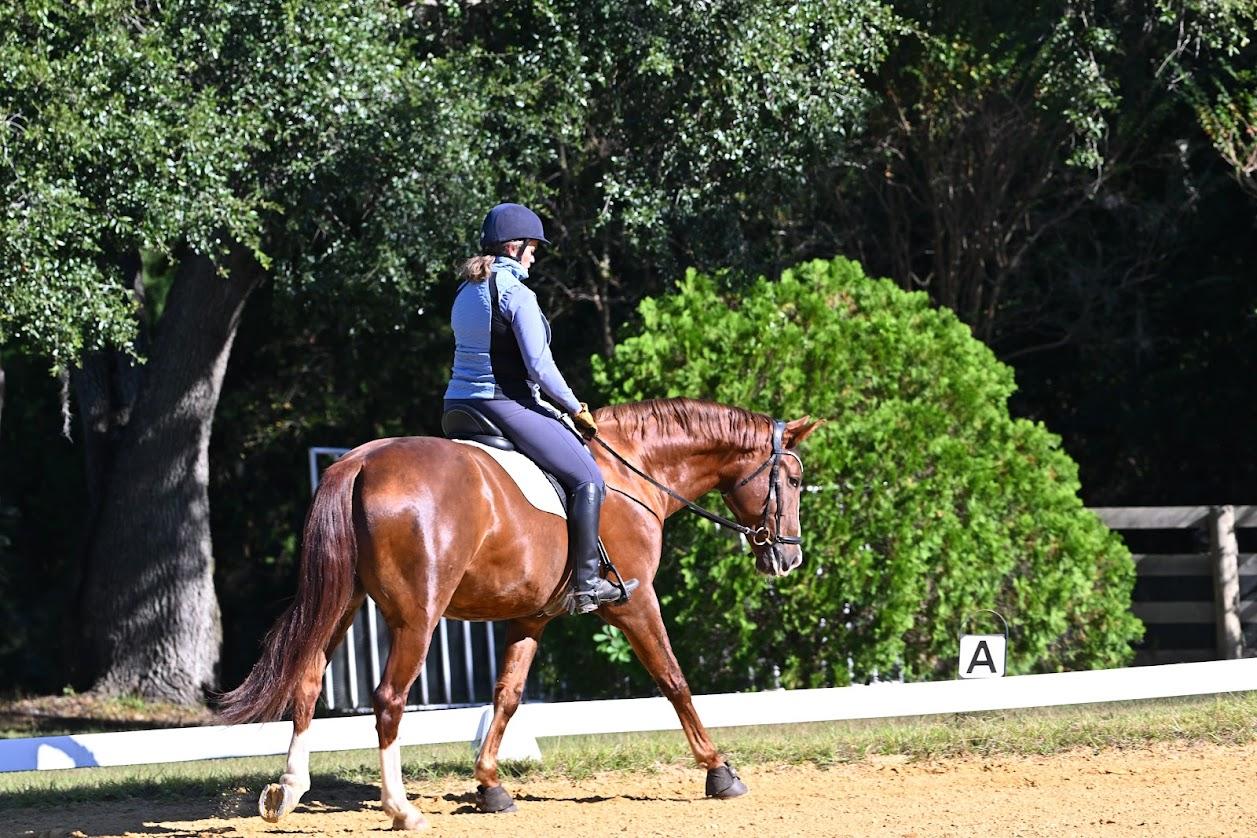
Riding and training horses is a privilege. Photo (c) Jennifer Dillon.
Always remember that we are extremely fortunate to ride and train horses. They are our responsibility and our partners. Dressage is SUPPOSED to be a systematic approach to creating partnership and understanding between two species. Competition is supposed to be the proof that this process is going in the right direction. Horses have very little choice in whether they get to participate in our activities. For everything they do for us, we owe it to them to be kind, and circumspect, and educated in our approach to training them.
Remember: limited knowledge is limited judgment.

Gwyneth and Flair in competition at Grand Prix. (c) flatlandsfoto.
Gwyneth McPherson has over 35 years experience competing, training, and teaching dressage. She began her education in in the late 1970s, riding in her backyard on an 11 hh pony. Her first instructor introduced her to Lendon Gray (1980 and 1988 Olympian). who mentored Gwyneth for a decade during which she achieved her first National Championship in 1984, and her Team and Individual Young Rider Gold Medals in1987.
In 1990 Gwyneth began training with Carol Lavell (1992 Olympian) who further developed Gwyneth as an FEI rider and competitor. Gwyneth achieved a Team Bronze in 1991 and a Team Silver in 1992 in the North American Young Riders Championships, and trained her stallion G’Dur to do all the Grand Prix movements while riding with Carol.
In 2008, while Head Trainer at Pineland Farms, Gwyneth began training with Michael Poulin (Olympian 1992). Michael was trained by Franz Rochowansky (Chief Rider for the Spanish Riding School 1937-1955). Michael has shared much of Rochowansky’s knowledge and wisdom with Gwyneth, completing her education as a Grand Prix rider, trainer, and competitor.
Gwyneth’s teaching and training business, Forward Thinking Dressage,is based in Williston, FL. In addition to teaching riders and training, Gwyneth also loves sharing her knowledge of the sport and art of dressage as well as discussing relevant topics pertaining to the training itself and the current competitive landscape.

