



Training in the Right Way: Using the Lower Leg
You can do so much more than simply “kick to go”…
Dressage training is supposed to be the process of training ANY horse to be a better riding horse. The more the horse learns, in theory, the easier it is to communicate with and therefore complete more complex tasks with. Although competition dressage training often is more focused on training for the dressage test, that is not what the original intention (and original judging requirements) were for competitive dressage. Initially, it was designed to give riders and trainers a way to determine how their training measured up to the theoretical ideal of the training process. That said, it is critically important to understand the meanings and reasons for some of the terms we use to describe dressage training and what to look for when observing training and competition (and videos and photos), regardless of whether you intend to compete or just train your horse to be a better whatever you do with him. That, ultimately, is the main purpose of my articles. To provide education and knowledge for riders to understand and improve their eye and understanding of what dressage training is supposed to be. While there will always be some differences in practice and theory, good horse training is always recognizable to the educated eye. That said, it absolutely is necessary that we remember and understand that limited knowledge is limited judgment.
* * *
Often, when I’m teaching new students, I find that they have not been taught how to use the lower leg beyond two legs means go and one leg means go sideways. But when used in the right way, the rider’s lower leg can have multiple different effects on the horse’s body and way of going beyond those basics. (Of course, if you do not use the leg in an effective way already, this nuance will be lost on your horse. Although creating and preserving the correct response to the rider’s leg is a different article).
So, let’s discuss. Have you ever thought about why a horse goes forward from the leg aid? Horses do have to learn that response early in their training life, but it does (pretty much) always work. Two legs bumping or lightly squeezing the side of the horse inspires them to move forward (the direction). To be completely honest, I do not know the scientific explanation of what nerve-endings are along the horse’s side that create that response to the rider’s leg, but I do know that there is an area where the leg works, and then there is a lot of space where the leg does not work. Also, different parts of the “target” area for the rider’s leg can have specific results that we can then create more nuanced, trained results from.
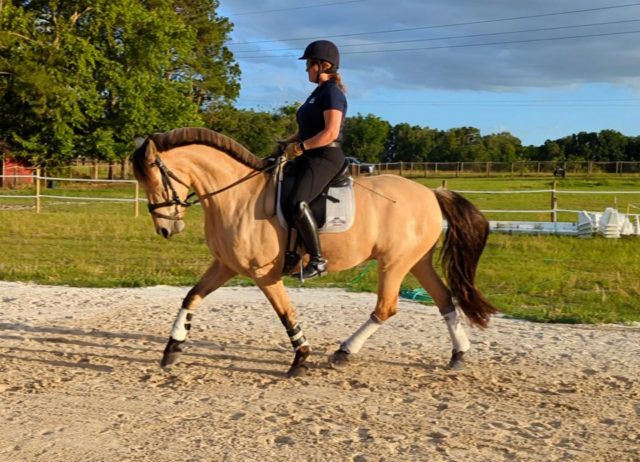
Rarely do I see a rider who consistently uses their leg too far forward. It’s far more common to see it too far back. One very important reason to have the lower leg in the right place is the rider’s balance. And, fortunately, that area is the same area that horses respond to the leg the best! If you look at a picture a rider with an excellent position, you will notice that their head is vertically aligned with their shoulders, their shoulders are aligned with their pelvis, and their pelvis is aligned with their feet. The bottom of the rider’s feet should be parallel to the ground, or have a slightly lower heel positioning. This is how our brain aligns the body to maintain balance, and this is how physics work to keep (or lose) our balance. Once this alignment is lost, we are at the mercy of physics (and the horse’s movement).
So, the rider’s lower leg in its most commonly go-forward-with-the-rider-in-balance placement, should hang down from the knee slightly behind the girth. This assumes that the horse and rider are appropriately sized for each other. This is the moment that you should be thinking, “Wait a second, does the size of the rider on the horse matter partially because of where the lower leg hangs on the horse’s side?” Um. YES. There are many reasons for the horse and rider to be matched by size. One of the reasons is how the rider’s leg hangs on the horse’s side. One of the other really big reasons this is important is that balance thing again — but I digress. Perhaps I will make an article about that some day (Size matters?).
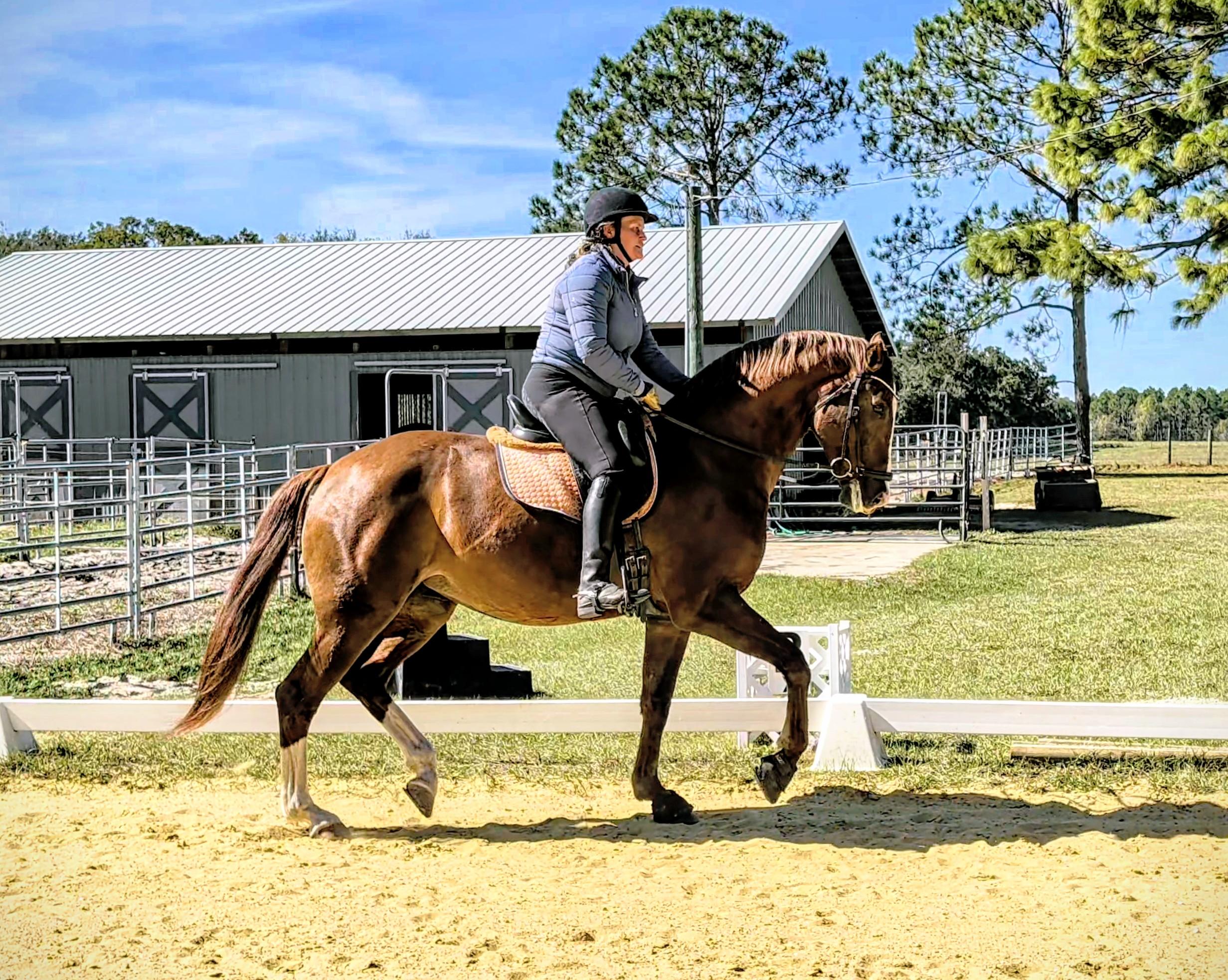
Yes, I am leaning forward in this picture. I am patting Milona for having done something well. Regardless, my body is balanced over my feet and my lower leg is in an effective and balanced position. Photo (c) Morgane Schmidt.
When the rider’s leg is in this area (slightly behind the girth) it reaches the target area that the horse is most likely to respond with a “go forward” response. If the leg is used there to produce a leg yield, most often the horse will respond with moving his whole self sideways away from the leg. To create a good leg yield, your supporting aids (all the other ones I didn’t mention – the other leg, seat, and both hands) need to do the things that direct the horse to leg yield at a specific angle and trajectory. However, that leg position is the position the produces that response. If you put the leg closer to girth (again with the caveat that the other aids are doing supportive things for the leg yield) the rider will effect the horse’s shoulders more.
So, if your horse’s haunches are leading in the leg yield, you can use your leg slightly forward from the standard normal position and put the shoulders in front of the haunches (don’t forget the other aids have to be doing the things that allow this). If your horse’s haunches are trailing, putting the leg slightly further back will help correct this.
I would like to take this moment to remind everyone that when I talk about leg placement and aids, I do NOT mean that you slap the leg on and hold it there until the exercise is over. I mean, in the moment, of those possible alignment issues, you can give AN AID in the position to help correct it. An aid lasts one stride. It can be repeated the next stride, or possibly modified to effect the horse’s body differently, but it does not stay on indefinitely. So, no, you do not just stick your leg in one of these positions and squeeze or kick with all your strength until the end of the exercise. Riding an exercise, any exercise, is done through giving aids in the rhythm of the gait that adjust to what the horse’s response and balance is in the moment. Sorry guy, it’s not “Set it and forget it.”
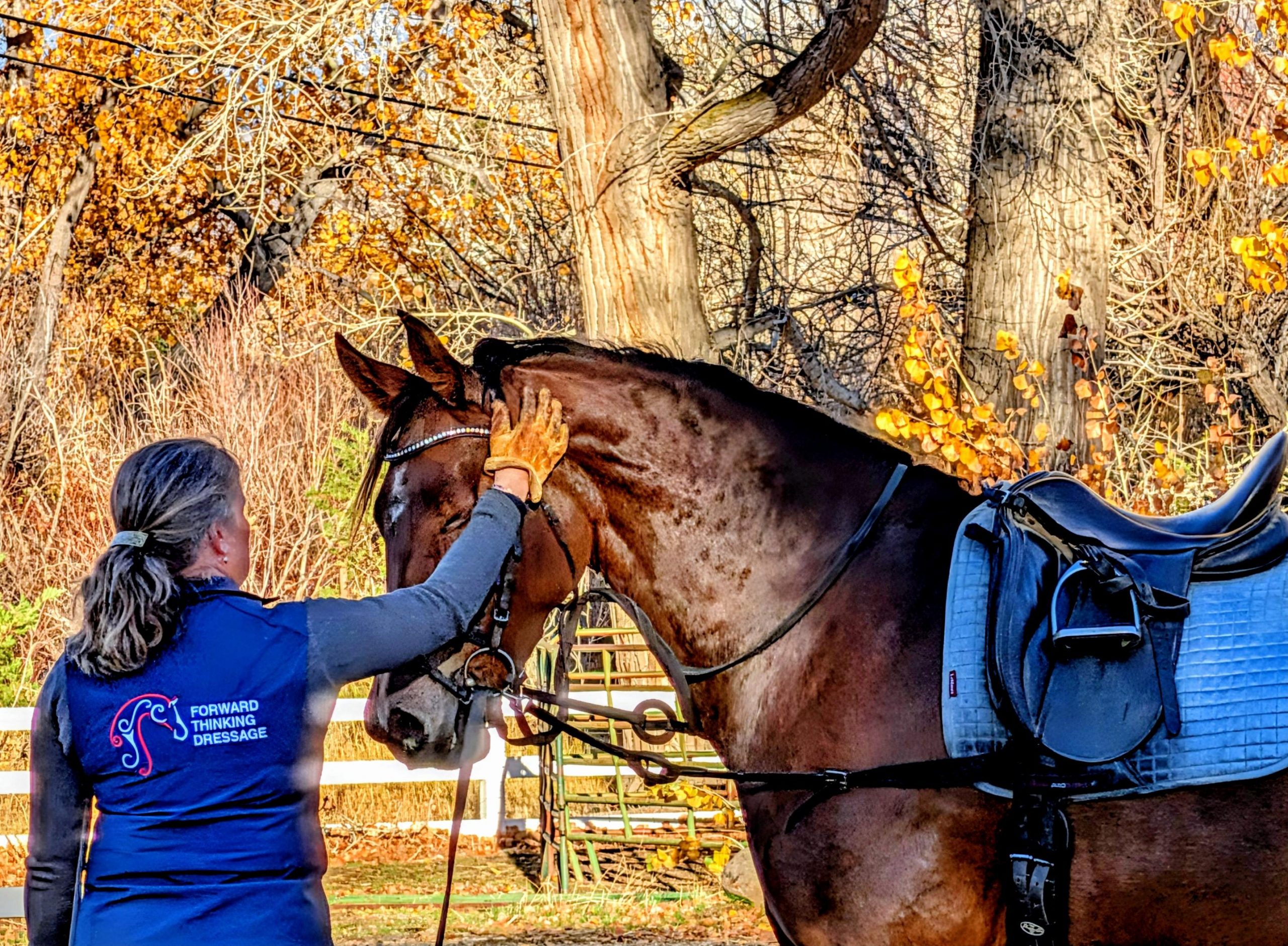
Training is simply repetition of the same expectations over days, weeks, months and years with a systematic approach to introducing new concepts. Photo (c) Morgane Schmidt.
Though I use this example, the intent of this article is not to give a tutorial on how to ride a leg yield. Rather, the intent is to use the leg yield as an example of how the rider’s lower leg placement can have different effects on the horse’s response to the leg. There are many other situations and exercises where the rider would employ similar placements to create similar results in different exercises. Primarily, I would like readers to come away with the understanding that the lower leg of the rider MUST be in the right area for the rider to be balanced on the horse, and for it to have the intended effect of the aid, and that careful placement of the lower leg in specific ways will provide nuance to the horse’s reaction. Because training is simply repetition of the same expectations over time, careful placement and usage of the lower leg over days, weeks, months, and years, will create a better (more on the aids) response from the horse which is the basis of developing self-carriage (which is, of course, ultimately what dressage is all about).
Remember: limited knowledge is limited judgment.

Gwyneth and Flair in competition at Grand Prix. (c) flatlandsfoto.
Gwyneth McPherson has over 35 years experience competing, training, and teaching dressage. She began her education in in the late 1970s, riding in her backyard on an 11 hh pony. Her first instructor introduced her to Lendon Gray (1980 and 1988 Olympian). who mentored Gwyneth for a decade during which she achieved her first National Championship in 1984, and her Team and Individual Young Rider Gold Medals in1987.
In 1990 Gwyneth began training with Carol Lavell (1992 Olympian) who further developed Gwyneth as an FEI rider and competitor. Gwyneth achieved a Team Bronze in 1991 and a Team Silver in 1992 in the North American Young Riders Championships, and trained her stallion G’Dur to do all the Grand Prix movements while riding with Carol.
In 2008, while Head Trainer at Pineland Farms, Gwyneth began training with Michael Poulin (Olympian 1992). Michael was trained by Franz Rochowansky (Chief Rider for the Spanish Riding School 1937-1955). Michael has shared much of Rochowansky’s knowledge and wisdom with Gwyneth, completing her education as a Grand Prix rider, trainer, and competitor.
Gwyneth’s teaching and training business, Forward Thinking Dressage,is based in Williston, FL. In addition to teaching riders and training, Gwyneth also loves sharing her knowledge of the sport and art of dressage as well as discussing relevant topics pertaining to the training itself and the current competitive landscape.

