



Barn Fire Safety: What Every Horse Owner Needs to Know This Winter
Prevention is key, but have a plan. Because barn fires are devastating and they happen fast.
Key insights courtesy of Dr. Kyle Jonson of Texas A&M University School of Veterinary Medicine and Biomedical Sciences
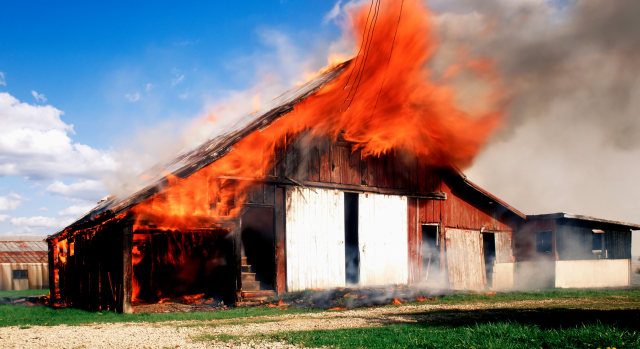
When winter rolls in, we all start migrating into the barn like horses to a feed bucket. Heat lamps, closed doors, extension cords, hay stacked everywhere… it’s cozy until it isn’t. Barn fires are fast, devastating, and often preventable — and protecting our horses means getting ahead of the danger before the first cold snap hits.Embed from Getty Images
Horse Nation rounded up the must-knows from Dr. Kyle Johnson, clinical assistant professor at the Texas A&M College of Veterinary Medicine and Biomedical Sciences, to help you fire-proof your barn and prep a solid emergency plan.
Why Barn Fires Happen (And Why They’re So Dangerous)
Barns are basically giant tinderboxes full of hay, shavings, dust, and wood — and according to Texas A&M:
Over 80% of barn fires start because of electrical issues or human error.
Common culprits:
- Cigarettes tossed where they shouldn’t be
- Space heaters too close to hay
- Hot equipment left on combustible surfaces
- Lightning strikes are another major cause — especially in rural, open areas.
And because barns are often far from town, emergency response can be delayed, meaning prevention becomes critical.
Fire Prevention 101: What Every Barn Needs
To cut down on ignition sources and fire fuel, Dr. Johnson recommends:
🚭 No smoking in or near the barn (ever).
🔌 Check all electrical wiring regularly and fix issues fast.
⚡ Don’t overload outlets or run a spaghetti mess of extension cords.
🔧 Avoid welding or torch-cutting in or near the barn.
🟫 Store hay, straw, diesel, and gasoline separately — not piled together.
🧹 Remove cobwebs and dust often (they catch fire fast).
🌩️ Install a professional lightning protection system to divert strikes safely.
Important note: regular smoke detectors don’t work well in barns due to dust and humidity. Instead, use:
- Carbon monoxide detectors
- Commercial fire-detection systems tied to a security company or local fire department
These can drastically improve response time.
If a Fire Starts: Seconds Matter
Barn fires move fast. How fast?
- Hay and shavings can hit 300°F in under five minutes.
Once flames take hold, your priority is getting out and getting your animals out — safely.
Dr. Johnson stresses:
- Call 911 immediately.
- Do NOT go back inside — smoke and toxic fumes can kill before the flames reach you.
- Heat and structural damage make barn collapse likely.
Always have fully charged ABC fire extinguishers mounted at every barn entrance — and make sure everyone knows how to use them.
Evacuating Horses: Your Step-By-Step Plan
When the clock is ticking, you need a plan you’ve practiced — not one you’re making up on the fly. Dr. Johnson recommends:
- Keep a halter and lead rope at every stall (not buried under blankets, not “somewhere in the tack room”).
- Stay calm and lead horses quickly away from smoke and flames.
- Move them to a pre-selected paddock or pasture far from the fire zone.
- Hose them off thoroughly to remove embers and soot.
Why hose them?
- Soot contains toxins harmful to humans and horses.
- Embers can stay hot and reignite bedding or hair.
Once evacuated, every animal should be checked by a veterinarian, even if they look fine. Smoke inhalation injuries can take 12–24 hours to appear and can be life-threatening.
Write the Plan. Practice the Plan. Post the Plan.
A barn fire plan isn’t something you store digitally in the “I think I saved that somewhere” folder.
Dr. Johnson’s advice:
- Write it down.
- Go over it with everyone — boarders, barn help, family, kids, the neighbor who feeds when you’re away.
- Practice it just like a fire drill.
In an emergency, adrenaline takes over — and training saves lives.
A barn fire is every horse owner’s nightmare — but preparation can mean the difference between tragedy and everyone walking out safe. With smart prevention, a clear plan, and the guidance shared by Texas A&M University, your barn can stay warm this winter without becoming a fire hazard.
Stay safe, Horse Nation. Your horses (and your peace of mind) will thank you.
About Texas A&M University
Established in 1876 as the state’s first public university, Texas A&M University is one of the largest universities in the nation yet remains grounded in its military roots and Aggie Core Values of Excellence, Integrity, Leadership, Loyalty, Respect and Selfless Service. As a research powerhouse and a land-, sea- and space-grant institution, Texas A&M seeks to solve the issues facing Texas, the nation and the world. Named by Fast Company Magazine as one of the world’s Most Innovative Companies in 2025, Texas A&M counts seven Fortune 500 CEOs as former students and was named by The Wall Street Journal as the best in Texas and No. 11 public institution in the U.S. for 2025. Texas A&M was named the most recognized university in the state of Texas and No. 2 among all U.S. public universities in the latest Global University Visibility (GUV) rankings compiled by higher education research and consulting firm American Caldwell.
