



Training in the Right Way: Let’s Discuss Self-Carriage
Or, why it isn’t always “bad” that your horse anticipates.
Dressage training is supposed to be the process of training ANY horse to be a better riding horse. The more the horse learns, in theory, the easier it is to communicate with and therefore complete more complex tasks with. Although competition dressage training often is more focused on training for the dressage test, that is not what the original intention (and original judging requirements) were for competitive dressage. Initially, it was designed to give riders and trainers a way to determine how their training measured up to the theoretical ideal of the training process. That said, it is critically important to understand the meanings and reasons for some of the terms we use to describe dressage training and what to look for when observing training and competition (and videos and photos), regardless of whether you intend to compete or just train your horse to be a better whatever you do with him. That, ultimately, is the main purpose of my articles. To provide education and knowledge for riders to understand and improve their eye and understanding of what dressage training is supposed to be. While there will always be some differences in practice and theory, good horse training is always recognizable to the educated eye. That said, it absolutely is necessary that we remember and understand that limited knowledge is limited judgment.
* * *
How many times have you been told that you shouldn’t practice your dressage test because your horse will learn the test and anticipate the movements? Similarly, you have probably been taught to correct a horse that anticipates an exercise that you did not ask for. Both of these are real training challenges and must be addressed to have success both in training and in the competition arena. That said, having your horse anticipate a movement is not always bad.
Without question, we do not want a horse to perform an exercise that we did not ask for, or that we are trying to prevent as the horse is blowing through our aids. But we DO want a horse to know his job (be trained) well-enough that he can anticipate what is expected of him and be ready to perform the movement that he knows is coming next. There is a very important distinction between the two types of anticipation that makes one acceptable, and the other undesirable.
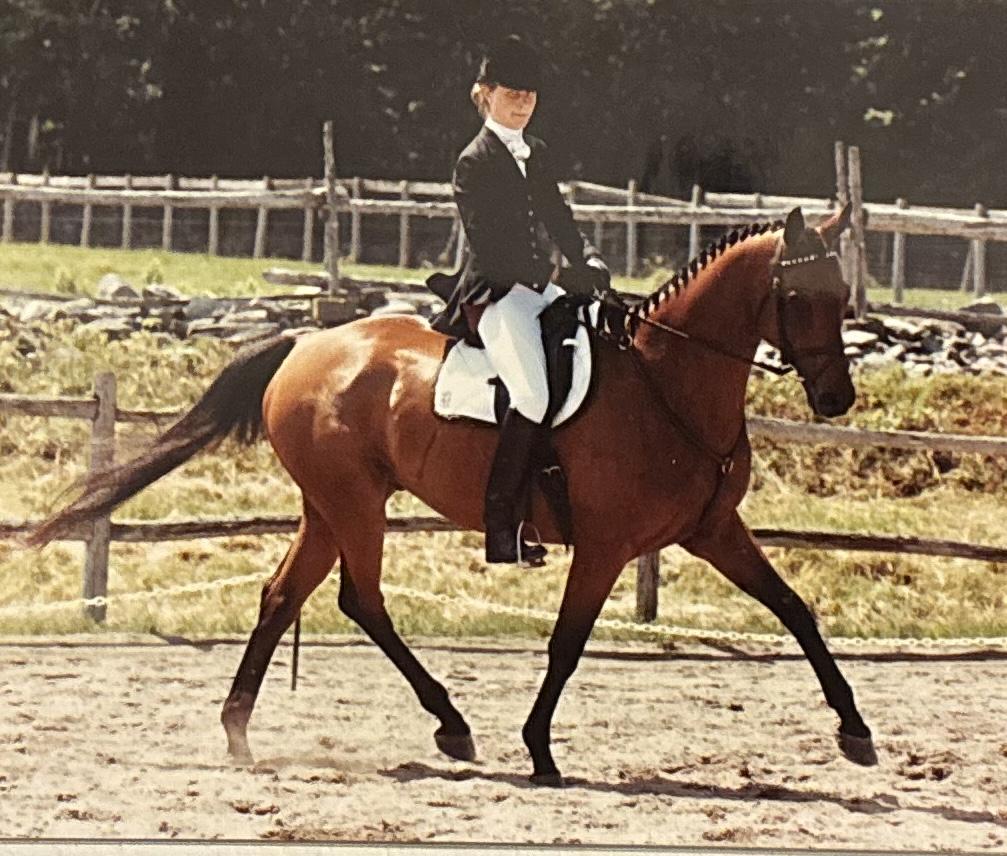
Shades of self-carriage can be seen at lower levels in horses that have achieved proficiency at that level. But true self-carriage is only seen in the fully trained upper level horse. Photo (c) Gwyneth McPherson
When the horse anticipates an exercise and ignores the aids we are giving to prevent it, we say that “the horse is not on the aids,” and in dressage training (all training, really) we do not like our horses to be “not on the aids” because it means we are no longer in control of the exercise (or the animal, or maybe our immediate life-expectancy). But, when the horse is “on the aids” and is anticipating a movement but is waiting for the rider to cue the start of the movement, we call that “self-carriage.”
The term self-carriage covers a lot of territory and cannot simply be defined as the horse anticipating an exercise but waiting for the aids to be given for it. However, that is the part of self-carriage that we are going to focus on in this article. Briefly, for the sake of understanding, self-carriage (of any kind) does not occur with a horse that is:
- Not educated (has not been taught the exercises he is being asked to perform)
- Not on the aids/on the bit
- Not balanced (on the forehand)
- Not supple
- In the wrong contact
Self-carriage is not fully developed until the horse is capable (has been trained to do) all of the Grand Prix movements proficiently, with confidence, in appropriate collection and in the right contact. Some would argue that even that does not fulfill the requirements of self-carriage, but we can’t get into that right now. But with it in mind, it’s key to note that horses can learn a degree of self-carriage that is appropriate to their level of training. This is what we look for to gauge whether a horse has achieved proficiency in an exercise or a level of training.
Practicing the dressage test at home helps both the horse and rider be better prepared for the competition arena IF the horse is on the aids. Photo (c) Gwyneth McPherson
Another way to say that is that the aids for an exercise or exercises (and suppleness, balance and contact) are so familiar that the horse is confident in what they are preparing him to do, so that he anticipates what is coming next but (through consistent, disciplined repetition) knows to wait for the aids to tell him when to start it. This is literally why we do dressage training. To make educated horses that recognize that specific aids mean to do specific things and therefore do not require strength aids to “make” them do the things.
If you have been following along with some of the previous articles, you will recall that suppleness is crucial to putting a horse on the aids and that training is the careful application of the same aids meaning the same things, over time (days, weeks, months, years-not for just 30-60 minutes). This is the process of developing the good kind of anticipation. This process teaches the horse to look to the rider for guidance when he is uncertain and develops the horse’s confidence in what your aids mean (what his response is supposed to be) and confidence in what he is supposed to produce every day. This process of putting the horse on the aids, when done correctly, creates the balance (collection) suppleness, contact and confidence to create self-carriage.
So. Is it okay to practice your dressage test? YES — if your horse is on the aids and waits for you to tell him when to start the movements. This actually improves your test riding because your horse is actively participating in getting ready for the next movement because it is familiar and he can anticipate what is coming next.
If, however, he takes over and anticipates in a not-so-desirable way (does the exercise without your aid, or against the aids that are specifically telling him not to do it), you know that he is (at least for that movement) not on the aids and not supple enough. This gives you a direction of what needs to be done to make his understanding better rather than just trying to correct or punish him out of doing the exercise before you gives the aids for it. Think about it — do you want him to NEVER do the exercise/always avoid or be afraid of it? Or do you want him to wait for you tell him when to start it? And, yes, this is a place where having a very well-trained teacher help you train the self-carriage into the movement is not just helpful, but necessary.
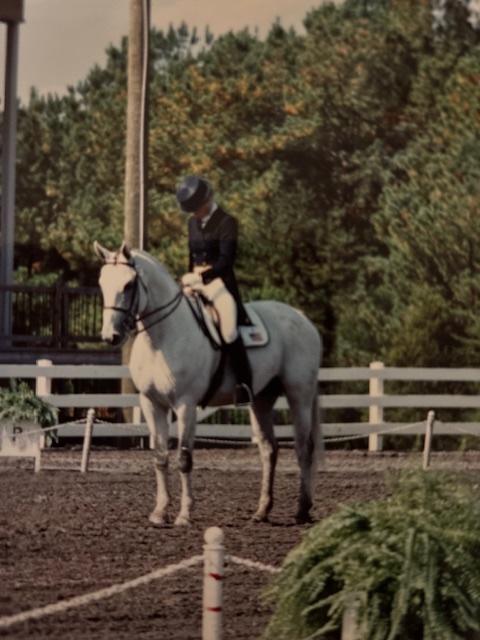
The trained dressage horse has confidence in what is expected of him and looks to his rider for guidance when he is unsure. Photo (c) Gwyneth McPherson
The term self-carriage describes a complex intertwining of characteristics that effect the communication of the horse and rider, and it is the pinnacle of top quality training. One important piece of it is the development of the horse’s confidence in the rider’s aids and what is expected of him when he feels those aids. This form of anticipation must be developed and nurtured in the education of any horse, but specifically in a competitive Grand Prix dressage horse. Knowing that anticipation is not always undesirable helps the rider teach the horse to have confidence in his job and become a partner in the training and competition process.
Remember: limited knowledge is limited judgment.

Gwyneth and Flair in competition at Grand Prix. (c) flatlandsfoto.
Gwyneth McPherson has over 35 years experience competing, training, and teaching dressage. She began her education in in the late 1970s, riding in her backyard on an 11 hh pony. Her first instructor introduced her to Lendon Gray (1980 and 1988 Olympian). who mentored Gwyneth for a decade during which she achieved her first National Championship in 1984, and her Team and Individual Young Rider Gold Medals in1987.
In 1990 Gwyneth began training with Carol Lavell (1992 Olympian) who further developed Gwyneth as an FEI rider and competitor. Gwyneth achieved a Team Bronze in 1991 and a Team Silver in 1992 in the North American Young Riders Championships, and trained her stallion G’Dur to do all the Grand Prix movements while riding with Carol.
In 2008, while Head Trainer at Pineland Farms, Gwyneth began training with Michael Poulin (Olympian 1992). Michael was trained by Franz Rochowansky (Chief Rider for the Spanish Riding School 1937-1955). Michael has shared much of Rochowansky’s knowledge and wisdom with Gwyneth, completing her education as a Grand Prix rider, trainer, and competitor.
Gwyneth’s teaching and training business, Forward Thinking Dressage,is based in Williston, FL. In addition to teaching riders and training, Gwyneth also loves sharing her knowledge of the sport and art of dressage as well as discussing relevant topics pertaining to the training itself and the current competitive landscape.

