



That Horse is a Work of Art
Whenever I travel I fill my camera roll with photos of horses. These are in the Museum of Fine Arts in Boston.
I like to call this first one, “Someone left the gate open and I was in the shower.” But actually it’s Automedon with the Horses of Achilles by Henri Renault (1868).

Photo by Sydney Uechi Ronan
One of my favorites in the museum, Dama a caballo, is a 1785 painting by Puerto Rican artist Jose Campeche y Jordan.
One, it’s just objectively beautiful. Two, I love a horse girl that matches her own hair bow to her horse’s hair bows. Three, I’m pretty sure this qualifies as a grulla, which is rare in real life and really rare in art. Four, the absolute mare glare coming from the rider and the horse (I know, it’s clearly a stallion, I don’t care) is magnificent.

The next one is the 1806 portrait George Washington at Dorchester Heights painted by Gilbert Stuart, but it should be called “Baby Got Back.” Also, why is GW so serene while his ride is clearly flabbergasted?

The Triumph of the Winter Queen: Allegory of the Just, is a truly massive piece of revenge art.
The “queen” depicted was real life Elizabeth Stuart, daughter of King James I of England. Her husband died. Her son died. Her and her family were stripped of their royal titles and exiled to the Netherlands. She commissioned the painting to depict her whole family, including the deceased, in radiant light, while the family’s enemies (namely Death, Envy, and the god Neptune… because the son died at sea) are being crushed under them.
This painting walked so Mean Girl style burn books could run.

I’ll be honest, I have no information about the next few pieces of art. I completely forgot to take notes and I refuse to use AI.
This first one was on a folding screen, it was huge, and it was red. I’m referring to it as “Mares Conspire.”

This one, another lacquered folding screen, was covered in horse escapades. This corner broke my brain, because for way too long I thought they were hunting crabs… on horses… in the mountains.

One of my favorite parts of touring the MFA was exploring the equestrian art from parts of the world not usually displayed in museums. Like the 1990 painting Retour des Esprits Guinen Apres La Guerre d’Independance d’Haiti by Haitian painter Andre Pierre.

Or these Indian miniatures. Many of the paintings from India depicted blue roans, which fascinated me.


Although we can’t ignore the classic race day paintings by Degas, because they’re by Degas, or Grand Prix Day (1887) by American Impressionist artist Childe Hassam.


The Boston MFA doesn’t have anywhere near the equestrian artifact collection compared to The Met in New York, but it did provide a few really unique examples. My favorite were these elaborately decorated bits from Iran dated to the 10th-9th century BCE.

As well as these 10th-9th century BCE harness adornments including a roundel, a collar, and blinkers belonging to the extinct Iron Age Kingdom of Urartu.

Last but not least, because they don’t get near enough recognition in art, the noble mule.
First up is this Greek fragment dated to around 480 BCE.

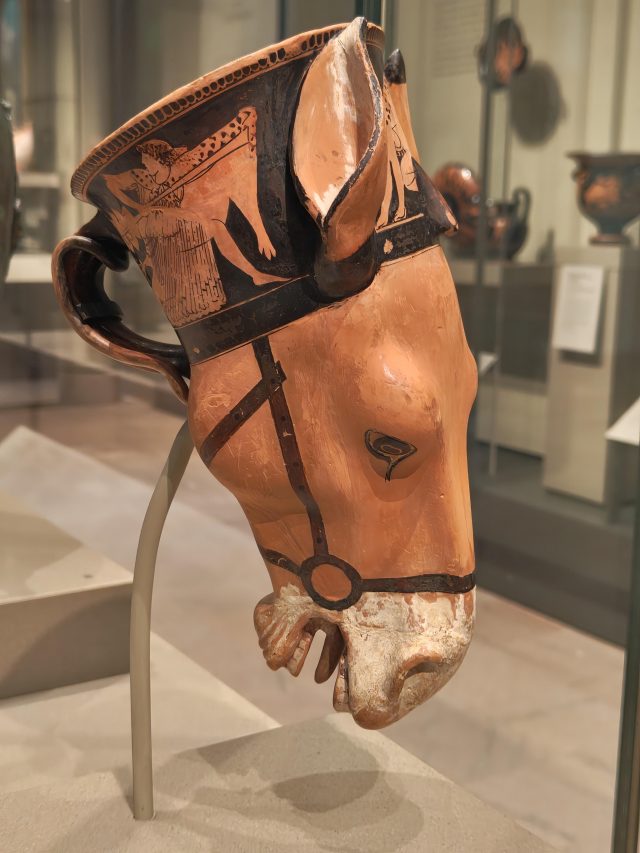
But my absolute favorite find on this trip was this terracotta drinking vessel also dated to around 480 BCE. I genuinely love this piece. Honestly, it’s completely absurd. It can’t even be set down. But I love it. I would buy a replica immediately. Take my money.

Go riding.
Amanda Uechi Ronan is an equestrian, an author, and a wannabe race car driver. Follow her @au_ronan.
