



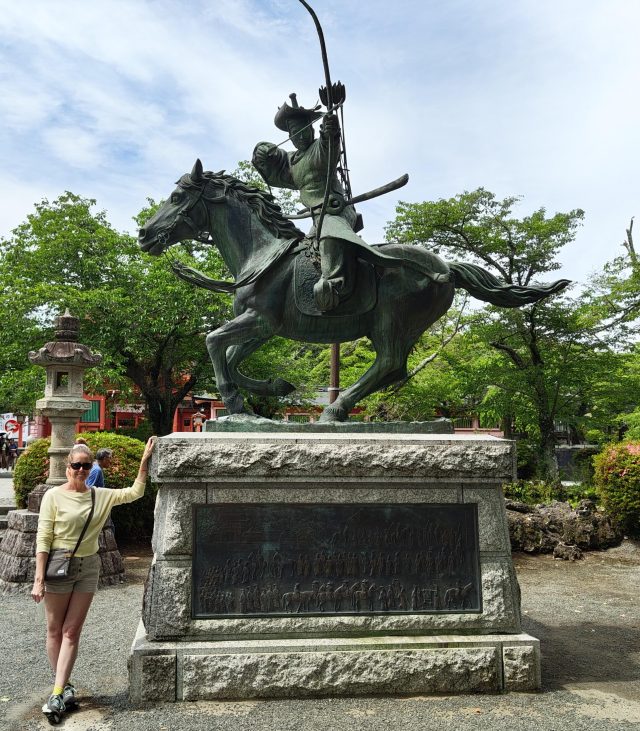
Horses of Japan: Samurai Warriors
From religion to a thriving modern equestrian industry, the horse has profoundly influenced the traditions, beliefs and everyday life of Japan. Here’s what I learned on my recent trip to Fujinomiya.

Tsukioka Yoshitoshi. Public Domain.
Samurai trace their origins to around 1192, when wealthy landowners — the most notable being the Minamoto and Taira clans — began hiring warriors to fight the central government for control of the country. Minamoto won, ushering in a 700-year age of the samurai, and the country settled into a rigid social caste with samurai sitting at the top, just below their wealthy patrons.
The town of Fujinomiya served as a strategic samurai hub for Shogun Minamoto no Yoritomo and staging ground for Fuji no Makigari — a massive 1193 military training hunt — at the base of Mount Fuji.

Fuji tax. Photo by Josh Ronan
Minamoto no Yoritomo ruled from 1192 until 1199 as the first shogun in the history of Japan. The hunting extravaganza, Fuji no Makigari, happened from June to July 1193 with an estimated 700,000 attendees. There are many theories about why Minamoto held such a large event ranging from “just being a show off” to “subtly taking over a trade route without anyone noticing.”
Either way, the event made a lasting impression on the area and on samurai in general. At the event, or at least around the same general time, Minamoto no Yoritomo established the practice of yabusame, a rigorous form of horseback archery.
“Before the sword became the primary symbol of the samurai, the warrior’s profession was known as the “Way of the Horse and Bow.” While rudimentary mounted archery existed in Japan as early as the 6th century, it was Yoritomo who formally codified the rules and etiquette under the guidance of expert practitioners to ensure his warriors stayed battle-ready.” – Two Second Street
Because of the smaller size of their mounts, samurai primarily relied on speed, maneuverability, and archery rather than the brute force charge typically associated with European cavalry.
The most famous samurai mount was the ancient Kiso horse, a rugged breed native to Japan that was previously used for agricultural purposes. Averaging 13 hands high with thick hooves, the Kiso was known for endurance and was well-adapted to Japan’s mountainous terrain.
Two of Minamoto no Yoritomo’s most famous horses were Ikezuki “Moon Biter,” an infamously wild-tempered horse given to the warrior Sasaki Takatsuna by Minamoto no Yoritomo that was said to be so aggressive it would bite even the moon’s reflection in a bucket of water and Surusumi “Ground Ink,” a solid black horse given to the warrior Kajiwara Kagesue.
Legend says during the 1184 Battle of the Uji River, the allied Minamoto forces needed to cross a flooded, fast-flowing river to attack the rival stronghold on the opposite bank. The planks of the Uji Bridge had been removed, forcing the warriors to swim their horses across. Sasaki Takatsuna and Kajiwara Kagesue, mounted on Ikezuki and Surusumi, raced to see who could cross the river and reach the enemy lines first.

By Utagawa Kuniyoshi – Ukiyo-e.org [1] (Museum of Fine Arts Boston), Public Domain, https://commons.wikimedia.org/w/index.php?curid=316655
So probably he was just leaning into the lore that gods ride paints for his portraits.
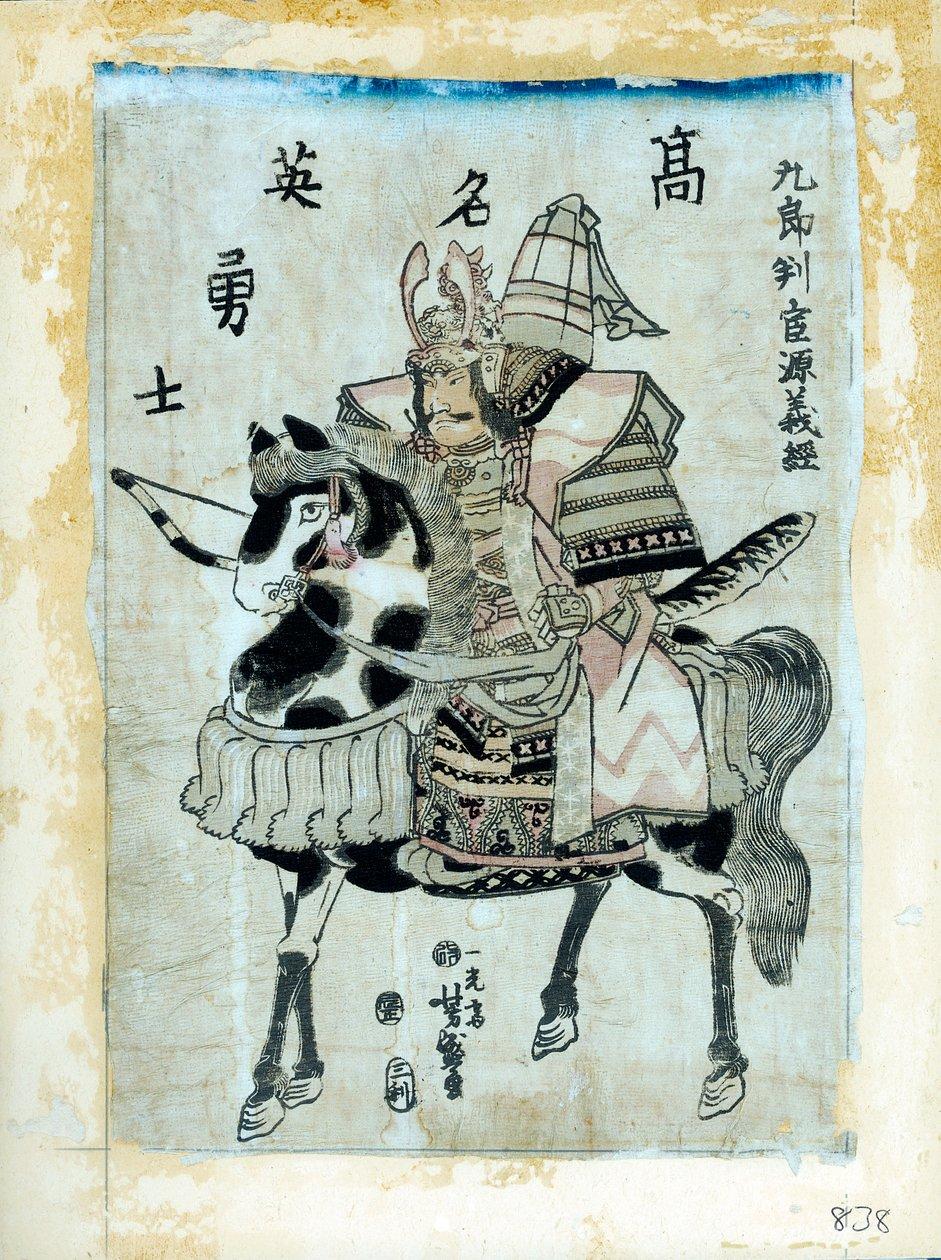
Japan’s feudal era did eventually come to an end in 1868, and the samurai class was abolished a few years afterwards. But yabusame remains one of Minamoto no Yoritomo’s most enduring legacies. It is celebrated at festivals throughout Japan and the subject of countless works of art.

Photo by Josh Ronan
Go riding.
Amanda Uechi Ronan is an equestrian, author, and wannabe race car driver. Follow her on Instagram @au_ronan.
