



Horses of Japan: Horse Girls and Shrines
From religion to a thriving modern equestrian industry, the horse has profoundly influenced the traditions, beliefs and everyday life of Japan. Here’s what I saw on my recent trip to Kyoto.

Kubo Shunman, Japanese, 1813. Public Domain.
Fujinomori Shrine is an ancient place of worship founded 1,800 years ago by Empress Jingu, a legendary Japanese empress that ruled following her husband’s death in 200 CE.
-
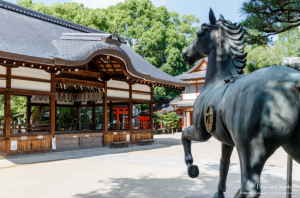
- Sacred Horse at Fujinomori Shrine.

-
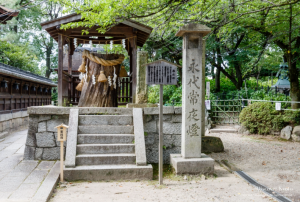
- A sacred tree where Empress Jingu consecrated items from her military campaigns.

Without getting too bogged down in the details, Empress Jingu is a controversial figure. Legend says she led armies, avenged her husband’s death, conquered lands, survived a ship wreck, and had a brief love affair with the god Azumi-no-isora, all before finally giving birth to an heir… three years after his father died.
These stories originated in the Kiki (記紀) or Japanese Chronicles, which include myths as well as potential historical facts.
But her legitimacy — and outright existence — began to be questioned during the 14th century when she was officially removed from the imperial lineage during the reign of Emperor Meiji.
Still, she remained so popular despite this historical exile that she became the first woman featured on a Japanese bank note in 1881 and first woman featured on a Japanese postage stamp in 1908. Also, the festival at her shrine remains one of the most popular in the country. Take from that what you will.
As a woman living in the year 2026, I am inclined to believe that Empress Jingu was an absolute powerhouse horse girl that was dragged through the muck because she did not fit a strict andocentric view of the past.
Although giving birth to an heir three years after the baby daddy died… is a bit sus.

By Utagawa Kuniyoshi – Waseda University Theatre Museum, Ukiyo-e.org A. [1] B. [2] C. [3], Public Domain, https://commons.wikimedia.org/w/index.php?curid=425117
“On May 5th each year Fujinomori Shrine holds the Kakeuma Shinji, a ritual in which men called noriko riders gallop horses full tilt down the shrine’s entrance path while performing tricks such as hanging off the saddle by a single foot or performing shoulder stands, all of which were said to have been practiced by samurai in the past. Though several shrines once performed this sort of festival, only Fujinomori Shrine continues to do so to this day.” – Discover Kyoto
Just down the street, sits the Fushimi Inari Taisha Shrine.
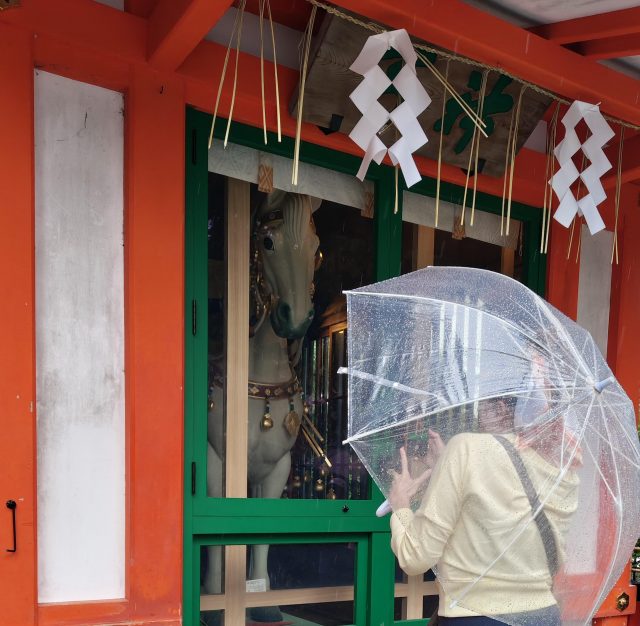
Just inside the gates is the White Horse and her foal.

Photo by Josh Ronan
In the Shinto religion, horses were considered intermediaries between the human world and the realm of the kami. The darker side of this is that, unfortunately, horses used to be ritualistically sacrificed. In modern times, wooden amulets and statues take the place of real horses, but many shrines still “stable” replica stand-ins.
At Fushimi Inari Taisha, people leave business cards with White Horse, praying for good fortune. The horse statues are removed from their stables and decorated during festivals with the most famous festival held at Fushimi Inari Taisha being the “First Day of the Horse.” Held in February, it marks the legendary descent of the Inari deity to Mount Inari in February 711 CE.
Along with foxes, the horse theme continues throughout the grounds. My favorite were these two flanking a smaller shrine about halfway up the mountain. Other visitors left carrots, but I opted to leave a special message to my horse, Aggie, who passed away in 2024.


Go riding.
Amanda Uechi Ronan is an equestrian, author, and wanna be race car driver. Follow her on Instagram @au_ronan.
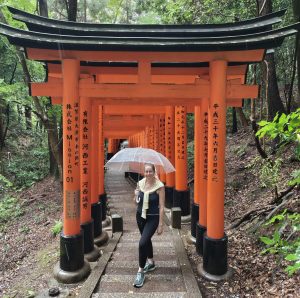
Photo by Josh Ronan
