



Horses of Japan: Archaeology, Racing, and Trading Cards
From religion to a thriving modern equestrian industry, the horse has profoundly influenced the traditions, beliefs and everyday life of Japan. Here’s what I saw on my recent trip to Tokyo.

Japan late 17th–early 18th century. Public Domain.
The first horses in Japan were 4th century imports, possibly brought in by invaders from northern Asia. This ‘horse-rider theory’ was first proposed by the historian Egami Namio in 1948 to explain the cultural and political development of what would become known as the Yamato state. It’s worth noting that this theory is controversial. What we definitely know to be true, though, is that a lot of horse tack and horse related art shows up in the archeological record around that time.
One of the most famous is the Haniwa Horse, currently housed in the Tokyo National Museum.

Photo by Amanda Uechi Ronan
Dated to the first half of the sixth century, the Haniwa Horse is made from clay and stands just over 34 inches tall. The artifact is particularly important because of it’s detailed depiction of the era’s horse tack.
“The haniwa’s tack, from nose to tail, comprise the headgear, in the form of a bridle with decorative metal fittings where the straps cross—incorporating the headpiece or bit. In this case, the bit is part of a cheekpiece that contains six small bells of the type known as rei (鈴), and reins. It has a set of four horse bells, slung from the breast-strap. The saddle tree or kurabone (鞍橋) and saddle flaps or aori (障泥) cover and protect the horse’s flanks. The flanks are surmounted by ring stirrups or wa-abumi (輪鐙). To the rear, the crupper or shirigai (尻繫) has pendant plum leaf-shaped decorations with triple bells attached in three directions.” – Wikipedia

Photo by Amanda Uechi Ronan
Several examples of tack were exhibited next to the Haniwa Horse. A few of the more striking were a saddle from the 6th-7th century, a flagpole holder from the 6th century, and horse armor from 5th-6th century.


They also had several examples of bits and stirrups. One thing I noticed were the extremely long cheek pieces.
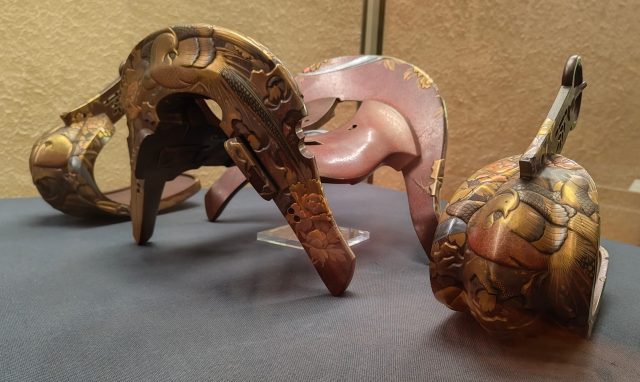
There was also a beautiful 19th century saddle from the Edo period. The intricate pattern of peonies and pheasants were first carved and then embellished with metallic powders and multiple coats of lacquer. The saddle was most likely owned by an elite samurai and used for ceremonial processions.


Speaking of the Edo period, just around the time it was ending and the Meiji restoration was underway (around 1860) the first western-style horseracing began in the newly named city of Tokyo. Though evidence of horse racing can be traced as early as 8th century, this was the first time it was being done on such a massive scale and viewable by the general population. Early events pit famous samurai against each other and attracted countless fans.

Courtesy of japanracing.jp
The Japan Racing Association was established in 1954, propelling Japanese race horses onto the international stage. The Japan Cup, which began in 1981, is now one of the most prestigious races in the world. The race horse fever continues today, revealing itself at book stores throughout the country, in the form of “Pokemon” style collectible cards, and stuffies… everywhere there are stuffies of famous horses.


Go riding.
Amanda Uechi Ronan is an equestrian, author, and wannabe race car driver. Follow her on Instagram @au_ronan.

Photo by Josh Ronan
